
After Reading This Article You Can Solve This UPSC Mains Model Question:
Trace the evolution of the Indian national flag and examine its role as a symbol of unity during the freedom struggle. 250 Word (GS-1, Culture)
Recent Context
Recent allegations against Hardik Pandya for alleged disrespect to the national flag have renewed focus on the Flag Code of India, 2002 and the Prevention of Insults to National Honour Act, 1971.
Legal Framework on National Symbols
1. Prevention of Insults to National Honour Act, 1971
- Scope: Prohibits desecration of or insult to the country’s national symbols, including the National Flag, the Constitution, and the National Anthem.
- Key Offenses: Burning, defacing, trampling, or showing disrespect to the flag in public or within public view.
- Punishment: Imprisonment for up to 3 years, or a fine, or both.
2. Flag Code of India, 2002
- Key Provisions:
- Universal Rights: Since 2002, private citizens, educational institutions, and organizations can hoist the flag on all days (with dignity).
- Material: Allows hand-spun, hand-woven, or machine-made flags (Cotton, Polyester, Wool, Silk, Khadi).
- Display Rules: The flag must occupy the position of honor and be distinctly placed. It should never be dipped in salute to any person or thing.
- 2022 Amendment: Changed to allow the flag to be flown day and night if displayed in the open or on a house (previously only sunrise to sunset).
3. Constitutional Provisions
- Article 51A(a): It is a Fundamental Duty of every citizen to abide by the Constitution and respect its ideals and institutions, the National Flag, and the National Anthem.
- Article 19(1)(a): The Supreme Court (Union of India v. Naveen Jindal, 2004) ruled that flying the National Flag is a Fundamental Right as an expression of one’s allegiance and pride.
4. Emblems and Names (Prevention of Improper Use) Act, 1950
- Scope: Restricts the use of the national flag, coat-of-arms used by a government department, the official seal of the President or Governor, etc., for commercial or professional purposes without prior permission.
Judicial Interpretations:
- Union of India v. Naveen Jindal (2004): The Supreme Court declared that flying the National Flag with respect and dignity is a Fundamental Right under Article 19(1)(a).
Evolution of the Indian National Flag
- 1906/1907 (Calcutta Flag): Early tricolour (green, yellow, red) designed by Sachindra Prasad Bose and Sukumar Mitra.
- 1907 (Bhikaji Cama): Madame Cama became the first to hoist the Indian flag on foreign soil (Stuttgart, Germany).
- 1917 (Home Rule): Annie Besant and Tilak used a flag with five red and four green horizontal stripes.
- 1921 (Pingali Venkayya): Proposed a design with a charkha (spinning wheel), endorsed by Mahatma Gandhi.
- 1947 (Final Adoption): The Constituent Assembly adopted the Saffron, White, and Green tricolour with the Ashoka Chakra (24 spokes) replacing the charkha.
Symbolism & National Identity
1. The Tricolour (Tiranga) – Core Symbolism
- Saffron (Kesari): Represents strength and courage of the country.
- White: Represents peace and truth with the Dharma Chakra.
- Green: Represents fertility, growth, and auspiciousness of the land.
- Ashoka Chakra: The “Wheel of the Law of Dharma.”
- 24 Spokes: Symbolize 24 hours of the day, representing dynamism and progress (“Movement is life, stagnation is death”).
- Historical Link: Derived from the Sarnath Lion Capital of Maurya Emperor Ashoka.
2. Emotional & Psychological Connect
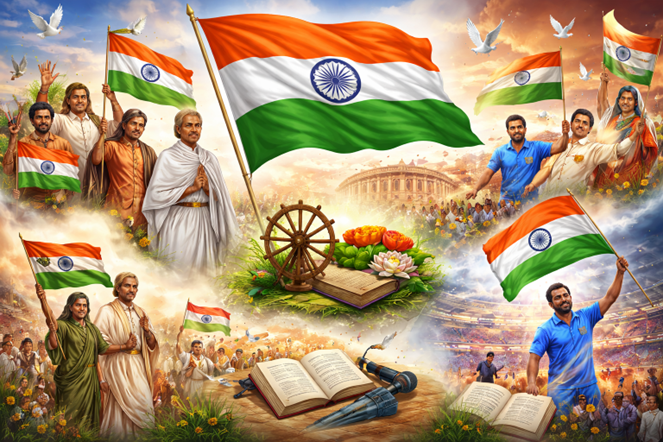
- Unifying Force: During the Freedom Struggle, the flag acted as a common identity transcending caste, religion, and linguistic barriers.
- National Pride: It represents the sovereignty of the nation. In Union of India v. Naveen Jindal (2004), the SC noted that flying the flag is an expression of “allegiance and pride.”
- Sacrifice: The flag is a silent reminder of the martyrs who fought for independence.
3. National Identity & Secularism
- Inclusive Design: While early versions had religious connotations (red for Hindus, green for Muslims), the final 1947 design moved toward secular values (courage, peace, and growth).
- National Anthem vs. National Song:Jana Gana Mana: Chosen as the Anthem because its lyrics reflect the geographical and cultural diversity of India, reinforcing a secular national identity.
- Vande Mataram: Remains a “National Song” with equal status, symbolizing the revolutionary spirit and personification of India as a Motherland.
4. Constitutional Patriotism
- Beyond Symbols: Identity is not just about the flag but about the values it represents: Justice, Liberty, Equality, and Fraternity.
- Duty-Bound: Respecting these symbols is a Fundamental Duty (Art 51A), linking individual identity with the collective national conscience.
National Anthem vs. National Song
| Feature | National Anthem (Jana Gana Mana) | National Song (Vande Mataram) |
| Author | Rabindranath Tagore (1911) | Bankim Chandra Chattopadhyay (1870s) |
| Source | Originally a Brahmo hymn in Bengali. | From the novel Anandamath (1882). |
| Adoption | Adopted by Constituent Assembly on Jan 24, 1950. | Adopted on Jan 24, 1950 (Equal Status). |
| Symbolism | Represents Secularism & Diversity (Geographic/Cultural). | Symbol of Anti-Colonial Resistance & Revolutionary Zeal. |
| Language | Highly Sanskritised Bengali (Tatsama). | Mixture of Sanskrit and Bengali. |
| First Sung | 1911 Calcutta Session of INC. | 1896 Calcutta Session of INC (by Tagore). |
| Legal Status | Protected under the Prevention of Insults to National Honour Act, 1971. | Held to have “Equal Status” but no specific penal law for not singing. |
Jana Gana Mana was chosen as the Anthem specifically because its lyrics are considered more inclusive and secular, reflecting the vast geography and various communities of India.
Key Challenges: National Symbols & Identity
- Compulsory vs. Voluntary Patriotism: The debate over whether patriotism should be a spontaneous emotion or a state-mandated duty, highlighted by the Bijoe Emmanuel (1986) case which allows for silent respect over forced singing.
- Misuse & Commercialization: Preventing the desecration of symbols through improper disposal (especially plastic flags) and their illegal use in commercial branding or clothing under the 1950 Act.
- Inclusivity vs. Religious Imagery: Navigating the friction between the revolutionary symbolism of Vande Mataram (personifying India as a deity) and the requirements of a modern secular state.
- Dissent vs. National Honour: Balancing the Right to Protest with strict penal provisions under the 1971 Act, ensuring that political expression does not cross the line into intentional insult or desecration.
- Coercive vs. Constitutional Patriotism: The challenge of shifting focus from ritualistic nationalism (symbols/anthems) toward Constitutional Patriotism—upholding core values like Justice, Liberty, and Equality for all citizens.
Way Forward
- Promote Constitutional Patriotism: Shift from “coercive nationalism” (enforced rituals) to a values-based identity rooted in Justice, Liberty, Equality, and Fraternity.
- Awareness & Education: Integrate the Flag Code of India, 2002 into school curricula to ensure citizens understand the dignity of symbols through education rather than fear of legal penalties.
- Sustainable Symbolism: Strictly enforce the ban on plastic flags and promote the use of biodegradable or khadi materials to prevent the undignified littering of national symbols post-events.
- Judicial Consistency: Maintain the balance set in the Bijoe Emmanuel (1986) case—protecting the right to silent, respectful dissent while penalizing intentional desecration under the 1971 Act.
- Inclusivity in Celebrations: Ensure national symbols remain unifying tools that represent India’s diverse cultural fabric, preventing them from being used for majoritarian exclusion.
Conclusion
India must evolve from ritualistic nationalism to Constitutional Patriotism, balancing the sanctity of national symbols with individual liberties. Future progress lies in inclusive, voluntary respect that strengthens India’s democratic fabric.