
After Reading This Article You Can Solve This UPSC Mains Model Question:
In the context of the United Arab Emirates exit from Organization of the Petroleum Exporting Countries, examine its implications for India’s energy security and India–UAE strategic partnership. (10 marks, GS 2 International Relations)
Context
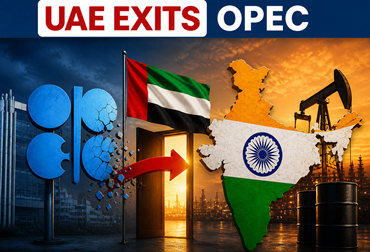
The recent announcement that the United Arab Emirates (UAE) driven by Abu Dhabi will exit OPEC and OPEC+ effective May 1, 2026, marks a seismic shift in global energy geopolitics.
Reasons Behind UAE’s Exit from OPEC
- Monetizing ‘Peak Oil’: With global demand expected to plateau, Abu Dhabi aims to extract and sell its 100 billion barrels of reserves now to maximize revenue before the transition to EVs and renewables devalues hydrocarbons.
- Funding ‘Vision 2031’: Surplus oil revenue is critical to financing the UAE’s transition into a knowledge-based economy, focusing on technology, tourism, and non-oil logistics.
- Idle Capacity & ROI: Having invested $150 billion to reach a 5 million barrels per day (mbpd) capacity, the UAE views OPEC-mandated production cuts as a waste of infrastructure and a loss of potential profit.
- Strategic Autonomy from Saudi Arabia: The exit marks a break from Saudi-centric policy, allowing the UAE to compete freely against Riyadh’s ‘Project HQ’ (requiring multinational firms to move their regional bases to Riyadh) and assert its own regional leadership.
- Preference for Bilateralism: By bypassing OPEC’s collective bargaining, the UAE can now offer direct discounts and long-term supply guarantees to key partners like India in exchange for strategic investments.
- Green Energy Rebranding: Leaving the “oil cartel” helps the UAE pivot its image toward a diversified energy superpower, prioritizing Green Hydrogen and Nuclear power while distancing itself from OPEC’s climate-action resistance.
Implications for Global Energy Order
- Weakening of the Cartel: The loss of the UAE’s ~14% production capacity diminishes OPEC’s ability to manipulate prices, shifting the global market from a Cartel-led to a Competitive-market model.
- Volume over Price: Abu Dhabi’s shift to high-volume production challenges the Saudi-led strategy of artificial price inflation, triggering a “race to monetize” reserves before the Peak Oil era.
- Geopolitical Fragmentation: The move signals the breakdown of OPEC+ consensus, paving the way for a fragmented energy landscape dominated by bilateral strategic partnerships (e.g., UAE–India).
- Energy Transition Subsidy: The UAE is using maximized oil revenues to fund its pivot into a Renewable Energy Superpower, setting a global precedent for using hydrocarbons to subsidize green hydrogen and nuclear futures.
- Market Pressure on Rivals: Increased independent supply puts downward pressure on global prices, benefiting importers while stressing the fiscal stability of other major producers like the USA, Brazil, and Guyana.
Significance for India
1. Economic Stability & Lower Import Bill
- Fiscal Relief: Every $1 drop in the price of crude oil reduces India’s import bill by approximately ₹10,000 crore. A UAE producing at full capacity (5 mbpd) puts downward pressure on global prices, helping India manage its Current Account Deficit (CAD).
- Inflation Control: Lower fuel costs have a cooling effect on logistics and food prices, assisting the RBI in maintaining its CPI inflation targets.
2. Enhanced Energy Security
- Diversification: India can now negotiate direct, long-term supply contracts with the UAE without the constraints of OPEC’s production quotas. This reduces dependence on the more volatile “OPEC+ consensus.”
- Proximity Advantage: The UAE is geographically closer to India than Russia or the US. This ensures lower freight costs and faster turnaround times for Indian refineries.
3. Strategic Petroleum Reserves (SPR)
- India and the UAE already cooperate through Abu Dhabi National Oil Company storing crude in Mangaluru’s strategic reserves, strengthening energy security. Post-OPEC exit, the UAE can expand storage in India, ensuring assured supply during global disruptions and geopolitical crises.
4. Strengthening the CEPA Framework
- The Comprehensive Economic Partnership Agreement (CEPA) signed in 2022 is the bedrock of India-UAE ties. India can offer the UAE guaranteed demand in exchange for the UAE investing oil revenues back into Indian infrastructure and the India-Middle East-Europe Economic Corridor (IMEC).
5. Support for “Refining Hub” Ambitions
- India aims to expand its refining capacity to 450 mmtpa by 2030. An independent UAE can act as a steady supplier of specific crude grades required for Indian refineries, supporting India’s goal of becoming a global exporter of refined petroleum products and petrochemicals.
6. Transition to Green Energy Cooperation
- Both United Arab Emirates and India are aligning oil monetisation with major investments in green hydrogen and solar energy. This complements India’s National Green Hydrogen Mission, enabling joint R&D and clean energy partnerships beyond the “Peak Oil” era.
Potential Challenges for India
- Market Volatility: The decline of OPEC’s stabilizing influence could lead to extreme price swings, making it difficult for India to maintain predictable budgetary allocations and fiscal planning.
- Geopolitical Tightrope: India must carefully balance its deepening strategic ties with an independent UAE without alienating Saudi Arabia, which remains a critical energy partner and leader of the remaining OPEC bloc.
- Asset Stranding Risk: A sudden surge in cheap oil from the UAE might slow India’s domestic momentum for Renewable Energy (RE) adoption, potentially delaying the long-term goal of Net Zero by 2070.
- Regional Instability: If the exit triggers a “price war” or deepens the rift between Gulf monarchies, it could lead to regional friction in the Middle East, threatening the security of the 9 million-strong Indian diaspora.
- Supply Chain Vulnerability: Increased reliance on bilateral deals over a regulated cartel system means India’s energy security becomes more sensitive to the domestic policy shifts or political stability of a single nation (the UAE).
Way Forward
- Deepening Bilateral Energy Diplomacy: India should leverage the CEPA framework to move beyond a buyer-seller relationship, securing long-term, fixed-price contracts and expanding joint ventures in upstream exploration within the UAE.
- Expansion of Strategic Reserves: Capitalize on the UAE’s production flexibility to fill India’s Phase II Strategic Petroleum Reserves (SPR) at Padur and Chandikhole, ensuring a robust buffer against global supply shocks or maritime disruptions.
- Balancing West Asian Ties: Adopt a “de-hyphenated” diplomatic approach to maintain strong ties with both the UAE and Saudi Arabia, ensuring that energy competition between the two does not adversely affect India’s regional security interests.
- Integrated Energy Transition: Use the period of potentially lower oil prices to redirect fiscal savings into the National Green Hydrogen Mission. Collaborating with the UAE on carbon capture and storage (CCS) technology can help decarbonize India’s heavy industries.
- Strengthening the IMEC Route: Accelerate the development of the India-Middle East-Europe Economic Corridor (IMEC) to integrate energy grids and pipelines, turning the UAE’s “Peak Oil” exit into a permanent logistical and energy highway for India.
- Refining Hub Optimization: Modernize Indian refineries to handle the specific crude grades that the UAE will now market independently, positioning India as the primary downstream processing hub for the UAE’s expanded output.
Conclusion
The UAE’s OPEC exit marks a shift toward market-driven energy realism. For India, this offers a strategic opportunity to secure affordable crude, strengthen bilateral ties, and leverage UAE investments to fuel its green transition.