
After Reading This Article You Can Solve This UPSC Mains PYQ 2025:
Inequality in the ownership pattern of resources is one of the major causes of poverty. Discuss in the context of ‘paradox of poverty’. 15 Marks (GS 2 Social Justice)
Context
Recent policy developments such as the implementation of the new Labour Codes and the replacement of Mahatma Gandhi National Rural Employment Guarantee Act (MGNREGA) with the Viksit Bharat-Guarantee for Rozgar and Ajeevika Mission (Gramin) Bill, 2025 have reignited debates on inequality, labour welfare and rural distress in India.
What is Inequality?
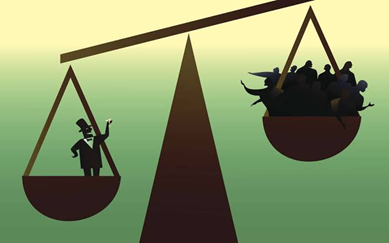
Inequality is the structural disparity in the distribution of economic assets (income, wealth) and life chances (education, healthcare, political voice). It is not merely about “having less,” but about the gap between different segments of a population.
Major Types of Inequality
1. Income Inequality: Unequal distribution of salaries, wages and earnings among individuals, where high-income groups earn disproportionately more than low-income workers.
Example: A corporate CEO earning lakhs per month while a daily wage labourer earns only a few hundred rupees a day.
2. Wealth Inequality: Unequal ownership of assets such as land, property, gold, shares and businesses, leading to concentration of wealth in a few hands.
Example: A small percentage of Indians owning large urban properties and financial assets while many rural families remain landless.
3. Consumption Inequality: Differences in the ability of households to spend on goods and services such as education, healthcare and lifestyle needs.
Example: Urban affluent families spending heavily on private education and luxury goods while poor households struggle to afford basic nutrition.
4. Social Inequality: Unequal access to opportunities and resources based on caste, gender, religion, class or region.
Example: Women and Scheduled Castes often facing barriers in employment, education and social mobility compared to dominant social groups.
Measuring Inequality
1. Gini Coefficient
A statistical measure used to assess the degree of inequality in income, wealth or consumption distribution within a society.
- Gini Coefficient = 0 → Perfect Equality
(Everyone has equal income or resources) - Gini Coefficient = 1 → Perfect Inequality
(One person possesses all income or resources)
Example:
If two households earn almost the same income, inequality is low; but if one household earns significantly more than others, inequality is high.
2. Monthly Per Capita Expenditure (MPCE)
MPCE measures the average monthly consumption expenditure per person in a household and is widely used to study consumption inequality in India.
Formula:
MPCE = Total Monthly Household Expenditure ÷ Total Number of Family Members
Example:
If a family spends Rs. 20,000 per month and has 5 members, then MPCE = Rs. 4,000.
Key Findings on Inequality in India
Based on the World Inequality Lab (2024) and the NSSO Household Consumption Expenditure Survey (HCES 2023-24), here are 5 crisp points for your notes:
- Rise of the “Billionaire Raj”: Inequality in India has skyrocketed since the early 2000s. As of 2022-23, the top 1% of the population holds 22.6% of the national income and 40.1% of the total wealth, marks that are historically higher than even the British Colonial Raj.
- Declining Consumption Inequality: Contrary to wealth trends, the Gini Coefficient for consumption has shown a decline. In 2023-24, it dropped to 0.237 (Rural) and 0.284 (Urban), suggesting that while wealth is concentrating at the top, basic consumption is becoming slightly more distributed across the broader population.
- Narrowing Rural-Urban Gap: The consumption gap between rural and urban India is shrinking. The difference in Monthly Per Capita Expenditure (MPCE) fell from 84% in 2011-12 to 70% in 2023-24, driven largely by faster growth in rural non-food spending.
- Shifting Spending Patterns (Non-Food Dominance): For the first time, food accounts for less than half of the average rural household’s expenditure (47%). Spending has shifted toward conveyance, consumer durables, and processed foods, reflecting a transition in the rural economy.
- Welfare Net Impact: Social welfare programs (like free food grains under PMGKY) have a measurable impact on the bottom deciles. When “imputed values” of free items are included, the MPCE for the poorest 5-10% shows the highest growth rate, indicating that the safety net is propping up bottom-tier consumption.
Causes of Rising Inequality in India
1. Skill-Biased Technological Change (SBTC): Rapid digitalization and AI adoption disproportionately reward high-skilled workers in the tech and service sectors. Conversely, low-skilled workers face stagnant wages or job displacement due to automation.
2. Regressive Taxation and Loopholes: High reliance on indirect taxes (like GST) burdens the poor more than the rich as a percentage of income. Simultaneously, the ultra-wealthy often leverage tax exemptions and loopholes to pay lower effective rates.
3. Capital Concentration vs. Labor Stagnation: Returns on capital (stocks, real estate) have historically outpaced growth in real wages. This “Piketty Effect” ensures that those who already own assets accumulate wealth much faster than those relying solely on labor.
4. Informality and Job Polarisation: Over 90% of India’s workforce remains in the informal sector without social security or collective bargaining power. This creates a “dual economy” where a tiny formal elite prospers while the rest remain in subsistence.
5. Low Female Labor Force Participation (FLFP): Persistent gendered barriers keep India’s FLFP at a low (approx. 15.7%), leading to “missing” household income. This gender gap suppresses the economic mobility of nearly half the population.
6. Structural Gaps in Human Capital: Unequal access to high-quality healthcare and “elite” education creates a cycle of intergenerational poverty. Children from affluent backgrounds access high-value networks, while others remain trapped in low-productivity cycles.
Key Government Initiatives to Reduce Inequality
1. Viksit Bharat—G RAM G Act, 2025
Replacing MGNREGA, this Act increases the statutory employment guarantee from 100 to 125 days per rural household. It prioritizes the creation of climate-resilient assets and “saturation-based” delivery to ensure no eligible rural family is left without a livelihood.
2. PM Garib Kalyan Anna Yojana (PMGKAY) Extension
The government has extended this massive food security net until December 2028, providing 5kg of free food grains monthly to over 80 crore people. This serves as a critical buffer against food inflation, protecting the bottom 60% of the population from consumption shocks.
3. Social Security for Informal & Gig Workers (e-Shram)
With the Code on Social Security (2020) coming into force in late 2025, gig and platform workers are being integrated into the e-Shram portal. This provides them with Universal Account Numbers (UAN) and access to health insurance under Ayushman Bharat (AB-PMJAY).
4. PMAY 2.0 (Urban & Gramin)
Launched in late 2024, PMAY 2.0 targets the construction of 3 crore additional houses to bridge the housing gap. By focusing on “Housing for All,” the initiative aims to reduce wealth inequality by providing permanent physical assets to the landless and urban poor.
5. National Social Assistance Programme (NSAP) Saturation
The 2026-27 policy shift aims for 100% saturation in social pensions for the elderly, widows, and disabled persons. Through Direct Benefit Transfer (DBT), the mission eliminates middlemen to ensure that the most vulnerable receive monthly financial aid directly in their bank accounts.
6. Pradhan Mantri Jan Vikas Karyakram (PMJVK)
This scheme targets “Horizontal Inequality” by developing socio-economic infrastructure in historically marginalized and minority-concentrated areas. It focuses on schools, health centers, and skill labs to ensure that regional disparities do not hinder individual economic mobility
Way Forward: Mitigating Inequality
1. Universal Social Security: Accelerate the transition of informal workers into the formal sector via the e-Shram portal to provide portable health, pension, and insurance benefits.
2. Progressive Fiscal Policy: Balance the tax structure by exploring wealth/inheritance taxes for the ultra-rich while lowering GST on essential commodities to reduce the burden on the poor.
3. Investing in the Care Economy: Expand public childcare and elderly care to improve Female Labour Force Participation (FLFP) and address gender-based economic gaps.
4. Outcome-Oriented Human Capital: Shift focus from “access” to “quality” in education and health to ensure intergenerational mobility regardless of a household’s paying capacity.
5. Labor-Intensive Growth: Incentivize high-employment sectors (textiles, food processing) via PLI 2.0 to create mass jobs for the semi-skilled workforce and counter skill-biased disparity.
6. Rurban Industrialization: Decentralize industries through the Viksit Bharat Mission (Gramin) to create agro-processing clusters, keeping value addition and income within the rural economy.
Conclusion
To achieve Viksit Bharat by 2047, India must bridge structural gaps through inclusive growth. Prioritizing social security, progressive taxation, and rural industrialization will ensure that prosperity is shared equitably, leaving no citizen behind.