
After Reading This Article You Can Solve This UPSC Mains Model Question:
“While the Salt Satyagraha challenged the legitimacy of a foreign power, the Mahad Satyagraha challenged the moral authority of an unequal internal social order.” In light of this statement, evaluate the significance of the Mahad Satyagraha (1927) in laying the ethical and legal foundations of the Indian Constitution.15 Marks (GS-1 History)
What is Mahad Satyagraha?
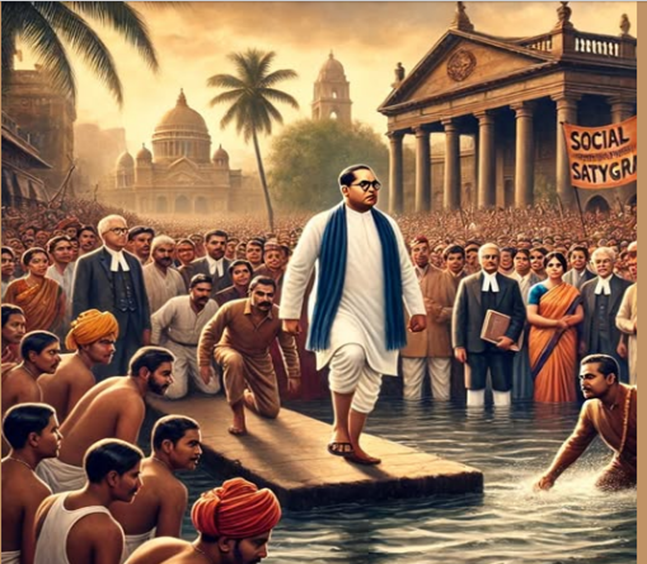
It was a non-violent social movement launched on March 20, 1927, in Mahad (Maharashtra) led by Dr. B.R. Ambedkar. It aimed to assert the right of the Dalit community (then “untouchables”) to access water from the Chavdar Tank, a public resource they were traditionally barred from using.
Background of the Mahad Satyagraha
- The S.K. Bole Resolution (1923): The Bombay Legislative Council passed a resolution allowing “untouchables” access to all public watering places, wells, and schools maintained by the government.
- Local Defiance: Despite the law and a 1924 Mahad Municipal Council order, the high-caste Hindu community resisted, often through violence and social boycotts.
- Institutional Mobilization: Under the banner of the Bahishkrit Hitakarini Sabha, Ambedkar turned a local grievance into a national civil rights issue.
Key Features of the Mahad Satyagraha
1. Symbolic Defiance (March 20, 1927)
- Direct Action: Dr. Ambedkar led a procession of thousands to the Chavdar Tank. He was the first to drink water, followed by his supporters.
- Breaking the Taboo: This act shattered the “pollution by touch” myth. It wasn’t about thirst; it was a demonstration of civil equality.
2. The “Manusmriti Dahan” (December 25, 1927)
- Phase Two: After orthodox groups “purified” the tank with cow urine, a second Satyagraha was organized.
- Radical Break: Ambedkar and his followers burned the Manusmriti, the ancient text seen as the source of caste-based discrimination. This symbolized the rejection of the religious basis of untouchability.
3. Inclusion of Women
- Gender Equality: For the first time in such a large-scale social movement, women participated actively.
- Social Reform: Ambedkar urged Dalit women to change their attire (e.g., wearing saris like other women) to shed the visual markers of “servitude” and reclaim their dignity.
4. Non-Violent Approach
- Strict Discipline: Despite being attacked by orthodox mobs after the first march, Ambedkar ensured his followers did not retaliate with violence.
- Constitutional Method: He maintained that the struggle was for the legal enforcement of a government resolution (the Bole Resolution).
5. Secular and Rights-Based
- Not a Religious Quest: Unlike temple-entry movements, Mahad was about Civic Rights. It focused on access to a public utility (water), framing it as a natural right of every human being.
- “Manushki” (Humanity): The core philosophy was centered on human dignity rather than seeking “purity” within the caste fold.
6. Legal Victory (1937)
- Rule of Law: The struggle didn’t end at the tank; it moved to the courts. After a decade-long battle, the Bombay High Court ruled in 1937 that Dalits had the legal right to use the water, affirming that “custom” cannot override “legal rights.”
Significance of the Mahad Satyagraha
1. The “First Rehearsal” of the Constitution
- Rights over Charity: It shifted the focus from seeking “mercy” or “reform” within the caste system to claiming Fundamental Rights as equal citizens.
- Article 17 Precursor: The demand for the abolition of untouchability at Mahad directly informed the drafting of Article 17 (Abolition of Untouchability) and Article 15 (Non-discrimination) in the Indian Constitution.
2. Transition to Mass Mobilization
- Political Awakening: It was the first time the “Depressed Classes” organized on such a massive scale (thousands of participants) to challenge the social order through Direct Action.
- Institutional Strength: It established the Bahishkrit Hitakarini Sabha as a potent force for social change, moving beyond mere petitions to active Satyagraha.
3. Intellectual & Symbolic Break
- Rejection of Hierarchy: The burning of the Manusmriti (Dec 1927) was a radical intellectual break from traditional social laws. It signaled that the movement would no longer accept religious justifications for inequality.
- Secularization of Rights: By fighting for water (a civic utility) rather than just temple entry, Ambedkar framed the struggle as a Secular Human Rights issue rather than a purely religious one.
4. Empowerment of Women
- The “Mahad Speech”: Ambedkar’s address to Dalit women during the Satyagraha is considered a milestone in Indian Feminism. He urged them to shed symbols of slavery and educate their children, recognizing women as the primary drivers of social reform.
Comparison: Mahad vs. Salt Satyagraha
| Feature | Mahad Satyagraha (1927) | Salt Satyagraha (1930) |
| Primary Adversary | Internal: The “Feudal-Caste” oppression and the Brahmanical social order. | External: The “Colonial-Imperial” exploitation by the British Raj. |
| The “Resource” | Water: A natural, life-sustaining resource denied based on birth (Caste). | Salt: A daily essential taxed by the state to generate revenue (Colonial Law). |
| Core Philosophy | Manushki (Humanism): Focused on reclaiming human dignity and “social citizenship.” | Swaraj (Self-Rule): Focused on political sovereignty and “national independence.” |
| Legal Trigger | Defiance of the 1923 Bole Resolution by local orthodox groups. | Defiance of the 1882 Salt Act by the Indian National Congress. |
| Gender Inclusion | Radical: Women were encouraged to shed visual symbols of caste slavery (Ambedkar’s 1927 speech). | Massive: Women joined the frontlines of the Civil Disobedience Movement. |
| Key Symbolic Act | Drinking water from Chavdar Tank and burning the Manusmriti. | Making salt at the Dandi coast. |
| Constitutional Legacy | Direct precursor to Articles 15, 17, and 21. | Foundation for the Fundamental Rights of Political Participation. |
Conclusion
The Mahad Satyagraha remains the foundational blueprint for Article 17, evolving today into a “Digital Mahad” ensuring equitable access to Digital Public Infrastructure and data dignity for all citizens.