
After Reading This Article You Can Solve This UPSC Mains Model Question:
“India’s engagement with the Nordic countries is evolving from climate-centric cooperation to a broader strategic partnership shaped by Arctic geopolitics and emerging global power shifts.” Discuss. 15 Marks (GS-2, International Relations)
Context
Prime Minister Narendra Modi visited Oslo for the 3rd India–Nordic Summit amid changing global geopolitics. Earlier India’s engagement with Nordic countries focused mainly on climate cooperation, innovation and the blue economy, but now the partnership is acquiring strategic, economic and security dimensions.
Evolution of India-Nordic Engagement
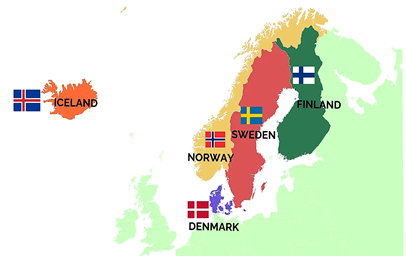
The Nordic countries include Norway, Sweden, Finland, Denmark, Iceland
- Phase 1 (2018–2022): Formulated during the first summit in Stockholm (2018) and the second in Copenhagen (2022). The relationship was primarily anchored in functional cooperation:
- Climate action and green transition.
- Digitalization and technological innovation.
- Blue economy and maritime cooperation.
- Phase 2 (Present – 2026 onwards): Driven by a shifting trans-Atlantic alliance and structural shifts in Europe, the relationship is transitioning from episodic engagement to a sustained strategic partnership.
Why the Partnership is Becoming Strategically Important
1. Geopolitical Realignment: It provides India with a trusted, non-hegemonic democratic partnership in the Indo-Pacific and Northern Europe amid escalating NATO-Russia-China polar rivalries.
2. Monsoon and Climate Security: Collaborative research on Arctic ice melt helps India understand and mitigate devastating disruptions to its summer monsoon and rising sea levels along its coastline.
3. Green Energy Transition: Nordic leadership in offshore wind, green hydrogen, and geothermal technology directly fuels India’s massive renewable energy expansion and net-zero targets.
4. Supply Chain Diversification: Access to Sweden’s rare earth elements and Norway’s deep-sea mining opportunities helps India diversify its critical mineral sourcing away from China’s dominance.
5. Maritime Connectivity: It opens avenues to link the Chennai-Vladivostok corridor to the Northern Sea Route, securing alternative, efficient maritime trade lanes to Northern Europe.
6. Advanced Technological Synergy: Nordic expertise in 5G/6G, artificial intelligence, and semiconductors perfectly complements India’s massive engineering talent and digital manufacturing scale.
India’s Arctic Engagement
India’s Arctic infrastructure includes:
India became an observer in the Arctic Council in 2013.
- Himadri Research Station
- IndARC underwater observatory
- Gruvebadet atmospheric laboratory in Norway
Challenges in India’s Arctic Strategy
1. Geopolitical Tightrope Balancing: India faces a steep diplomatic challenge in maintaining its deep energy cooperation with Russia along the Northern Sea Route without alienating the newly NATO-aligned Nordic states.
2. Severe Lack of Hard Infrastructure: India lacks critical domestic assets, such as heavy icebreakers and ice-class polar vessels, which heavily restricts its autonomous operational capability in the frozen Arctic waters.
3. Absence of Dedicated Diplomatic Leadership: Unlike other Asian observer states like China, Japan, and South Korea, India does not have a designated Special Envoy for Arctic Affairs, weakening its persistent diplomatic footprint.
4. Massive Financial Capital Requirements: Deploying polar-capable technologies, building specialized ships, and setting up deep-sea research infrastructure require massive, long-term capital investments that compete with immediate domestic economic priorities.
5. China’s Overwhelming Polar Dominance: China’s aggressive investments in the “Polar Silk Road,” advanced icebreakers, and joint infrastructure projects with Russia leave India struggling to close a massive strategic gap in the region.
6. Regulatory and Environmental Uncertainties: Navigating the evolving, highly strict environmental laws of the Arctic Council regarding resource extraction and shipping limits the commercial viability of Indian private sector participation.
Way Forward
1. Appoint a Special Envoy for Arctic Affairs: India must designate a dedicated Arctic diplomat to ensure a persistent, high-level voice in Arctic Council negotiations, mirroring other major Asian observer nations.
2. Fast-Track Ice-Class Shipbuilding: India needs to aggressively utilize its Shipbuilding Financial Assistance Policy to construct at least five Arctic-capable, ice-class vessels by 2030-31 to secure early-mover logistics advantages.
3. Operationalize an India-Arctic Economic Forum: Establishing a formal B2B platform will effectively connect Indian industries with Nordic partners for joint ventures in sustainable shipping, specialized manpower, and infrastructure.
4. Launch the Arctic-Himalaya Climate Data Corridor: India should co-develop a joint scientific data network with the Nordics to map the direct meteorological teleconnections between polar ice melt and the Indian monsoon.
5. Institutionalize Co-Development in Green Tech: The partnership must shift from a standard buyer-seller dynamic to joint manufacturing in offshore wind components, green hydrogen production, and grid-balancing technologies.
6. Maintain Strategic Autonomy through Dual Engagement: India should pragmatically pursue commercial shipping opportunities with Russia on the Northern Sea Route while simultaneously partnering with the Nordic states for sustainable, rule-based Arctic governance.
Conclusion
Transforming episodic engagement into a sustained strategic partnership with the Nordics empowers India to master polar geopolitics, secure climate-resilient monsoons, and pioneer green-tech innovations, anchoring its status as a vital global Arctic stakeholder.