
After Reading This Article You Can Solve This UPSC Mains Model Question:
Riverfront development projects aimed at rejuvenating polluted rivers often combine ecological restoration with economic objectives. In this context, critically examine the challenges in restoring rivers like the Musi and also suggest a approach for sustainable river basin management. 15 Marks (GS-3, Environment)
Introduction
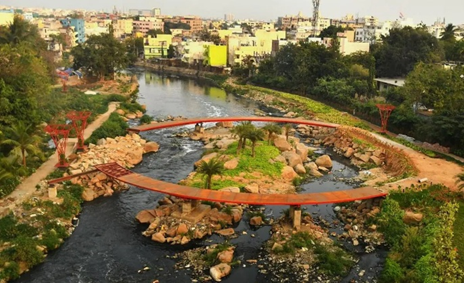
The Musi Riverfront Development Project (MRDP) has been launched by the Telangana government to transform Hyderabad’s historic river into a modern urban hub. While the project aims for ecological restoration and economic growth, it has sparked intense protests from residents facing displacement. The balance between urban renewal and the rights of long-term inhabitants remains a critical point of contention.
About Musi River: Geography and Significance
Historically known as the Muchukunda or Musunuru River, the Musi is a primary tributary of the Krishna River within the Deccan Plateau.
- Origin and Formation: The river originates in the Anantagiri Hills of the Vikarabad District. It is formed by the merging of two smaller rivulets: the Esi (8 km) and the Musa (13 km).
- Course and City Layout: It flows eastward, cutting through the heart of Hyderabad. Historically, the river served as the dividing line between the Old City and the New City. After exiting the urban landscape, it travels through the southern Telangana plains.
- End Point: The river completes its 240-kilometer journey by joining the Krishna River near Wazirabad in the Nalgonda district.
- Infrastructure and Reservoirs: Two major dams, Osman Sagar and Himayat Sagar, were constructed over the river to control floods and provide water. Additionally, Hussain Sagar Lake, a 24-kilometer water body, was built on a Musi tributary to meet the city’s irrigation and drinking needs.
- Historical and Agricultural Significance: The banks are lined with Qutb Shahi and Nizam-era architecture, including historic mosques and bridges. For agriculture, the river features 24 diversion weirs known locally as kathwas.
- Current Ecological Crisis: Due to unplanned urbanization, the river has transformed into a receptacle for unprocessed domestic and industrial waste from Hyderabad.
What is the Musi Riverfront Development Project (MRDP)?
The project aims to develop the entire 55-km river course inside Hyderabad in five phases. The stated objectives are:
- Flood mitigation
- Creation of an accessible riverfront
- A connected city
- Sustainable development
- Promotion of heritage tourism
In Phase I, 11.2 km of the Moosa and 9.8 km of the Esi will be covered up to their confluence. A Gandhi Sarovar Project is planned on 200 acres, featuring a 123-feet statue of Mahatma Gandhi, a cultural centre, and a museum. The phase is estimated to cost ₹6,500–7,000 crore (excluding land acquisition).
Other features include:
- An East-West road corridor on Build-Operate-Transfer model with tolls
- Promenades, bridges, viewpoints, walkways, and greenery
- Sewage treatment plants with nearly 3,000 million litres per day capacity
- Nature-based solutions such as wetlands, sedimentation basins, and vegetated swales
The government plans to divert 2.5 tmcft of water from Mallanna Sagar on the Godavari to make the Musi flow year-round. Over 10,000 properties across 3,279 acres are expected to be acquired for the full project.
Key Challenges Faced by the Musi Riverfront Development Project
The project faces a “toxic cocktail” of social, legal, and environmental hurdles:
- Displacement & The Human Cost: Over 10,000 properties are targeted for acquisition. Residents, including senior citizens and defence personnel, face the loss of their homes and secular communities. The government’s claim that properties in the buffer zone have “zero value” has caused financial panic and emotional trauma.
- Ecological Scepticism: Experts argue that 90% of the river’s flow is industrial waste. Beautification is seen as superficial unless the pollution is stopped at the source. Dredging tonnes of toxic sludge without a clear treatment plan poses a secondary environmental risk.
- Transparency & Legal Gaps: The Social Impact Assessment (SIA) has been bypassed through legal exemptions. The lack of a public Detailed Project Report (DPR) and the cancellation of Gram Sabhas have led to a breakdown of trust.
- Real Estate & Political Motives: Critics allege the project is a pretext for land grabbing. Concerns exist that by diverting Godavari water to the Musi, the government may scrap protective orders (like the 1996 catchment order) to open up land for private real estate.
- Compensation Uncertainty: The use of Transferable Development Rights (TDRs) is criticized as impractical for middle-class families who have existing bank loans and need immediate, physical housing.
- Hydrological Risks: Some residents argue that the technical definition of “buffer zones” is being applied inconsistently, noting that water has not reached their walls in decades, questioning the floodplain zoning accuracy.
Holistic Way Forward for Sustainable River Basin Management
For the Musi Riverfront Development Project to succeed without violating human rights or ecological principles, the following pillars are required:
- Prioritize Upstream Remediation: Before building promenades, the government must strictly enforce Zero Liquid Discharge (ZLD) on industries to stop chemical waste from entering the Moosa and Esi rivulets.
- Basin-Wide Restoration: Restoration must involve replanting riparian vegetation and reviving the traditional tank systems in the 40 villages of the catchment area to naturally recharge groundwater.
- Humane Resettlement: A legally binding compensation framework must be published. This should include “land-for-land” options or market-value cash payouts, ensuring no resident is left with unpaid bank loans or homelessness.
- Democratic Engagement: The Detailed Project Report (DPR) must be made public. Genuine public hearings should be conducted to make residents partners in development rather than victims of it.
- Nature-Based Solutions (NbS): Instead of heavy concrete engineering, the project should utilize floating wetlands, sedimentation basins, and vegetated swales to allow the river to breathe and self-purify.
- Independent Audit & Monitoring: An independent committee comprising environmentalists, urban planners, and citizen representatives should be formed to monitor the project’s progress and ensure transparency in fund utilization and environmental impact.
Conclusion
The Musi Riverfront Development Project is a test of the government’s ability to balance modernization with empathy. While the ecological revival of the Musi is a noble goal, the current approach risks creating a humanitarian crisis. A successful transformation requires the state to prioritize the rights of its people and the health of the river basin over commercial real estate gain.