
After Reading This Article You Can Solve This UPSC Mains Model Questions:
Judicial delays are often cited as a justification for ‘instant justice’. Evaluate whether bulldozer justice can be seen as a consequence of systemic weaknesses in India’s judicial system. 15 Marks (GS-2, Governance)
Context
Recently, the public glorification of “bulldozer justice”, reflected in symbolic gestures such as children gifting toy bulldozers to political leaders, indicates a troubling normalisation of extrajudicial punishment, where demolition of property is celebrated as decisive governance rather than questioned as a constitutional violation.
Understanding Bulldozer Justice: Meaning, Practice and Legal Context
Definition and Nature of Bulldozer Justice
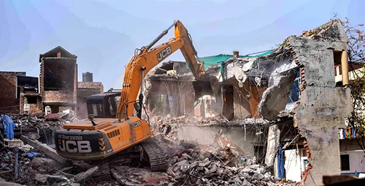
“Bulldozer Justice” refers to the extrajudicial demolition of properties belonging to individuals accused of crimes, often carried out by state authorities without completing legal procedures.
It bypasses the established sequence of allegation → investigation → adjudication → punishment, thereby violating the core principles of criminal justice.
The practice converts administrative action into punitive spectacle, where destruction becomes a substitute for legal accountability.
Historical Background and Evolution
The use of bulldozers as a coercive state tool is not new; during the Emergency period (1975–77), demolitions such as those in Turkman Gate were later criticised as state excesses.
However, unlike earlier criticism, the present trend is being celebrated politically and socially as a symbol of strong governance and zero tolerance.
This shift from condemnation to endorsement signals a dangerous normalization of executive overreach.
Contemporary Drivers Behind the Bulldozer Justice Practice
India’s justice system is burdened with a backlog of over 5.5 crore cases across all courts, with the Supreme Court alone having over 90,000 pending cases, creating an enormous perception of delay.
The India Justice Report 2025 revealed that India has only 15 judges per million people — far below the 1987 Law Commission recommendation of 50 judges per million — meaning systemic delays are structural, not incidental.
In 22 of 25 States, cases pending for over three years in subordinate courts constitute 25% of all pending cases; across 25 High Courts, cases pending for over five years account for 51% of total pendency.
In an era of rapid service delivery expectations, governance too faces pressure for quick outcomes, leading to shortcuts over due process.
Supreme Court’s Response: Declaring Punitive Demolitions Unconstitutional
In a landmark intervention in November 2024, the Supreme Court of India, invoking its extraordinary powers under Article 142 of the Constitution, issued pan-India guidelines declaring punitive demolitions unconstitutional.
Mandatory Prior Notice: Authorities must serve a written notice of at least 15 days to the property owner via registered post before any demolition action is initiated, giving them time to respond.
Right to be Heard: The affected party must be granted a personal hearing to contest the demolition order, and the authority must issue a reasoned written order explaining why demolition is the only viable option.
Accountability and Video Recording: All demolition proceedings must be recorded on video to ensure transparency and prevent abuse of power.
Personal Liability of Officials: Any public official found violating these guidelines will face contempt of court proceedings and will be held personally liable to pay for the restitution of the destroyed property from their own salary.
Exception Carved Out: The Supreme Court clarified that its directions will not apply to unauthorised structures in public places such as roads, footpaths, railway lines, or riverbanks, and to cases where demolition is ordered directly by a court of law.
Judicial Pronouncements Reinforcing Due Process and Property Rights
Maneka Gandhi Case, 1978: The Supreme Court expanded ‘procedure established by law’ to mean it must be just, fair, and reasonable — introducing due process of law into Indian jurisprudence, directly contradicting arbitrary demolitions based on mere suspicion.
Olga Tellis Case, 1985: The Court held that Article 21 — the right to life — also encompasses the right to livelihood and shelter, meaning demolishing homes without due process is a direct violation of the fundamental right to life.
KT Plantation (P) Ltd Case, 2011: The Court ruled that any legislation depriving a person of property under Article 300-A must be just, fair, and reasonable, reinforcing the need for procedural safeguards before property destruction.
Key Concerns: Why Bulldozer Justice Undermines the Rule of Law
1. Violation of the Rule of Law and Due Process
Bulldozer Justice fundamentally subverts the constitutional sequence of law enforcement by jumping from allegation directly to punishment, without investigation or adjudication — the state becomes investigator, judge, and executioner at once.
This dissolution of powers violates the doctrine of separation of powers, which is a basic feature of the Indian Constitution — the executive cannot assume the functions of the judiciary.
The practice amounts to a colourable exercise of power — using lawful municipal authority (demolition of unauthorised structures) for an impermissible or politically motivated objective (punishing an accused person).
Demolitions carried out immediately after an alleged offence — often before investigations are even completed — blur the line between punishment and extrajudicial state action, substituting spectacle for procedure.
2 Infringement of Fundamental Rights Under the Constitution
Right to Shelter (Article 21): The right to life and personal liberty includes the right to dignified shelter; sudden punitive evictions permanently destroy a family’s socioeconomic security and livelihood, violating the most basic constitutional guarantee.
Right to Property (Article 300-A): The Constitution mandates that no person shall be deprived of their property except by authority of law, which necessitates a fair procedure before any state seizure or destruction of property.
Right to Equality (Article 14): When authorities selectively raze the properties of specific communities or political dissenters while ignoring similar violations by others nearby, it constitutes a gross violation of the right to equal protection under the law.
Presumption of Innocence: Every accused person is presumed innocent until proven guilty — punitive demolitions before a trial effectively declare the accused guilty without a court’s verdict, violating this foundational principle of criminal jurisprudence.
3 The Problem of Collective Punishment
Demolishing shared homes punishes innocent family members — including children, elderly, and non-involved relatives — for the alleged crime of one individual, violating the principle of individual criminal liability that is central to Indian criminal law.
Such collective punishment is not only alien to Indian law but also violates the Geneva Convention 1949, which explicitly prohibits collective punishments, and the International Covenant on Civil and Political Rights (ICCPR), which affirms that no one shall be arbitrarily deprived of property.
4. The State’s Own Complicity: A Question that Cannot Be Ignored
If demolitions are justified on grounds of unauthorised construction, then a critical question arises: why did the government allow the structure to be built in the first place?
This reflects systemic municipal corruption and administrative failure — the same state that permitted the structure through inaction or complicity cannot selectively invoke building regulations as a post-hoc pretext for punishment.
5. Long-Term Erosion of Institutional Trust and Democratic Norms
The image of swift destruction creating an impression of decisive leadership normalises the idea that executive authority can override legal safeguards whenever public anger demands immediate retribution.
Over time, this risks weakening institutional credibility and erodes citizens’ trust in lawful processes, as people begin to accept that the law is selectively applied based on political power rather than impartial procedure.
As a result, the state reducing itself to the level of vigilante groups — handing out instant punishment outside the law — fundamentally undermines the constitutional compact between the state and its citizens.
Way Forward: Strengthening Rule of Law Instead of Bypassing It
1. Immediate Judicial and Legislative Safeguards
High Courts and district judiciaries must proactively exercise suo motu writ jurisdiction to issue pre-emptive stays when patterns of targeted demolitions emerge following communal clashes or political protests.
State legislatures must amend municipal laws to explicitly codify the proportionality doctrine, making demolition legally permissible only as an absolute last resort when the structure poses an immediate public hazard and cannot be regularised through other means.
The Representation of the People Act, 1951 should be amended to classify public endorsement or ordering of extrajudicial demolitions by elected representatives as a corrupt electoral practice, creating democratic accountability for political misuse.
2. Structural Institutional Reforms
India must urgently work towards achieving the Law Commission’s recommended ratio of 50 judges per million people by filling over 6,000 judicial vacancies, expanding court infrastructure, and allocating higher budgetary resources to the judiciary.
Cases involving heinous crimes must be mandatorily assigned to Fast-Track Courts with frequent hearings and fixed disposal timelines, ensuring that the demand for ‘quick justice’ is met through institutional speed rather than extrajudicial shortcuts.
Independent Municipal Property Tribunals should be established so that all final demolition orders are vetted by quasi-judicial bodies before execution, stripping local civic bodies of absolute and unchecked adjudicatory power.
3. Adopting International Standards
India should statutorily adopt the United Nations Basic Principles and Guidelines on Development-Based Evictions and Displacement (2007), which strictly prohibit forced evictions as a punitive measure and mandate comprehensive rehabilitation before any state-led demolition.
Strengthening investigative and prosecutorial capacity — by modernising forensic infrastructure, improving police-to-population ratios, and ensuring independent prosecution — will reduce the systemic delays that make extrajudicial shortcuts appear attractive to the public.
Conclusion
Although bulldozer justice may project an image of swift and decisive governance, it fundamentally undermines the rule of law, constitutional order, and due process, thereby weakening the very foundation of a democratic state. Therefore, true legitimacy lies not in the speed of punishment but in fairness, legality, and strong institutions, and hence strengthening these institutions rather than bypassing them is essential to ensure justice, accountability, and public trust.