
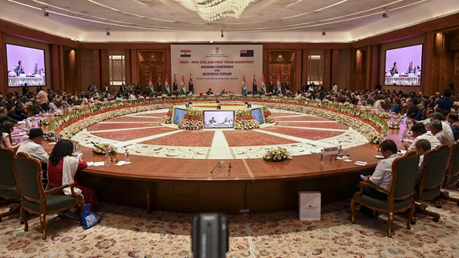
India–New Zealand Free Trade Agreement (FTA): A Strategic Leap Towards Viksit Bharat

After Reading This Article You Can Solve This UPSC Mains Model Questions:  Free Trade Agreements are no longer just economic tools but instruments of geopolitical strategy. Analyse this statement in the context of the India–New Zealand FTA. 15 Marks (GS-2, International Relations) Introduction At a time when global supply chains are fractured and protectionism is rising, India recently concluded a landmark Free Trade Agreement (FTA) with New Zealand one of its fastest-concluded FTAs ever, as a decisive reflection of its recalibrated foreign trade policy under the "Viksit Bharat 2047" vision, transitioning from a cautious, tariff-focused negotiator to a strategic, high-velocity trade partner. A Free Trade Agreement (FTA) is a treaty between two or more countries that reduces or eliminates barriers to trade such as tariffs, quotas, and regulatory restrictions to enable the free flow of goods, services, capital, and labour across borders, thereby enhancing economic cooperation. India–New Zealand Relations: The Foundation Historical Ties: Formal diplomatic relations were established in 1952; Indian soldiers fought alongside ANZAC forces at Gallipoli (1915) during World War I, forming a deep historical bond. Diplomatic relations were formally established in 1952, and both countries are members of the Commonwealth, sharing democratic values and common law traditions. Both nations support a rules-based international order, strengthening cooperation in global governance. Bilateral Trade: Total trade in goods and services reached USD 2.4 billion in 2024. Bilateral merchandise trade grew by 49% to USD 1.3 billion in 2024–25. India maintains a positive trade balance, exporting more than it imports. New Zealand is India's second-largest trading partner in the Oceania region. Trade Composition: India exports pharmaceuticals, machinery, textiles, and precious stones to New Zealand, while importing wool, iron & steel, fruits & nuts, and aluminium. Diaspora Bridge: The ~300,000-strong Indian diaspora roughly 5–6% of New Zealand's population acts as a powerful cultural and economic bridge between both nations. Cultural connections are further strengthened through education exchanges, tourism, and traditional knowledge systems. Defence & Security: A bilateral Defence Agreement signed in early 2025 enhanced military engagements and naval port visits. New Zealand is also aligning with India's Indo-Pacific Oceans Initiative (IPOI) to improve maritime domain awareness. Multilateral Cooperation: New Zealand supports India's bid for permanent UNSC membership and entry into the Nuclear Suppliers Group (NSG). It is a member of the International Solar Alliance (ISA) and the Coalition for Disaster Resilient Infrastructure (CDRI), both led by India. Strategic Features of the India–New Zealand FTA 1. Unprecedented Market Access for Indian Exports 100% Duty-Free Access: New Zealand has eliminated all tariffs on Indian exports, benefiting labour-intensive sectors like MSMEs, textiles, leather, footwear, and gems & jewellery where earlier tariffs were as high as 10%. India's Tariff Offer: India has offered tariff liberalisation on 70.03% of tariff lines, covering approximately 95% of bilateral trade value. While 30% of these lines will see immediate duty elimination, the rest will undergo phased reduction over 3 to 10 years. Input Cost Reduction: India gains duty-free access to key industrial inputs like wooden logs, coking coal, and metal scrap, directly enhancing manufacturing competitiveness and supporting 'Make in India'. 2. Protection of Sensitive Domestic Sectors Strategic Exclusion List: India has kept 29.97% of tariff lines outside the liberalisation framework to shield domestic industries. Excluded Items: All dairy products (fluid milk, cheese, yogurt), sensitive agricultural commodities like onions, peas, corn, sugar, aluminium, arms & ammunition, and specific gems & jewellery. Dairy Red Line: The exclusion of core dairy products is India's most significant protective win, shielding millions of small dairy farmers from New Zealand's global dairy dominance. Graduated Access for Value-Added Dairy: India will grant progressive duty-free access for infant formula and high-value-added dairy products over a seven-year period, enabling domestic firms to access quality raw materials. Tariff Rate Quota (TRQ) Mechanism: Products like apples, kiwifruit, Manuka honey, and albumins are regulated through TRQs with minimum import price safeguards and seasonal constraints, balancing market access with farmer protection. Trade Remedies: The FTA allows safeguard measures against import surges — including raising duties or pausing tariff cuts — ensuring balanced protection for domestic industries. 3. Massive Foreign Direct Investment Commitment USD 20 Billion Investment: New Zealand has made a binding commitment to invest USD 20 billion in India over the next 15 years in high-priority sectors including agri-tech, food processing, renewable energy, education, and healthcare management. Rebalancing Clause: A dedicated rebalancing mechanism addresses any shortfall in investment delivery, ensuring this commitment translates into tangible economic outcomes rather than remaining a paper pledge. 4. Talent Mobility & Human Capital Pathways 5,000 Skilled Professional Visas: An annual quota of 5,000 Temporary Employment Entry Visas (up to 3 years) has been created for skilled Indians in IT, healthcare, and engineering. Student-Friendly Provisions: Caps on Indian students are removed; students may work 20 hours per week during study, with post-study work rights of 3–4 years for STEM graduates. Working Holiday Visas: An annual quota of 1,000 work-and-holiday visas for young Indians aligns India's workforce with New Zealand's age-eligibility requirements. 5. Services, AYUSH & Cultural Diplomacy Services Market Access: New Zealand offers market access across 118 service sectors  including IT, education, finance, and tourism — along with Most-Favoured Nation (MFN) treatment in 139 sub-sectors. AYUSH Recognition — A Historic First: This is the first bilateral FTA to formally recognise India's traditional medicine systems like Ayurveda, Yoga, Unani, Siddha, and Homoeopathy (AYUSH) alongside New Zealand's indigenous Māori health practices, enabling formal trade and professional exchange in traditional medicine. Cultural Chapter: A dedicated chapter covering traditional knowledge, audio-visual industries, sports, and tourism strengthens people-to-people linkages between the two nations. 6. Intellectual Property & GI Protection GI Law Amendment: New Zealand has pledged to amend its Geographical Indication legislation within 18 months, providing EU-equivalent protection to Indian GI products in the Oceania market. Iconic Products Protected: Iconic Indian brands like Darjeeling Tea, Basmati Rice, and other GI-tagged exports will gain top-tier legal protection in New Zealand and Oceania. Mutual Recognition Arrangement (MRA): Shared standards via Australia enable India's 80+ organic exports including basmati rice, tea, flax seeds, and isabgol to gain smoother access in New Zealand. 7. Trade Facilitation, Pharma & Rules of Origin Faster Customs Clearance: The FTA mandates 24–48 hour cargo clearance, paperless trade systems, and Authorised Economic Operator (AEO) mechanisms to boost MSME efficiency. Pharma Fast-Track: Global Good Clinical Practice (GCP) / Good Manufacturing Practice (GMP) approvals such as US FDA and EMA certifications will be mutually recognised, reducing duplicative inspections and lowering costs for Indian pharma exports. Product Specific Rules of Origin (PSRs): A robust PSR framework ensures genuine value addition by Indian exporters, preventing misuse of trade benefits by third-country actors routing goods through India. 8. Geopolitical & Strategic Significance Gateway to Oceania & Pacific: The FTA enables India to use New Zealand as a logistical hub and regulatory reference point to access Pacific Island Countries (PICs), strengthening India's Indo-Pacific footprint. OECD Standards Compliance: By meeting New Zealand's high standards, India demonstrates its capacity to engage in OECD-standard global supply chains, setting a precedent for future FTA negotiations. First-Mover in Oceania: Negotiations concluded in just 9 months (March to December 2025), marking India's fastest FTA execution and a decisive first-mover advantage in the region. Key Challenges in India–New Zealand FTA China Shadow Over FTA Gains: New Zealand’s heavy economic dependence on China (~30% of exports) may push it to avoid taking clear positions in Indo-Pacific disputes, potentially diluting the FTA’s strategic value for India and limiting deeper supply chain integration. Investment Delivery Risk: The binding commitment of USD 20 billion over 15 years is ambitious. Without strong sector-specific enforcement, actual capital flows may fall well short of targets. The rebalancing clause provides a remedy mechanism, but its effectiveness will depend on consistent diplomatic follow-through from both sides. Dairy Exclusion vs. Agricultural Expectations: While India has protected core dairy products in the exclusion list, the phased market access for infant formula and high-value dairy products over seven years could still exert competitive pressure on domestic nutritional firms if domestic infrastructure is not upgraded simultaneously. Security Friction — Khalistan Issue: The presence of pro-Khalistan elements operating under New Zealand’s liberal policies creates diplomatic tension. This security friction, if unaddressed, can undermine trust and delay the smooth operationalisation of FTA provisions, particularly those linked to talent mobility and diaspora engagement. Weak Institutional Framework for Implementation: Effective FTA delivery demands strong bilateral institutions. Current gaps in counter-terrorism cooperation, critical minerals collaboration, and maritime security coordination reduce the overall strategic depth of the partnership, making it susceptible to disruptions caused by changes in political leadership on either side. Transactional Mindset Limiting FTA Depth: New Zealand largely still perceives India as a labour source and education destination rather than a comprehensive strategic partner. This transactional outlook may restrict the FTA’s potential in deep-tech, defence innovation, and critical capital partnerships that India needs to fully realise its Viksit Bharat 2047 ambitions. Way Forward: Measures to Strengthen the India–New Zealand FTA Fast-Track the USD 20 Billion Investment: Both countries must set up a Joint Investment Monitoring Committee to track sector-specific capital inflows in agri-tech, renewable energy, food processing, and healthcare. Activating the rebalancing clause early will prevent delivery gaps from becoming a diplomatic liability. Maximise FTA’s Trade Potential Through Digital Integration: India must leverage its Digital Public Infrastructure (UPI, Aadhaar, ONDC) to boost MSME exports, digital commerce, and cross-border fintech services under the FTA’s 118 services sectors market access commitment, directly helping India double bilateral trade to the USD 5 billion target in five years. Operationalise Agricultural & GI Commitments: India must promptly activate the Centres of Agricultural Excellence and pursue joint research in dairy modernisation, food safety, and cold-chain logistics. Simultaneously, India must push New Zealand to complete its GI law amendment within the 18-month timeline to unlock legal protection for brands like Darjeeling Tea and Basmati Rice in Oceania. Institutionalise Security to Protect FTA Gains: A bilateral counter-terrorism framework and Mutual Legal Assistance Treaty (MLAT) must be established to tackle the Khalistan issue and cross-border extremism. Without resolving this security friction, the trust needed for smooth implementation of the FTA’s talent mobility and diaspora provisions will remain fragile. Use FTA as a Launchpad for Future-Ready Sectors: The FTA’s investment commitment should be channelled into green hydrogen, space cooperation, clean technology, and AI-driven fintech to transform the partnership from a transactional trade deal into a long-term strategic alliance that truly serves the goals of Viksit Bharat 2047. Leverage Diaspora & Indo-Pacific Outreach to Expand FTA Reach: The 300,000-strong Indian diaspora must be systematically engaged to promote FTA awareness, business linkages, and AYUSH trade. Simultaneously, New Zealand’s role as a gateway must be used to deepen India’s outreach to Pacific Island Countries (PICs) under the Indo-Pacific Oceans Initiative (IPOI), giving the FTA true regional strategic weight. Conclusion The India–New Zealand FTA is a next-generation, inclusive partnership that simultaneously empowers farmers, MSMEs, women, youth, and startups while maintaining a careful balance between market access and domestic protection, taking India's total FTAs to 9 agreements with 38 advanced economies covering nearly 65–70% of global GDP. Far beyond a bilateral trade deal, this agreement is a geopolitical statement — signalling India's capacity for swift, standards-compliant diplomacy, its seriousness about Indo-Pacific leadership, and its resolute march towards Viksit Bharat 2047.

After Reading This Article You Can Solve This UPSC Mains Model Questions:
Free Trade Agreements are no longer just economic tools but instruments of geopolitical strategy. Analyse this statement in the context of the India–New Zealand FTA. 15 Marks (GS-2, International Relations)

Introduction

  • At a time when global supply chains are fractured and protectionism is rising, India recently concluded a landmark Free Trade Agreement (FTA) with New Zealand one of its fastest-concluded FTAs ever, as a decisive reflection of its recalibrated foreign trade policy under the “Viksit Bharat 2047” vision, transitioning from a cautious, tariff-focused negotiator to a strategic, high-velocity trade partner.
  • A Free Trade Agreement (FTA) is a treaty between two or more countries that reduces or eliminates barriers to trade such as tariffs, quotas, and regulatory restrictions to enable the free flow of goods, services, capital, and labour across borders, thereby enhancing economic cooperation.

India–New Zealand Relations: The Foundation

  • Historical Ties: Formal diplomatic relations were established in 1952; Indian soldiers fought alongside ANZAC forces at Gallipoli (1915) during World War I, forming a deep historical bond.
    • Diplomatic relations were formally established in 1952, and both countries are members of the Commonwealth, sharing democratic values and common law traditions. Both nations support a rules-based international order, strengthening cooperation in global governance.
  • Bilateral Trade: Total trade in goods and services reached USD 2.4 billion in 2024. Bilateral merchandise trade grew by 49% to USD 1.3 billion in 2024–25. India maintains a positive trade balance, exporting more than it imports. New Zealand is India’s second-largest trading partner in the Oceania region.
  • Trade Composition: India exports pharmaceuticals, machinery, textiles, and precious stones to New Zealand, while importing wool, iron & steel, fruits & nuts, and aluminium.
  • Diaspora Bridge: The ~300,000-strong Indian diaspora roughly 5–6% of New Zealand’s population acts as a powerful cultural and economic bridge between both nations. Cultural connections are further strengthened through education exchanges, tourism, and traditional knowledge systems.
  • Defence & Security: A bilateral Defence Agreement signed in early 2025 enhanced military engagements and naval port visits. New Zealand is also aligning with India’s Indo-Pacific Oceans Initiative (IPOI) to improve maritime domain awareness.
  • Multilateral Cooperation: New Zealand supports India’s bid for permanent UNSC membership and entry into the Nuclear Suppliers Group (NSG). It is a member of the International Solar Alliance (ISA) and the Coalition for Disaster Resilient Infrastructure (CDRI), both led by India.

Strategic Features of the India–New Zealand FTA

1. Unprecedented Market Access for Indian Exports

  • 100% Duty-Free Access: New Zealand has eliminated all tariffs on Indian exports, benefiting labour-intensive sectors like MSMEs, textiles, leather, footwear, and gems & jewellery where earlier tariffs were as high as 10%.
  • India’s Tariff Offer: India has offered tariff liberalisation on 70.03% of tariff lines, covering approximately 95% of bilateral trade value. While 30% of these lines will see immediate duty elimination, the rest will undergo phased reduction over 3 to 10 years.
  • Input Cost Reduction: India gains duty-free access to key industrial inputs like wooden logs, coking coal, and metal scrap, directly enhancing manufacturing competitiveness and supporting ‘Make in India’.

2. Protection of Sensitive Domestic Sectors

  • Strategic Exclusion List: India has kept 29.97% of tariff lines outside the liberalisation framework to shield domestic industries.
  • Excluded Items: All dairy products (fluid milk, cheese, yogurt), sensitive agricultural commodities like onions, peas, corn, sugar, aluminium, arms & ammunition, and specific gems & jewellery.
  • Dairy Red Line: The exclusion of core dairy products is India’s most significant protective win, shielding millions of small dairy farmers from New Zealand’s global dairy dominance.
  • Graduated Access for Value-Added Dairy: India will grant progressive duty-free access for infant formula and high-value-added dairy products over a seven-year period, enabling domestic firms to access quality raw materials.
  • Tariff Rate Quota (TRQ) Mechanism: Products like apples, kiwifruit, Manuka honey, and albumins are regulated through TRQs with minimum import price safeguards and seasonal constraints, balancing market access with farmer protection.
  • Trade Remedies: The FTA allows safeguard measures against import surges — including raising duties or pausing tariff cuts — ensuring balanced protection for domestic industries.

3. Massive Foreign Direct Investment Commitment

  • USD 20 Billion Investment: New Zealand has made a binding commitment to invest USD 20 billion in India over the next 15 years in high-priority sectors including agri-tech, food processing, renewable energy, education, and healthcare management.
  • Rebalancing Clause: A dedicated rebalancing mechanism addresses any shortfall in investment delivery, ensuring this commitment translates into tangible economic outcomes rather than remaining a paper pledge.

4. Talent Mobility & Human Capital Pathways

  • 5,000 Skilled Professional Visas: An annual quota of 5,000 Temporary Employment Entry Visas (up to 3 years) has been created for skilled Indians in IT, healthcare, and engineering.
  • Student-Friendly Provisions: Caps on Indian students are removed; students may work 20 hours per week during study, with post-study work rights of 3–4 years for STEM graduates.
  • Working Holiday Visas: An annual quota of 1,000 work-and-holiday visas for young Indians aligns India’s workforce with New Zealand’s age-eligibility requirements.

5. Services, AYUSH & Cultural Diplomacy

  • Services Market Access: New Zealand offers market access across 118 service sectors  including IT, education, finance, and tourism — along with Most-Favoured Nation (MFN) treatment in 139 sub-sectors.
  • AYUSH Recognition — A Historic First: This is the first bilateral FTA to formally recognise India’s traditional medicine systems like Ayurveda, Yoga, Unani, Siddha, and Homoeopathy (AYUSH) alongside New Zealand’s indigenous Māori health practices, enabling formal trade and professional exchange in traditional medicine.
  • Cultural Chapter: A dedicated chapter covering traditional knowledge, audio-visual industries, sports, and tourism strengthens people-to-people linkages between the two nations.

6. Intellectual Property & GI Protection

  • GI Law Amendment: New Zealand has pledged to amend its Geographical Indication legislation within 18 months, providing EU-equivalent protection to Indian GI products in the Oceania market.
  • Iconic Products Protected: Iconic Indian brands like Darjeeling Tea, Basmati Rice, and other GI-tagged exports will gain top-tier legal protection in New Zealand and Oceania.
  • Mutual Recognition Arrangement (MRA): Shared standards via Australia enable India’s 80+ organic exports including basmati rice, tea, flax seeds, and isabgol to gain smoother access in New Zealand.

7. Trade Facilitation, Pharma & Rules of Origin

  • Faster Customs Clearance: The FTA mandates 24–48 hour cargo clearance, paperless trade systems, and Authorised Economic Operator (AEO) mechanisms to boost MSME efficiency.
  • Pharma Fast-Track: Global Good Clinical Practice (GCP) / Good Manufacturing Practice (GMP) approvals such as US FDA and EMA certifications will be mutually recognised, reducing duplicative inspections and lowering costs for Indian pharma exports.
  • Product Specific Rules of Origin (PSRs): A robust PSR framework ensures genuine value addition by Indian exporters, preventing misuse of trade benefits by third-country actors routing goods through India.

8. Geopolitical & Strategic Significance

  • Gateway to Oceania & Pacific: The FTA enables India to use New Zealand as a logistical hub and regulatory reference point to access Pacific Island Countries (PICs), strengthening India’s Indo-Pacific footprint.
  • OECD Standards Compliance: By meeting New Zealand’s high standards, India demonstrates its capacity to engage in OECD-standard global supply chains, setting a precedent for future FTA negotiations.
  • First-Mover in Oceania: Negotiations concluded in just 9 months (March to December 2025), marking India’s fastest FTA execution and a decisive first-mover advantage in the region.

Key Challenges in India–New Zealand FTA

  • China Shadow Over FTA Gains: New Zealand’s heavy economic dependence on China (~30% of exports) may push it to avoid taking clear positions in Indo-Pacific disputes, potentially diluting the FTA’s strategic value for India and limiting deeper supply chain integration.
  • Investment Delivery Risk: The binding commitment of USD 20 billion over 15 years is ambitious. Without strong sector-specific enforcement, actual capital flows may fall well short of targets. The rebalancing clause provides a remedy mechanism, but its effectiveness will depend on consistent diplomatic follow-through from both sides.
  • Dairy Exclusion vs. Agricultural Expectations: While India has protected core dairy products in the exclusion list, the phased market access for infant formula and high-value dairy products over seven years could still exert competitive pressure on domestic nutritional firms if domestic infrastructure is not upgraded simultaneously.
  • Security Friction — Khalistan Issue: The presence of pro-Khalistan elements operating under New Zealand’s liberal policies creates diplomatic tension. This security friction, if unaddressed, can undermine trust and delay the smooth operationalisation of FTA provisions, particularly those linked to talent mobility and diaspora engagement.
  • Weak Institutional Framework for Implementation: Effective FTA delivery demands strong bilateral institutions. Current gaps in counter-terrorism cooperation, critical minerals collaboration, and maritime security coordination reduce the overall strategic depth of the partnership, making it susceptible to disruptions caused by changes in political leadership on either side.
  • Transactional Mindset Limiting FTA Depth: New Zealand largely still perceives India as a labour source and education destination rather than a comprehensive strategic partner. This transactional outlook may restrict the FTA’s potential in deep-tech, defence innovation, and critical capital partnerships that India needs to fully realise its Viksit Bharat 2047 ambitions.

Way Forward: Measures to Strengthen the India–New Zealand FTA

  • Fast-Track the USD 20 Billion Investment: Both countries must set up a Joint Investment Monitoring Committee to track sector-specific capital inflows in agri-tech, renewable energy, food processing, and healthcare. Activating the rebalancing clause early will prevent delivery gaps from becoming a diplomatic liability.
  • Maximise FTA’s Trade Potential Through Digital Integration: India must leverage its Digital Public Infrastructure (UPI, Aadhaar, ONDC) to boost MSME exports, digital commerce, and cross-border fintech services under the FTA’s 118 services sectors market access commitment, directly helping India double bilateral trade to the USD 5 billion target in five years.
  • Operationalise Agricultural & GI Commitments: India must promptly activate the Centres of Agricultural Excellence and pursue joint research in dairy modernisation, food safety, and cold-chain logistics. Simultaneously, India must push New Zealand to complete its GI law amendment within the 18-month timeline to unlock legal protection for brands like Darjeeling Tea and Basmati Rice in Oceania.
  • Institutionalise Security to Protect FTA Gains: A bilateral counter-terrorism framework and Mutual Legal Assistance Treaty (MLAT) must be established to tackle the Khalistan issue and cross-border extremism. Without resolving this security friction, the trust needed for smooth implementation of the FTA’s talent mobility and diaspora provisions will remain fragile.
  • Use FTA as a Launchpad for Future-Ready Sectors: The FTA’s investment commitment should be channelled into green hydrogen, space cooperation, clean technology, and AI-driven fintech to transform the partnership from a transactional trade deal into a long-term strategic alliance that truly serves the goals of Viksit Bharat 2047.
  • Leverage Diaspora & Indo-Pacific Outreach to Expand FTA Reach: The 300,000-strong Indian diaspora must be systematically engaged to promote FTA awareness, business linkages, and AYUSH trade. Simultaneously, New Zealand’s role as a gateway must be used to deepen India’s outreach to Pacific Island Countries (PICs) under the Indo-Pacific Oceans Initiative (IPOI), giving the FTA true regional strategic weight.

Conclusion

  • The India–New Zealand FTA is a next-generation, inclusive partnership that simultaneously empowers farmers, MSMEs, women, youth, and startups while maintaining a careful balance between market access and domestic protection, taking India’s total FTAs to 9 agreements with 38 advanced economies covering nearly 65–70% of global GDP.
  • Far beyond a bilateral trade deal, this agreement is a geopolitical statement — signalling India’s capacity for swift, standards-compliant diplomacy, its seriousness about Indo-Pacific leadership, and its resolute march towards Viksit Bharat 2047.