
After Reading This Article You Can Solve This UPSC Mains Model Question:
Examine how the Artemis Program, particularly Artemis II, reflects emerging trends in global space geopolitics and international cooperation. 15 Marks (GS-3 Science & Technology)
Context
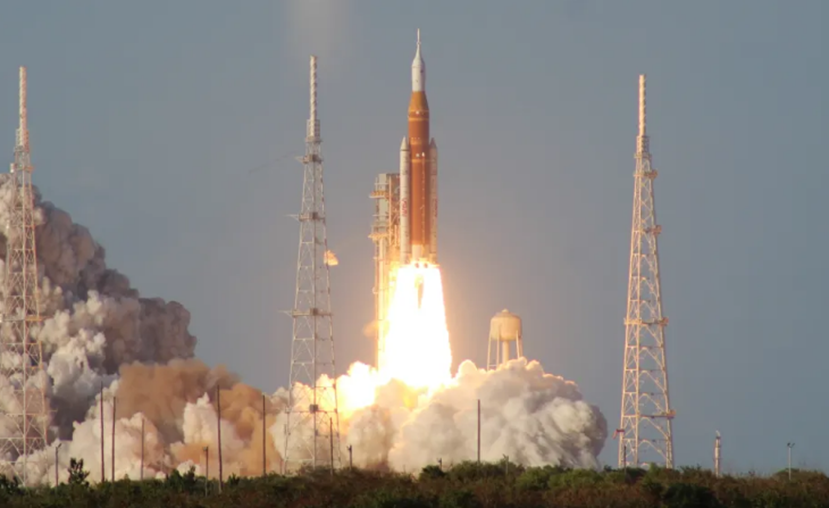
Artemis II is the first crewed mission of NASA’s Artemis program, marking the return of humans to the lunar vicinity after a gap of over 50 years (since Apollo 17 in 1972).
About Artemis II Mission
- Launch Date: April 1, 2026 (Successfully launched from Kennedy Space Center, Florida).
- Nature of Mission: A crewed lunar flyby (The crew does not land on the Moon).
- Duration: Approximately 10 days.
- Spacecraft: Orion Multi-Purpose Crew Vehicle, powered by the European Service Module (ESM).
- Launch Vehicle: Space Launch System (SLS)—the most powerful operational rocket in history, producing 8.8 million pounds of thrust.
The Historical “Firsts” of the Crew
The four-member crew represents a shift toward inclusivity and international cooperation in deep space:
- Reid Wiseman (Commander): NASA veteran.
- Victor Glover (Pilot): First person of color to leave Low Earth Orbit (LEO).
- Christina Koch (Mission Specialist): First woman to travel to the Moon’s vicinity.
- Jeremy Hansen (Mission Specialist): First non-American (Canadian Space Agency) to fly to the Moon.
| Mission | Status/ Date | Spacecraft & Launcher | Key Objective |
| Artemis I | Completed (Nov-Dec 2022) | SLS Block 1 & Orion (Uncrewed) | System Validation: Tested the SLS rocket and Orion’s heat shield during a high-speed re-entry from lunar orbit. |
| Artemis II | Ongoing (Launched April 1, 2026) | SLS Block 1 & Orion (Crewed) | Human Validation: 10-day lunar flyby to test Life Support Systems (ECLSS) and communication in deep space. |
| Artemis III | Scheduled (Mid-2027) | SLS, Orion & SpaceX Starship HLS | Crewed mission in Low Earth Orbit to test the Starship HLS and Blue Moon landers, and new Axiom space suits. (No lunar landing). |
| Artemis IV | Scheduled (Early 2028) | SLS Block 1B & Orion | First Lunar Landing of the program. Crew will land at the Lunar South Pole. |
| Artemis V | Scheduled (Late 2028) | SLS Block 1B & Blue Origin Lander | Second lunar landing; beginning of the Lunar Base Camp construction. |
Key Objectives of the Artemis Program
Artemis II serves as a bridge between the uncrewed Artemis I and the landing mission, Artemis III.
- Human-System Integration: Validating the Environmental Control and Life Support System (ECLSS) in Orion to ensure it can regulate oxygen, remove CO2, and maintain temperature for a four-person crew over 10 days.
- Manual Maneuvering & Proximity Operations: Performing a “Prox Ops” demonstration where the pilot manually maneuvers Orion near the ICPS (the rocket’s upper stage) to test manual handling and docking sensors.
- Deep Space Navigation & Communication: Testing the high-speed Optical (Laser) Communications and the Deep Space Network to ensure continuous, high-bandwidth data and video links at 400,000 km from Earth.
- Radiation & Environment Assessment: Monitoring the crew’s exposure to high-energy solar and cosmic radiation once they leave the protection of Earth’s Van Allen belts, providing data for long-duration stays.
- Re-entry and Recovery Validation: Testing the high-speed re-entry (approx. 40,000 km/h) into Earth’s atmosphere and the precision splashdown/recovery procedures in the Pacific Ocean with humans on board.
Significance of the Artemis Program
- Transition to Sustainable Habitation: Unlike the “flags and footprints” approach of Apollo, Artemis focuses on long-term presence. It prioritizes In-Situ Resource Utilization (ISRU), specifically extracting water ice from the Lunar South Pole for life support and rocket fuel (LH2/LOX).
- “Moon to Mars” Proving Ground: The Moon serves as a critical testbed for deep-space technologies needed for Mars missions in the 2030s, including nuclear thermal propulsion, advanced radiation shielding, and closed-loop life support systems.
- Space Geopolitics & Rules-Based Order: Through the Artemis Accords (which India signed), the mission establishes a U.S.-led international framework for transparent, peaceful exploration. This acts as a strategic counterweight to the China-Russia International Lunar Research Station (ILRS).
- The Cislunar Economy: Artemis is catalyzing a “New Space” economy by partnering with private entities (e.g., SpaceX, Blue Origin). This fosters commercial lunar mining, satellite refueling hubs, and the economic integration of Low Earth Orbit (LEO) with lunar space.
- Inclusivity & Science Diplomacy: Artemis II breaks historical barriers by including the first woman, person of color, and non-U.S. citizen (Canadian) on a lunar mission. This reflects a shift from Cold War nationalistic competition to modern, inclusive global science diplomacy.
- Strategic Value for India: India’s participation aligns with ISRO’s Vision 2040 (landing an Indian on the Moon). It provides critical technical data for the Gaganyaan mission and the development of the Bharatiya Antariksha Station, while enhancing NASA-ISRO tech transfers.
Critical Challenges of the Artemis Program
- Technical Reliability & Safety: Artemis I revealed significant heat shield charring and erosion issues. Ensuring the Orion capsule can protect a human crew from re-entry temperatures of 2,760°C remains a primary engineering hurdle.
- Cost Sustainability: Each SLS launch costs approximately $2 billion, leading to a “fiscal sustainability” debate. Unlike private reusable rockets (like SpaceX Starship), the SLS is expendable, making long-term mission frequency economically taxing.
- Deep-Space Radiation: Beyond Earth’s Van Allen belts, astronauts face high-energy Galactic Cosmic Rays (GCRs) and Solar Particle Events (SPEs). Developing lightweight yet effective shielding for multi-week missions is a persistent biological challenge.
- Lunar Dust (Regolith) Toxicity: Lunar dust is sharp, abrasive, and statically charged. It can cause “Lunar Hay Fever” in humans and mechanically degrade spacesuits, seals, and scientific instruments over long durations.
- Geopolitical Fragmentation: The emergence of two competing blocs—the Artemis Accords (led by the US/India) and the ILRS (led by China/Russia)—risks a “Cold War 2.0” in space, potentially leading to territorial disputes over “safety zones” and resource-rich sites.
- Landing Complexity (South Pole): The Lunar South Pole features extreme topography with deep craters and Permanently Shadowed Regions (PSRs). Landing in these areas requires unprecedented precision and the ability to operate in near-total darkness and cryogenic temperatures.
Way Forward for the Artemis Program
- Transition to Reusability: To ensure fiscal sustainability, NASA and its partners must transition from the expendable SLS model to fully reusable heavy-lift vehicles (like SpaceX’s Starship). This will significantly lower the cost per kilogram of payload to the lunar surface.
- Strengthening Space Diplomacy: With the rise of competing blocs (Artemis vs. ILRS), a universal legal framework under the UN Office for Outer Space Affairs (UNOOSA) is needed. This would prevent “resource colonization” and ensure “Safety Zones” are used for science, not territorial claims.
- Developing In-Situ Resource Utilization (ISRU): The focus must shift from “carrying supplies” to “living off the land.” Perfecting technologies to extract Oxygen and Hydrogen from Lunar Regolith is the only way to make the Moon a viable “pit-stop” for Mars.
- Public-Private Partnership (PPP) Models: Expanding the role of private players—not just for transport but for lunar communication (e.g., Nokia’s 4G lunar network) and mining—will drive innovation and reduce the burden on national exchequers.
- India’s Strategic Autonomy: India should leverage the Artemis Accords to fast-track its “Vision 2040.” This involves securing a seat for an ISRO astronaut on a future lunar mission and seeking tech-transfers for heavy-lift rocketry and human-rated life support systems.
- Planetary Defense and Science: Utilizing the Moon’s “Far Side” (radio-quiet zone) for deep-space telescopes can revolutionize our understanding of the early universe, turning the Moon into a global hub for High-Energy Astrophysics.
Conclusion
Artemis represents a paradigm shift from exploration to sustainable habitation. For India, it catalyzes Vision 2040, fostering global cooperation and a cislunar economy while securing strategic leadership in deep-space governance.