
Context
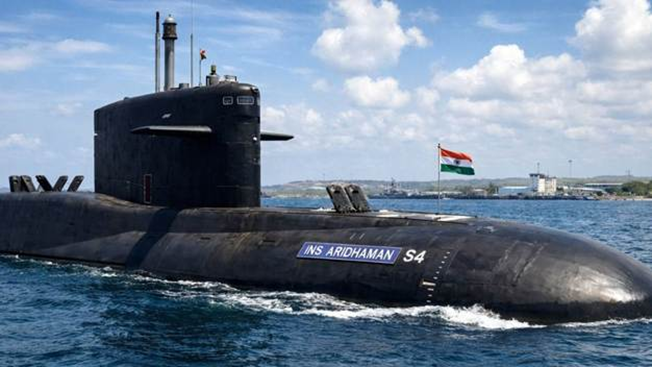
- Recently, the Union Defence Minister Rajnath Singh formally commissioned INS Aridhaman (S4) into the Indian Navy at the Shipbuilding Centre (SBC) in Visakhapatnam. This induction is a landmark event as it marks the completion of a critical phase in India’s Advanced Technology Vessel (ATV) project.
- The commissioning coincided with the induction of the stealth frigate INS Taragiri, further emphasizing India’s push toward Aatmanirbharta (self-reliance) in the maritime defense sector.
1. Classification and Project
- Class: It is the third Arihant-class nuclear-powered ballistic missile submarine (SSBN).
- Project: Developed under the highly classified Advanced Technology Vessel (ATV) Project, managed by the DRDO, Department of Atomic Energy (DAE), and the Indian Navy.
- Name Meaning: “Aridhaman” is a Sanskrit word translating to “Vanquisher of Foes” or “Destroyer of Enemies.”
2. Technical Specifications
- Displacement: Approximately 7,000 tonnes, making it larger and heavier than its predecessors, INS Arihant (~6,000 tonnes) and INS Arighaat.
- Length: The submarine features a “stretched hull” (approx. 130 meters) to accommodate additional weaponry and equipment.
- Propulsion: Powered by an indigenously developed 83 MW Pressurized Light-Water Reactor (CLWR), allowing it to remain submerged for months, limited only by food supplies and crew endurance.
- Indigenization: It boasts nearly 70-75% indigenous content, involving over 200 Indian MSMEs and major firms like L&T and Tata.
3. Weaponry and Firepower
- Vertical Launch Tubes: INS Aridhaman is equipped with 8 launch tubes, which is double the capacity of INS Arihant and INS Arighaat (which have 4 each).
- Missile Payload:
- K-4 SLBM: It can carry up to 8 K-4 intermediate-range missiles with a strike range of 3,500 km.
- K-15 Sagarika: Alternatively, it can carry 24 K-15 short-range missiles with a range of 750 km.
- Strategic Reach: The inclusion of K-4 missiles allows the submarine to target deep-seated regional threats while remaining safely stationed in the deep waters of the Indian Ocean or the Bay of Bengal.
4. Advanced Features
- Stealth: Features advanced silencing technologies and an upgraded reactor design that significantly reduces its acoustic signature, making it harder to detect.
- Sensors: Equipped with the indigenous USHUS sonar suite and Panchendriya unified fire control systems.
5. Strategic Significance
A. Completion of the Nuclear Triad
- The nuclear triad refers to a country’s ability to launch nuclear strikes from land, air, and sea. While land and air legs were established earlier, a survivable sea leg is crucial.
- With three SSBNs (Arihant, Arighaat, and Aridhaman), India can now maintain Continuous At-Sea Deterrence (CASD), ensuring at least one submarine is always on patrol while others are in transit or maintenance.
B. Credible Second-Strike Capability
- As a nation with a “No First Use” (NFU) nuclear doctrine, India requires a guaranteed retaliatory capability.
- SSBNs are the most survivable platform in the event of a first strike because they are hidden deep underwater, ensuring that India can deliver a “credible second strike.”
Q. With reference to the recently commissioned submarine INS Aridhaman, consider the following statements:

1. It is a nuclear-powered attack submarine (SSN) primarily designed for anti-submarine warfare.
2. It features double the number of vertical launch tubes compared to its predecessor, INS Arihant.
3. It is the first vessel in the Arihant-class to be equipped with the K-4 ballistic missile.

Which of the statements given above is/are correct?
A) 1 and 2 only
B) 2 only
C) 2 and 3 only
D) 1, 2 and 3

Answer: B

Solution:
•	STATEMENT 1 IS INCORRECT: INS Aridhaman is a Nuclear-powered Ballistic Missile Submarine (SSBN), not an attack submarine (SSN). Its primary role is strategic deterrence and carrying nuclear missiles, whereas SSNs carry conventional weapons.

•	STATEMENT 2 IS CORRECT: INS Aridhaman has 8 vertical launch tubes, whereas INS Arihant and INS Arighaat were equipped with only 4 launch tubes.

•	STATEMENT 3 IS INCORRECT: While INS Aridhaman is optimized for the K-4, the K-4 missile was also tested and intended for use with previous vessels like INS Arighaat; hence, it is not the "first" class vessel to utilize K-series technology, though it is the first to carry 8 such missiles.