
After Reading This Article You Can Solve This UPSC Mains Model Question:
Judicial intervention in religious matters raises concerns of overreach as well as necessity. Discuss the challenges involved and suggest a way forward. 15 Word (GS 2 Polity)
Context: The Nine-Judge Bench Review
The Sabarimala temple entry case represents one of the most profound constitutional dilemmas in contemporary India — the tension between religious freedom and gender equality. The 2018 judgment in Indian Young Lawyers’ Association v. State of Kerala did not merely address the entry of women into a temple; it reopened foundational questions about the scope of Articles 25–26, the Essential Religious Practices (ERP) doctrine, and the role of the judiciary in social reform.
Evolution of Secularism
1. Comparative Models of Secularism
- USA (“Wall of Separation”): Based on the First Amendment; maintains mutual exclusion where the State and religion do not interfere in each other’s affairs. It emphasizes negative liberty—protecting religious practice from state reach.
- France (“Laïcité”): Born from anti-clerical struggle; treats religion as a strictly private matter. The State asserts primacy by actively keeping the public sphere free of religious symbols.
- India (“Principled Distance”): Grounded in Sarva Dharma Sambhava (Equal respect). The State maintains a “principled distance,” allowing positive intervention for social reform (e.g., banning Triple Talaq) and providing financial aid to religious schools.
2. Evolution of Indian Secularism
Phase I: Colonial & Nationalist Roots
- Context: Countered British “Divide and Rule” to unite a pluralistic society.
- Decision: The Constituent Assembly rejected “strict separation” to empower the State to reform religion-rooted social evils like untouchability.
Phase II: The Essential Religious Practices (ERP) Era (1954–1980s)
- Shirur Mutt (1954): Defined the Essential Religious Practices (ERP) doctrine; State regulates “secular” aspects (finance/admin) while protecting “essential” rituals.
- S.R. Bommai (1994): Reinforced the 42nd Amendment, declaring secularism a part of the Constitution’s Basic Structure.
Phase III: Transformative Constitutionalism (2015–Present)
- Shift: Priority moved from “tradition” to Individual Dignity (Arts. 14, 15, 21).
- Sabarimala (2018): Established that “Constitutional Morality” overrides even essential practices; individual rights now outweigh group/denominational autonomy.
Comparison: Article 25 vs. Article 26
| Feature | Article 25 | Article 26 |
| Focus | Individual Right: Protects the person. | Group Right: Protects the “Religious Denomination.” |
| Applicability | To “all persons” (citizens and non-citizens). | To every religious denomination or any section thereof. |
| Primary Scope | Freedom of conscience; right to profess, practice and propagate. | Right to manage religious affairs, own property and establish institutions. |
| Restrictive Clauses | Public order, morality, health, AND other Fundamental Rights. | Public order, morality, and health (NOT explicitly subject to other rights). |
| State Intervention | Allows State to regulate secular activities and provide for social reform. | Protects autonomy in “matters of religion” from State interference. |
Essential Religious Practices (ERP) Doctrine
The ERP Doctrine is a judicial tool used by Indian courts to determine which religious practices are integral to a faith and thus protected under Articles 25 and 26 of the Constitution.
1. Origin and Evolution
- Shirur Mutt Case (1954): The Supreme Court (SC) moved away from the “assertion of the community” and held that the Court would decide what constitutes an “essential” practice based on the tenets of that religion.
- Objective: To distinguish between sacred rituals (protected) and secular activities (associated with religion but open to State regulation, e.g., financial management).
2. The Test of Essentiality
To qualify as an ERP, a practice must satisfy the following:
- Indispensability: Would the fundamental character of the religion change if this practice were removed?
- Scriptural/Tenet Basis: Is the practice supported by the religion’s foundational texts or long-standing traditions?
- Integrality: Is it a core belief rather than a peripheral or optional ritual?
3. Current Judicial Shift (2015–Present)
The doctrine has evolved from merely protecting tradition to being a tool for Social Reform:
- From Ritual to Reason: Earlier, courts protected most rituals. Now, they apply a Constitutional Morality filter.
- Conflict with Rights: If a practice (even if “essential”) violates Article 14 (Equality) or Article 21 (Dignity), the Court may strike it down (e.g., Sabarimala Case, Triple Talaq).
- High Threshold: In recent cases (Adi Saiva Sivachariyargal), the SC held that even pre-constitutional customs are not protected if they aren’t core to the faith’s identity.
Impact of the Supreme Court Judgment
1. Legal & Jurisprudential Impact
- Constitutional Morality: Redefined “morality” in Articles 25 and 26 to mean constitutional values (equality, liberty, dignity) rather than religious or individual standards.
- ERP Scrutiny: Raised the bar for Essential Religious Practices; a practice must now be “indispensable” to the faith. Exclusionary customs were labeled “backward rituals.”
- Article 17 Expansion: Broadened “Untouchability” to include social exclusion based on biological factors like menstruation, not just caste.
2. Institutional Impact
- Limited Autonomy: Denied Ayyappa devotees “denominational” status, signaling that groups cannot use Article 26 to bypass equality laws.
- Governance Reform: Struck down Rule 3(b) of the Kerala Rules (1965), removing legal sanction for custom-based gender exclusion.
3. Social & Political Impact
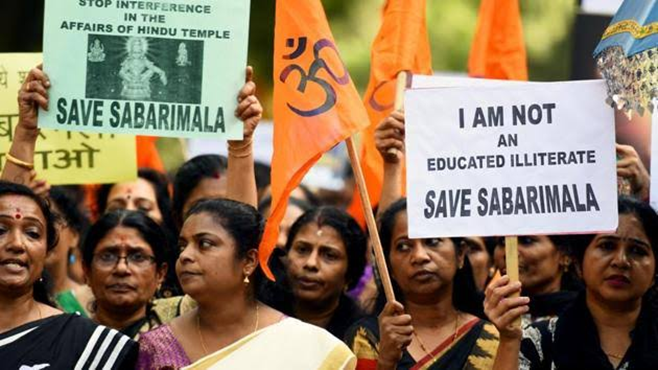
- Faith vs. Law: In a deeply religious society, legal mandates that contradict long-standing traditions often face massive public resistance, making them difficult to enforce on the ground.
- Polarization: Sparked mass protests in Kerala; critics viewed it as secular “encroachment” on traditional faith.
- Resistance: Massive implementation challenges led to 60+ review petitions, necessitating the current nine-judge bench.
4. The “Sabarimala Legacy”
- Broadened Review: Opened a “Pandora’s box,” leading the SC to examine similar issues in other faiths (e.g., Entry of women into Mosques, Parsi Fire Temples, and Female Genital Mutilation Dawoodi Bohra community).
- Substantive Equality: Shifted focus from “formal equality” to dismantling structural oppression within religious institutions.
Way Forward
1. Harmonious Construction
- Seek a “middle path” where Article 25 (Individual Rights) and Article 26 (Group Autonomy) coexist.
- Religious autonomy should be respected unless it violates the core of human dignity and equality.
2. Refining the ERP Doctrine
- Judicial Restraint: Shift focus from interpreting scriptures to evaluating if a practice causes harm or discrimination.
- Balanced Inquiry: Consider both ancient texts and the “living faith” of the current community to determine what is essential.
3. Substantive Equality
- Move beyond “formal equality” to dismantle structural patriarchy and historical exclusion within religious spaces.
- Ensure “custom” is not used as a legal shield for discriminatory practices.
4. Internal Reform & Legislative Action
- State Leadership: The State should drive social reform through legislation (as per Art. 25(2)) rather than relying solely on judicial mandates.
- Community Dialogue: Encourage internal reforms led by religious leaders to reduce social resistance and ensure sustainable change.
5. Defining Constitutional Morality
- The Nine-Judge Bench must provide an objective definition of “Constitutional Morality.”
- This creates a stable legal benchmark and prevents the term from being perceived as subjective judicial overreach.
Conclusion
While the Supreme Court pursues transformative justice, Hobbesian social contract theory warns that judicial intervention in deep-seated faith risks destabilizing the social order. Forcing secular reforms on religious “Leviathans” may undermine the communal stability that the state was originally contracted to protect.