
Context
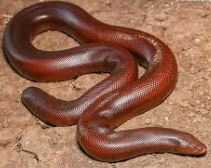
- Officials from the Hyderabad zonal unit of the Directorate of Revenue Intelligence (DRI) intercepted a suspect and seized two live Indian Red Sand Boa snakes during a decoy undercover operation in Warangal, Telangana. The individual was attempting to sell the reptiles in the grey/black market.
- This bust highlights the persistent threat of illegal wildlife trafficking in India and underscores the role of central economic intelligence agencies in combating non-fiscal environmental crimes.
About Red Sand Boa
- Scientific Name: Eryx johnii
- Common Names: Indian Sand Boa, John’s Sand Boa, Brown Sand Boa. In local parlance, it is often referred to as ‘Mandul’ or ‘Du-tondya’ (the one with two mouths).
- Physical Characteristics: It is a non-venomous, harmless snake primarily reddish-brown in color with a thick-set body.
- It is the largest of the sand boas in the world, capable of growing over 4 feet long.
- “Double-Headed” Appearance: It features a characteristically blunt, wedge-shaped tail that closely resembles its head. This serves as a defense mechanism to confuse predators.
- Behavior and Habitat: It is nocturnal (active at night) and fossorial (spends the majority of its time underground in loose sand or burrows).
- It is ovoviviparous, meaning embryos develop inside eggs that remain within the mother’s body until they are ready to hatch, resulting in live births.
- Geographical Distribution: Endemic to Iran, Pakistan, and India.
- In India, it is found throughout dry and arid regions. Notably, it is generally absent in the North-Eastern states.
- Ecological Significance: Often called the “farmer’s friend” because its primary diet consists of destructive rodents, bats, lizards, and occasionally other snakes, helping naturally regulate pest populations.
Conservation & Legal Status
- IUCN Red List: Near Threatened (NT)
- CITES: Appendix II (regulates its international commercial trade)
- Wildlife (Protection) Act, 1972: Scheduled under Schedule I (making its possession, trade, or hunting a punishable criminal offense).
About DRI
- The Directorate of Revenue Intelligence (DRI) is the apex anti-smuggling intelligence agency of India.
- It functions under the Central Board of Indirect Taxes and Customs (CBIC), Department of Revenue, Ministry of Finance.
- While its primary mandate is safeguarding economic frontiers (curbing trade frauds and duty evasions), it also acts as a frontline agency enforcing allied environmental laws like the Wildlife (Protection) Act to curb cross-border wildlife trafficking.
With reference to the Indian Red Sand Boa (Eryx johnii), consider the following statements:
1. It is a non-venomous snake known for its blunt tail that resembles its head.
2. It is an oviparous species that lays eggs outside the body.
3. It is listed under Appendix II of CITES.
4. In India, it is commonly found in the North-Eastern states.
Which of the statements given above are correct?
(a) 1 and 3 only
(b) 2 and 4 only
(c) 1, 2 and 3 only
(d) 1, 3 and 4 only
Answer:
(a) 1 and 3 only
Explanation:
• Statement 1 is Correct — The Indian Red Sand Boa is a non-venomous snake with a tail resembling its head, giving a “double-headed” appearance.
• Statement 2 is Incorrect — It is ovoviviparous, meaning eggs hatch inside the mother’s body, resulting in live births.
• Statement 3 is Correct — It is listed under CITES Appendix II.
• Statement 4 is Incorrect — It is generally absent in the North-Eastern states of India.