
Context
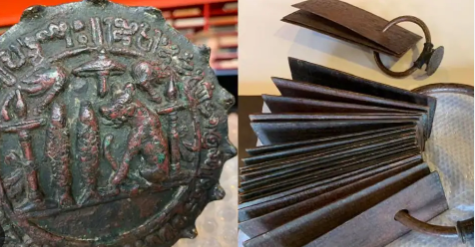
- Recently, the Leiden University Library in the Netherlands formally repatriated the 11th-century Chola-era Anaimangalam Copper Plates (popularly known as the Leiden Plates) to the Government of India.
- These plates were removed from Nagapattinam without indigenous consent during Dutch colonial rule (VOC control) in the 18th century, eventually entering Leiden University’s collection in 1862.
1. Epigraphical Features of the Leiden (Anaimangalam) Plates
- Composition: The artifact consists of two distinct sets:
- The Larger Leiden Plates: A massive set of 21 large copper sheets bound together by a heavy bronze ring carrying the royal Chola seal.
- The Smaller Leiden Plates: A set of 3 smaller copper sheets bound by a ring featuring the royal seal of a later king, Kulottunga Chola I (reigned 1070–1120 CE), recording subsequent land additions.
- Bilingual Framework:
- Sanskrit Section (5 Plates): Written in the Grantha script. It traces the mythical, divine solar lineage (Suryavamsha) and historical genealogy of the Chola monarchs.
- Tamil Section (16 Plates): Written in the local Tamil script, outlining the granular details of local administration, land boundaries, tax exemptions, and executive execution.
- The Royal Insignia (Chola Seal): The binding ring contains the standard royal herald of imperial supremacy over rival dynasties:
- A central Tiger (the dynastic emblem of the Cholas).
- Two Fish (representing the subjugation of the Pandyas).
- A Bow (representing the subjugation of the Cheras).
- Complemented by fly-whisks (chamaras), a royal parasol, and a swastika.
2. Religious Pluralism & Socio-Economic History
The core value of the Leiden plates lies in what they reveal about the socio-political fabric of early medieval India:
- Socio-Religious Harmony: Though the Chola emperors were devout Shaivite Hindus (worshipers of Lord Shiva), the plates document state patronization of heterodox faiths.
- The Grant Details: The plates formalize a Pallichchandam (a specific tax-exempt land revenue grant dedicated explicitly to non-Hindu institutions like Jain basadis or Buddhist monasteries).
- The Beneficiary: The land revenue of the entire village of Anaimangalam was granted to sustain the Chudamani Vihara (also known as the Chulamanivarma Vihara), a magnificent Buddhist monastery constructed in the international port town of Nagapattinam.
- Trans-Maritime Geopolitics: The vihara was built by King Sri Mara Vijayottungavarman of the Srivijaya Kingdom (spanning Sumatra, Java, and the Indonesian archipelago). This proves the deep diplomatic, trade, and cultural networks bridging South India and Southeast Asia.
4. Core Personalities Implicated in the Inscription
- Raja Raja Chola I
- Rajendra Chola I
- Kulottunga Chola I
A. Raja Raja Chola I (r. 985–1014 CE)
- Cultural Contribution: Built the architectural marvel Brihadisvara Temple (Peruvudaiyar Kovil) at Thanjavur, dedicated to Lord Shiva. It is a pinnacle of Dravidian architecture and a UNESCO World Heritage site.
- Initiated a massive land survey project to streamline agrarian revenue and local administration.
B. Rajendra Chola I (r. 1012–1044 CE)
- Cultural & Military Legacy: Known for his aggressive maritime expeditions, conquering Srivijaya (Southeast Asia) to safeguard Chola trade routes.
- Marched northward to the Ganga river, earned the title Gangaikonda Chola, and established a new capital city: Gangaikondacholapuram.
- Constructed the vast western artificial lake/reservoir called Chola Gangam to upgrade regional irrigation.
C. Kulottunga Chola I (1070–1122 CE)
- Contribution: Kulottunga was a prolific builder and patron of the arts, integrating new elements into Dravidian temple architecture.
- Chidambaram Nataraja Temple: Kulottunga I and his son famously expanded the sprawling complex of the Chidambaram Nataraja Temple, increasing its footprint multiple times and renovating its halls.
- Kulottunga I is immortalized in Tamil epigraphy and literature with the title “Sungam Tavirtta Chola” (or Shungamataravita), meaning “the Chola who abolished tolls/customs duties”.
With reference to the Anaimangalam Copper Plates (Leiden Plates), consider the following statements:
1. The plates record a tax-exempt land grant to a Buddhist monastery at Nagapattinam.
2. The Sanskrit section of the plates was written in the Brahmi script.
Which of the statements given above is/are correct?
(a) 1 only
(b) 2 only
(c) Both 1 and 2
(d) Neither 1 nor 2
Answer: A
Explanation:
•  Statement 1 is Correct: The Anaimangalam (Leiden) Plates record a Pallichchandam (tax-exempt land grant) given to the Chudamani Vihara, a Buddhist monastery located at Nagapattinam.
•  Statement 2 is Incorrect: The Sanskrit portion of the plates was written in the Grantha script, not the Brahmi script.