
Context
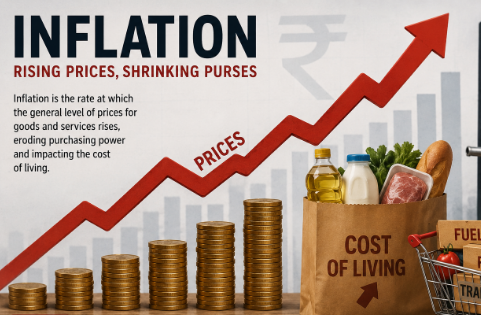
- Recent economic data indicates a significant divergence between retail and wholesale inflation in India. While retail inflation (CPI) reached a 13-month high of 3.48% in April, wholesale inflation (WPI) surged to 8.3%.
- This trend is primarily driven by global geopolitical conflicts leading to soaring fuel and energy costs, alongside rising food prices. The situation presents a complex challenge for both fiscal policy (government) and monetary policy (RBI) to maintain the inflation tolerance band of 2%–6%.
1. Understanding Inflation Indices: CPI vs. WPI
Inflation in India is primarily measured using two different indices that track price changes at different stages of the supply chain.
A. Consumer Price Index (CPI)
- Definition: Measures the average change over time in the prices paid by ultimate consumers for a basket of consumer goods and services.
- Base Year: 2024 (Current).
- Released by: National Statistical Office (NSO), Ministry of Statistics and Programme Implementation.
- Key Components: Food and beverages (36.75%), fuel and light, housing, clothing, and miscellaneous services (education, health, etc.).
- Significance: It is the primary tool used by the Reserve Bank of India (RBI) for monetary policy targeting.
B. Wholesale Price Index (WPI)
- Definition: Measures the changes in the prices of goods sold and traded in bulk by wholesale entities to other businesses.
- Base Year: 2011-12.
- Released by: Office of Economic Adviser, Ministry of Commerce and Industry.
- Key Components: Manufactured products (highest weightage), Primary Articles (food, non-food), and Fuel & Power.
- Note: WPI does not include services.
2. Key Differences at a Glance
| Feature | Wholesale Price Index (WPI) | Consumer Price Index (CPI) |
| Primary Focus | Goods at the wholesale level (B2B) | Goods and services at retail level (B2C) |
| Prices paid by | Manufacturers and wholesalers | Final consumers |
| Services Included | No | Yes |
| Policy Use | Tracks supply-side pressures | Used for Inflation Targeting by RBI |
| Weights | Manufactured goods have highest weight | Food and beverages have highest weight |
3. Factors behind Inflation and response to curve inflation
I. Cost-Push Factors
- Energy Prices: A surge in petroleum and natural gas prices (67.2%) due to international conflict acts as a major supply-side shock.
- Imported Inflation: As the Rupee depreciates against the Dollar, the cost of importing essential commodities (like crude oil and gold) increases, further fueling domestic inflation.
II. Fiscal and Monetary Response
- Fiscal Measures: The government has increased import duties on gold and silver to discourage “safe-haven” investments and support the Rupee. There are also appeals for reduced discretionary spending.
- Monetary Measures: The RBI is mandated to keep CPI within the 4% (+/- 2%) range. With inflation “bursting at the seams,” the central bank may be forced to tighten monetary policy (e.g., increasing the Repo Rate) to reduce liquidity and curb demand.
4. Socio-Economic Impact
- Impact on Consumption: Rising costs of essential items like commercial LPG cylinders directly affect migrant labor and low-income households, potentially dampening overall consumption demand in the economy.
- Sectoral Hits: The hospitality and accommodation sectors are witnessing sharper price increases due to the cascading effect of fuel costs.
5. Essentials Concepts to Remember
- Headline Inflation: The total inflation within an economy, including commodities such as food and energy prices (which are volatile).
- Core Inflation: Headline inflation minus the volatile food and fuel components.
- Disinflation: Disinflation is a temporary slowing in the rate of price inflation, where prices continue to rise but at a slower pace.
- Stagflation: Stagflation is an economic condition defined by the simultaneous occurrence of slow economic growth, high unemployment, and rising prices (high inflation).
Consider the following statements regarding inflation indices in India:
1. The Consumer Price Index (CPI) includes services such as education and healthcare, whereas the Wholesale Price Index (WPI) does not include services.
2. The Reserve Bank of India uses WPI as the primary benchmark for inflation targeting under monetary policy.
3. In the CPI basket, food and beverages have the highest weightage, whereas manufactured products have the highest weightage in WPI.
Which of the statements given above are correct?
(a) 1 and 3 only
(b) 2 and 3 only
(c) 1 and 2 only
(d) 1, 2 and 3
Answer:
(a) 1 and 3 only
Explanation:
• Statement 1 is correct: CPI includes both goods and services such as education, health, and housing, whereas WPI tracks only goods traded at the wholesale level.
• Statement 2 is incorrect: The RBI uses CPI, not WPI, as the primary benchmark for inflation targeting.
• Statement 3 is correct: Food and beverages carry the highest weight in CPI, while manufactured products have the highest weight in WPI.