
Context
- Recently, the Little Rann of Kutch in Gujarat has been experiencing severe heatwave conditions, with temperatures frequently crossing 45 degree and at times nearing 48 degree. Nearly 50,000 salt workers are enduring these extreme conditions in shade-less salt pans without electricity while harvesting salt that fulfills around three-fourths of India’s salt demand, exposing them to serious health risks.
1. Physical Geography & Formation
- The Rann of Kutch is a vast salt marsh region in the northwestern Indian subcontinent, spread across Gujarat’s Kutch district and parts of Pakistan’s Sindh province. It is geographically divided into the Great Rann and the Little Rann of Kutch.
- It is one of the largest seasonal salt marshes in the world, known for its unique ecosystem consisting of saline desert plains, grasslands, thorn scrub forests, and wetlands.
- Origin: Geologically, it was once a shallow arm of the Arabian Sea. Ongoing tectonic uplift and the deposition of sediments by rivers (like the Luni) transformed it into a closed basin.
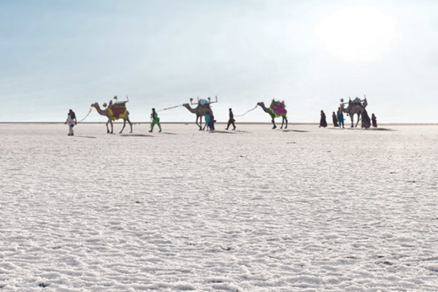
- Seasonal Dynamics: During the monsoon, the area is inundated with shallow water (a mix of seawater and freshwater). As the water evaporates during the grueling summer, it leaves behind a thick crust of salt, forming the famous “White Desert.”
2. History and Culture
- The Rann of Kutch has a rich historical and cultural heritage, with evidence of Neolithic and Indus Valley Civilization settlements such as Dholavira, the largest Harappan site in India.
- Historians believe the region was once a navigable archipelago supporting maritime trade. It later became part of the Maurya Empire and Gupta Empire.
- During British rule, Mahatma Gandhi’s salt protest highlighted the region’s significance, while today the Rann Utsav celebrates its vibrant local art and culture.
- The Rann of Kutch Biosphere Reserve is inhabited by indigenous communities such as the Rabari, Koli, Bajanias, Kutchis, Gujjars, and Bharvads.
- Among them, the Rabari tribe is well known for its pastoral lifestyle, camel herding, colorful attire, and traditional embroidery, while all these communities possess deep ecological knowledge of the region’s harsh environment.
3. Ecological Dimensions & Wildlife
- The Rann of Kutch is the only large flooded grassland region in the Indomalayan realm, supporting diverse ecosystems such as mangroves and desert vegetation due to its unique location between the desert and the sea.
- The Rann of Kutch hosts around 50 mammal species, including herbivores like the Indian wild ass, chinkara, nilgai, and blackbuck, along with predators such as the Indian wolf, striped hyena, desert wildcat, and caracal. Notably, the Indian wild ass is endemic to this region.
- Banni Grasslands: One of Asia’s largest and finest tropical grasslands. It is home to the Maldhari tribes and the unique Banni buffalo breed, which is adapted to grazing at night to avoid the daytime heat.
- The Concept of “Bets”: During monsoon, the Rann gets flooded for a period of about one month and is dotted with about 74 elevated plateaus or islands, locally called ‘bets’. These bets are covered with grass and feed the population of around 2,100 animals.
- Important rivers draining into the Rann:
- Luni
- Banas
- Saraswati
- Rupen
4. Conservation and protected areas
- In 2008, the Rann of Kutch was designated as a biosphere reserve to conserve its unique biodiversity and promote sustainable development.
- The Kachchh Biosphere Reserve is mainly composed of two major ecosystems — the Great Rann of Kachchh (GRK) and the Little Rann of Kachchh (LRK) — covering an area of 12,454 km².
- It includes the Kachchh Desert Sanctuary (in GRK) and the Wild Ass Sanctuary (in LRK).
| Indian Wild Ass Sanctuary (LRK): The Little Rann is the only home to the Indian Wild Ass (Khur), listed as Near Threatened on the IUCN Red List. They are known for their stamina and ability to survive in high temperatures and saline environments. Flamingo City: Located in the Great Rann, this is the only known concentrated nesting ground of Greater Flamingos in India. Kutch Bustard Sanctuary: Home to the Great Indian Bustard (Critically Endangered), focusing on the grasslands (Banni) adjacent to the salt flats. |
5. The Economic Dimension: Agariyas and Salt
- Salt Production: Gujarat accounts for roughly 75% of India’s salt production, a significant portion of which comes from the Little Rann.
- The Agariyas: This traditional salt-farming community lives in the LRK for eight months of the year. They endure the extreme 45°C+ heat to extract Karkach salt (crystals) from brine pumped from underground wells.
- Environmental Challenge: The overlap between salt pans and the Wild Ass Sanctuary often leads to debates regarding conservation vs. livelihood.
6. Strategic and Political Importance
- International Border: The Great Rann of Kutch forms part of the international border between India and Pakistan.
- Sir Creek Dispute: A 96-km long tidal estuary in the uninhabited marshlands. The dispute lies in the interpretation of the boundary line (mid-channel vs. eastern bank), which impacts the Exclusive Economic Zone (EEZ) and maritime resources (petroleum and gas).
Consider the following statements regarding the Rann of Kutch:
1. The Rann of Kutch was once a shallow extension of the Arabian Sea.
2. The Indian Wild Ass is endemic to the Little Rann of Kutch.
3. Flamingo City in the Great Rann is the only concentrated nesting ground of Greater Flamingos in India.
Which of the statements given above are correct?
(a) 1 and 2 only
(b) 2 and 3 only
(c) 1 and 3 only
(d) 1, 2 and 3
Answer:
(d) 1, 2 and 3
Explanation:
• Statement 1 is correct: Geological evidence suggests that the Rann was once a shallow arm of the Arabian Sea.
• Statement 2 is correct: The Indian Wild Ass (Khur) is endemic to the Little Rann of Kutch.
• Statement 3 is correct: Flamingo City in the Great Rann is the only known concentrated nesting ground of Greater Flamingos in India.