
Context
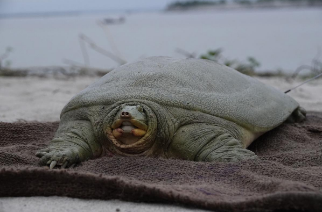
- Recently, coinciding with the observation of Endangered Species Day on May 15, 2026, wildlife biologists successfully released India’s first satellite-tagged Ganges Softshell Turtle (Nilssonia gangetica) into the Kaziranga National Park and Tiger Reserve.
- The initiative—jointly conducted by the Wildlife Institute of India (WII), the Assam Forest Department, and funded by the National Geographic Society—marks a shift from passive observation to active bio-telemetry. Tracking this freshwater apex predator along the northern banks of the Brahmaputra River will provide data on its migratory pathways, breeding zones, and micro-habitat usage.
1. About Active bio-telemetry
Active bio-telemetry is a wildlife tracking technique in which a transmitter attached to an animal continuously sends real-time location and movement data to satellites, radio receivers, or GPS systems.
It helps scientists monitor:
- Migration patterns
- Habitat use
- Behaviour and survival
- Threats from poaching or habitat loss
In conservation, active bio-telemetry is widely used for tracking endangered species such as turtles, tigers, elephants, and birds.
2. The Species Profile – Ganges Softshell Turtle
- Taxonomy & Identification: Locally known as the Indian Softshell Turtle (Nilssonia gangetica), it is a large freshwater reptile. It is distinguished from other riverine turtles by its prominent arrowhead-shaped markings on the top of its head, a compressed carapace that aids in fast swimming, and a distinctive tube-like snout used as an underwater snorkel.
- Geographical Distribution: Endemic to the northern and eastern regions of the Indian subcontinent. It is primarily found across the major mud-bottomed river networks of the Indus, Ganga, Yamuna, Mahanadi, and Brahmaputra river basins.
- Ecological Role: Operating as an apex riverine predator and scavenger, it fulfills a vital ecosystem cleanup service by feeding on carrion, dead organic matter, and fish, directly checking the bacterial degradation of river ecosystems.
- Conservation & Legal Status:
- IUCN Red List: Endangered
- Wildlife (Protection) Act, 1972: Schedule I (afforded the highest tier of legal protection alongside the Royal Bengal Tiger).
- CITES: Appendix I
- Major Threats: Rampant illegal poaching networks targeting its meat for domestic black markets, habitat loss driven by unauthorized riverbed sand mining, and mortality caused by heavy monsoonal gill-net fishing.
3. About Kaziranga National Park & Tiger Reserve
- Geographical Matrix: Situated partly across the Golaghat and Nagaon districts of Assam, the park occupies the dynamic floodplains of the Brahmaputra River Valley. It is bounded by the Brahmaputra river channel along the north and the Karbi Anglong Hills to its immediate south.
- Hydro-Geomorphic Features: The landscape is a complex mosaic of wet alluvial tall elephant grasslands, tropical moist deciduous forests, and numerous shallow oxbow lakes locally termed Beels. The Diphlu River flows directly through the core area of the sanctuary.
- International Designations: Designated as a UNESCO World Heritage Site in 1985.
- Identified as an Important Bird Area (IBA) by BirdLife International.
- Recognized as a core Tiger Reserve since 2006.
- The Big Five Richness: While famous globally for holding over two-thirds of the world’s population of the Great Indian One-Horned Rhinoceros, its “Big Five” megafauna include the Asian Elephant, Royal Bengal Tiger, Wild Water Buffalo, and Swamp Deer (Barasingha).
- Turtle Conservation Hub: As per the Wildlife Institute of India (WII), Assam serves as a top global priority zone for freshwater chelonian conservation. Out of the eight distinct species of softshell turtles found across India, five species breed naturally within the Kaziranga ecosystem alone.
With reference to Active Bio-telemetry, consider the following statements:
1. It enables real-time tracking of animal movement through transmitters.
2. It is mainly used for tracking only marine species.
3. It helps scientists study migration patterns and habitat use.
Which of the statements given above is/are correct?
(a) 1 and 3 only
(b) 2 only
(c) 1, 2 and 3
(d) 3 only
Answer: [A] 1 and 3 only
Explanation:
• Statement 1 is correct: Active bio-telemetry uses transmitters attached to animals to send real-time movement and location data through satellites, GPS, or radio systems.
• Statement 2 is incorrect: It is not limited to marine species. It is widely used for terrestrial, freshwater, and aerial wildlife such as turtles, tigers, elephants, and birds.
• Statement 3 is correct: Scientists use this technique to study migration routes, habitat use, behaviour, breeding patterns, and survival of species.