
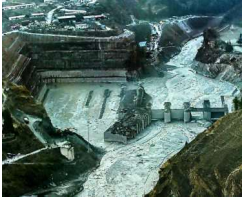
Context
- Recently, the Union Government informed the Supreme Court that no new hydropower projects will be allowed in the upper Ganga basin in Uttarakhand due to ecological and seismic concerns.
- Only seven already commissioned or nearly completed projects will continue, citing the harmful cumulative impact of “bumper-to-bumper” dams in the fragile Himalayan region.
1. Ecological and Legal Background
- Origin: The legal battle stems from the June 2013 Kedarnath disaster. The Supreme Court directed the Environment Ministry to evaluate if hydroelectric projects amplified the tragedy.
- Expert Committees:
- Expert Body-I (Ravi Chopra Committee – 2014): Concluded that 23 out of 24 examined projects would severely impact the Alaknanda and Bhagirathi river basins.
- Vinod Tare Committee (IIT-Kanpur): Flawed design/siting of multiple proposed projects.
- Expert Body-II (B.P. Das Committee – 2020): Took a more permissive view (recommending 26 projects), but the Centre ultimately accepted only seven.
- Geographical Fragility Factor: The decision is driven by extreme vulnerability to landslides, flash floods, Glacial Lake Outburst Floods (GLOFs).
2. Hydropower Projects and Associated Rivers
| Hydropower Project | Associated River / Basin |
| Tehri Pumped-Storage Project (1,000 MW) | Bhagirathi River |
| Tapovan Vishnugad (520 MW) | Dhauliganga River |
| Vishnugad Pipalkoti (444 MW) | Alaknanda River |
| Singoli Bhatwari (99 MW) | Mandakini River |
| Phata Byung (76 MW) | Mandakini River |
| Madhyamaheshwar (15 MW) | Madhyamaheshwar Ganga (Tributary of Mandakini) |
| Kailganga-II (6 MW) | Kaliganga River (Tributary of Mandakini) |
With reference to the recent decision on hydropower projects in the upper Ganga basin, consider the following statements:
1. The Union Government informed the Supreme Court that no new hydropower projects will be allowed in the upper Ganga basin of Uttarakhand.
2. The Ravi Chopra Committee recommended that most examined hydropower projects would severely affect the Alaknanda and Bhagirathi basins.
3. The decision was mainly driven by concerns related to cyclones and coastal erosion in the Himalayan region.
Which of the statements given above is/are correct?
(a) 1 and 2 only
(b) 2 and 3 only
(c) 1 and 3 only
(d) 1, 2 and 3
Answer:
(a) 1 and 2 only
Explanation:
• Statement 1 is correct: The Centre informed the Supreme Court that no new hydropower projects will be permitted in the upper Ganga basin.
• Statement 2 is correct: The Ravi Chopra Committee concluded that 23 of the 24 examined projects would severely impact the Alaknanda and Bhagirathi river basins.
• Statement 3 is incorrect: The decision was driven by risks such as landslides, flash floods, earthquakes, and Glacial Lake Outburst Floods (GLOFs), not cyclones or coastal erosion.