
Context
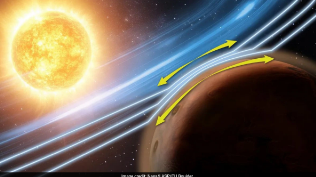
- Recently, a study published in Nature Communications found evidence of a rare space phenomenon called the “Zwan-Wolf effect” on Mars. Using data from MAVEN, scientists discovered that this effect changes how solar wind interacts with planets that do not have a strong global magnetic field, like Mars.
- In December 2023, a powerful solar storm called a Coronal Mass Ejection (CME) hit Mars. This created strong magnetic disturbances in Mars’s weak magnetic field, helping scientists detect the rare Zwan-Wolf effect, which is usually too weak to observe.
1. What is the Zwan-Wolf Effect?
- The Zwan-Wolf effect has been observed on Mars. This effect occurs when particles in the ionosphere are pushed into specific regions by the solar wind.
- How does it Happen?
- Compression at Boundaries: As this magnetized solar wind approaches the magnetic field or the plasma boundary of a planet, it undergoes severe compression near the planet’s magnetic boundaries.
- Pressure Gradient Setup: This compression creates a steep pressure gradient along the magnetic field lines.
- The Diverter Mechanism: This pressure gradient acts as a “stream diverter,” squeezing and pushing the charged particles along the magnetic field lines and forcing them away from the central stream.
- The Net Result: Consequently, closer to the stream boundary, an area forms with a significantly lower density of charged particles. This is called the Zwan –Wolf Effect.
- On Earth, this mechanism deflects much of the solar wind and protects us from the Sun’s constant bombardment.
2. About the MAVEN Mission
- Agency: Launched by NASA in 2013.
- Objective: To explore Mars’s upper atmosphere, ionosphere, and its specific interactions with the Sun and solar wind.
Some Important Mars Mission
| Space Mission | Country / Space Agency |
| Viking 1 | United States / NASA |
| Mars Orbiter Mission (MOM) / Mangalyaan | India / ISRO |
| Perseverance (Mars 2020) | United States / NASA |
3. Understanding Coronal Mass Ejections (CMEs)
- A Coronal Mass ejection (CME) is a massive expulsion of magnetized plasma and solar wind from the Sun’s corona into space.
- When they strike a planet, they cause severe space weather events, triggering geomagnetic storms on Earth, and can acutely alter ionospheric densities on weaker-magnetized bodies like Mars.
- Impacts on Earth and Technology
- Geomagnetic Storms: CMEs can disrupt power grids and damage electrical systems.
- Communication & Navigation: They disturb the ionosphere, affecting radio communication and GPS signals.
- Space Assets: Satellites and astronauts face harmful radiation exposure.
- Auroras: Charged particles interacting with Earth’s atmosphere create Northern and Southern Lights.
MCQ
“With reference to the ‘Zwan-Wolf effect’, which is sometimes seen in the news, it is primarily associated with:”
(a) Black hole radiation
(b) Solar wind interaction with planetary magnetic boundaries
(c) Formation of asteroids
(d) Lunar eclipses
Answer: B
Explanation:
It describes the phenomenon where electrically charged particles in a planet's ionosphere are squeezed and compressed along magnetic structures, known as magnetic flux tubes, as a result of pressure gradients created by the solar wind