
Context
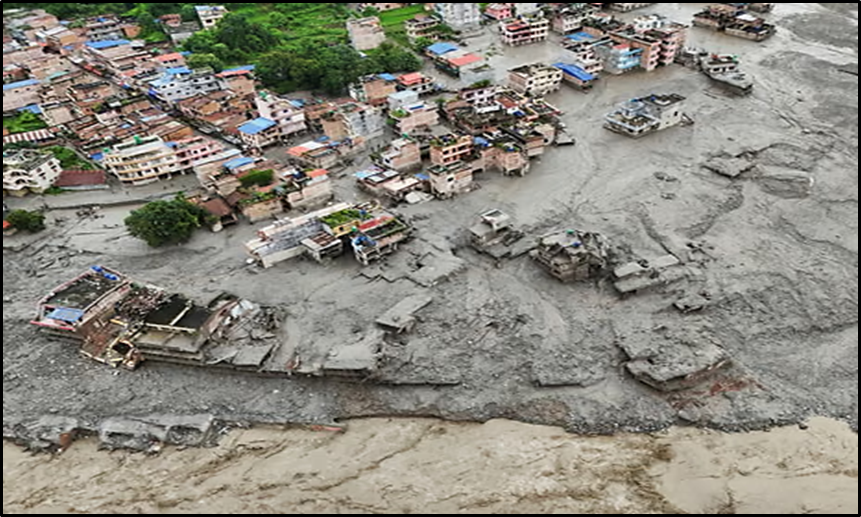
Recently, a massive flash flood along Nepal’s Bhotekoshi River killed over a hundred people and left hundreds missing, following a rock-and-ice landslide along the Nepal–China border that triggered a debris-laden flood.
The disaster caused extensive damage to villages, bridges and infrastructure, while a possible minor earthquake and ice avalanche are being investigated as triggers through satellite imagery.
Location of the Flash Flood
- Mainly Rasuwa district, around the Bhotekoshi River and Rasuwagadhi near the Nepal–China border.
About FLASH FLOODS
Flash floods are sudden and highly localised floods that develop within a few hours, generally when intense rainfall produces runoff faster than the soil, rivers and drainage systems can absorb or carry it.
Major Causes
- Cloudbursts & extreme rainfall – sudden, very high-volume runoff; IMD defines a cloudburst as ≥100 mm rainfall in about 1 hour over a small area.
- Steep slopes & narrow valleys – rapidly concentrate and accelerate water flow, especially in mountainous regions.
- Rapid snow/glacier melt – sudden increase in river discharge, particularly when combined with heavy rainfall.
- Dam/embankment failure – sudden release of a large volume of stored water.
- Deforestation & urbanisation – reduce infiltration and increase surface runoff.
- Landslides & ice/rock avalanches – can suddenly introduce huge volumes of debris, ice and sediment into river channels, triggering destructive debris-laden flash floods, as recently witnessed in the Bhotekoshi River, Nepal.
Why are they highly destructive?
Steep terrain + intense runoff + saturated/impermeable surfaces can cause water levels to rise extremely rapidly. Siltation, landslides and blocked river channels may temporarily obstruct flow and then trigger sudden downstream flooding.
Flash floods generally have less than 6 hours between the causative rainfall/event and the peak flooding, leaving very little time for warning and evacuation.
Geomorphological Trigger for Bhotekoshi River flash flood
- A rock-and-ice landslide/ice avalanche along the Himalayan Nepal–China border introduced large amounts of ice, rock and sediment into the Bhotekoshi River system.
- The sudden debris influx generated a debris-laden flash flood, significantly increasing its destructive potential downstream.
Geographical Susceptibility of Bhotekoshi River
- The Bhotekoshi River flows through steep, tectonically active Himalayan terrain, making the valley highly susceptible to landslides, rockfalls and sudden sediment influxes.
- A preceding minor earthquake and ice avalanche are being investigated as possible triggers, with satellite imagery being used to establish the precise sequence of events.
Impact of the Disaster
- At least 157 people were reported dead in Nepal, with hundreds missing. The affected area included villages, roads, bridges and hydropower infrastructure.
- Indians affected: More than 130 Indians were among those reported missing in the initial reports, including people travelling in the border/pilgrimage region.
- Cross-border dimension: The disaster also affected Tibet’s Gyirong County, where Chinese authorities reported deaths and people missing.
India’s response
- Honourable Prime Minister of India spoke to the Prime Minister of Nepal and offered India’s assistance; India also began sending relief material.
About the Bhotekoshi River
- Origin: Rises in Tibet (China) and enters Nepal through the Himalayas.
- River System: A major tributary of the Sunkoshi River, forming part of the Koshi river system.
- Course: Flows through the steep, tectonically active Himalayan terrain of central Nepal.
- Significance: Known for its high hydropower potential and susceptibility to landslides and flash floods.
| Important CTC from this article for UPSC Trans-boundary River Systems Flash Floods |
Q. Consider the following statements:
I. The Bhotekoshi River eventually enters India as the Gandak River.
II. The flood was officially confirmed by Nepali authorities to be a classic Glacial Lake Outburst Flood (GLOF).
III. Rainfall was recorded on the Tibetan side of the border before the flood, while the Nepali side received no rain.
Which of the statements given above is/are correct?
(a) I and II only
(b) I and III only
(c) II and III only
(d) I, II and III
Answer: (b) I and III only
Explanation
Statement I is Correct: The Bhotekoshi River, originating in Tibet, joins Nepal's Trishuli River and eventually enters India as the Gandak River.
Statement II is Incorrect: Nepali authorities cited a suspected rock-and-ice landslide as the trigger; the disaster was not officially confirmed as a classic GLOF, and the exact sequence remained under verification.
Statement III is Correct: Nepali authorities noted no rainfall in the affected region before the flood, while rainfall was recorded on the Tibetan side of the border.