
Context
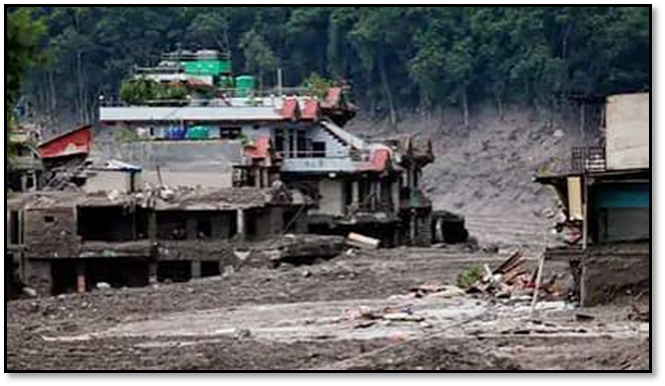
- Recently, a devastating flash flood struck Nepal’s Rasuwa district along the Bhote Koshi River after a sudden surge from Tibet, has highlighted the growing vulnerability of the Himalayan region to glacier-related hazards.
What Triggered the Flood?
- The event was not primarily associated with heavy rainfall in the affected Rasuwa area.
- Satellite observations indicated an upstream blockage and temporary accumulation of water.
- The sudden release carried enormous quantities of mud, rocks, ice and debris, greatly increasing the destructive power of the flood.
- Authorities are still examining whether the event should technically be classified as a Glacial Lake Outburst Flood (GLOF) or an ice-avalanche/landslide-induced outburst flood.
- Ice/rock avalanche → River blockage → Temporary natural lake → Sudden breach → Flash flood + debris flow
Why is This Important?
1. Himalayan Cryosphere
- The Himalayan cryosphere consists of glaciers, snow, ice and permafrost and acts as an important component of the region’s water system.
- Rising temperatures can contribute to glacier instability, snow/ice melt and changes in glacial lakes, increasing certain types of mountain hazards.
2. Glacial Lake Outburst Flood (GLOF)
- A Glacial Lake Outburst Flood (GLOF) occurs when a glacial lake suddenly releases a large volume of water.
- Possible triggers include:
- Ice or rock avalanche entering a lake.
- Failure of a moraine or ice dam.
- Rapid accumulation of meltwater.
- Landslides or earthquakes.
3. Debris-Dammed Lake vs Glacial Lake
| Feature | Debris-Dammed Lake | Glacial Lake |
| Formation | River blocked by landslide/ice-rock debris | Associated with glacial processes |
| Dam | Rock, soil, ice and debris | Often moraine/ice |
| Major Risk | Sudden dam failure | GLOF |
Why Are Himalayan Valleys Highly Vulnerable?
- Steep gradients allow flood waves to travel rapidly downstream.
- Young and tectonically active terrain is prone to landslides and slope failure.
- Glaciers, unstable slopes and river valleys coexist within a limited area.
- Mountain settlements and infrastructure are often concentrated along narrow river valleys.
- Damage to roads and bridges can severely hamper rescue operations.
| Important CTC from this article for UPSC: Glacial Lake Outburst Flood (GLOF) |
Q. With reference to flash floods in the Himalayan region, consider the following statements:
1. A Glacial Lake Outburst Flood (GLOF) involves the sudden release of water stored in a glacial lake.
2. An ice or rock avalanche can trigger the sudden release of water from a glacial lake.
3. Every flash flood occurring in the Himalayan region is necessarily a GLOF.
Which of the statements given above is/are correct?
(a) 1 and 2 only
(b) 2 and 3 only
(c) 1 and 3 only
(d) 1, 2 and 3
Answer: (a) 1 and 2 only
• Statement 1 – Correct: GLOF refers to the sudden release of water from a glacial lake, producing a potentially destructive flood.
• Statement 2 – Correct: Ice/rock avalanches can enter a glacial lake, displace water and trigger an outburst.
• Statement 3 – Incorrect: Himalayan flash floods can also result from cloudbursts, intense rainfall, landslides, or natural river blockages; therefore, every flash flood is not a GLOF.