
Context
- With rising summer temperatures and heightened awareness around skin health, understanding the science behind Sun Protection Factor (SPF), ultraviolet radiation types (UVA vs. UVB), and the efficacy of dermatological blocks is crucial for health and scientific literacy.
Key Concepts & Technical Details
1. Ultraviolet (UV) Radiation Types & Impact
- UVB Radiation: This is the primary component of sunlight responsible for sunburns and skin redness (erythema). SPF values strictly measure protection against UVB radiation only.
- UVA Radiation: This type penetrates the skin more deeply than UVB. It is strongly linked to pigmentation, photoageing, wrinkles, and loss of skin elasticity.
2. What is SPF (Sun Protection Factor)?
- Definition: It is a measure of how much ultraviolet exposure is needed to cause minimal redness (erythema) on sunscreen-applied skin compared to unprotected skin.
- Mathematical Concept: If a sunscreen is rated SPF 30, it theoretically means the amount of UV exposure required to cause minimal erythema is 30 times higher than on unprotected skin.
- Non-Linear Protection: One of the most common misconceptions is that SPF protection increases linearly. Protection gains actually become progressively smaller at higher SPF values:
- SPF 30 blocks about 95% to 97% of UVB radiation.
- SPF 50 blocks roughly 97% to 98% of UVB radiation.
- SPF 80 blocks close to 99% of UVB radiation.
- Takeaway: The difference between SPF 30 and SPF 50 is small (roughly 1 to 2 percentage points), meaning a higher number does not automatically mean vastly superior protection.
4. Types of Sunscreen
- Mineral (Physical) Sunscreens: Contain inorganic ingredients such as zinc oxide and/or titanium dioxide. They mainly absorb UV rays and also provide protection by reflecting and scattering some UV radiation.
- Chemical (Organic) Sunscreens: Contain organic UV-filtering molecules that protect the skin primarily by absorbing UV rays. Some particulate organic filters can also reflect and scatter a small amount of UV light.
- Hybrid Sunscreens: Combine both mineral (inorganic) and chemical (organic) UV filters to provide broad-spectrum sun protection.
5. About UV Radiation
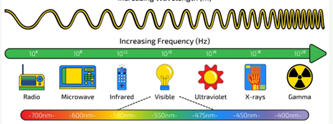
- Ultraviolet (UV) radiation is a form of electromagnetic radiation emitted mainly by the Sun.
- It has wavelengths shorter than visible light but longer than X-rays.
- UV radiation is invisible to the human eye.
- Wavelength range: 100–400 nanometers (nm).
- Classification of UV Radiation:
1. UV-A (315–400 nm)
- Longest wavelength and lowest energy among UV rays.
- Makes up about 95% of UV radiation reaching Earth.
- Penetrates deep into the skin, contributing to skin aging and long-term damage.
2. UV-B (280–315 nm)
- Medium wavelength and higher energy UV radiation.
- Partially absorbed by the ozone layer.
- Causes sunburn, DNA damage, and increases skin cancer risk.
- Also helps in vitamin D synthesis in humans.
3. UV-C (100–280 nm)
- Shortest wavelength and highest energy UV radiation.
- Extremely harmful to living organisms.
- Almost completely absorbed by atmospheric oxygen and ozone, so it rarely reaches Earth’s surface.
- Commonly used for water purification, air sterilization, and medical disinfection.
· Sources of UV Radiation
· Natural Sources
- The Sun (primary source)
- Stars and other celestial bodies
· Artificial Sources
- UV lamps
- Welding torches
- Mercury vapor lamps
- Tanning beds
- Germicidal lamps
Which of the following statements correctly distinguishes mineral sunscreens from chemical sunscreens?
(a) Mineral sunscreens contain only organic molecules.
(b) Chemical sunscreens work exclusively through reflection of UV rays.
(c) Mineral sunscreens commonly use zinc oxide and titanium dioxide as active ingredients.
(d) Hybrid sunscreens contain only inorganic UV filters.
Answer: C
Explanation:
• (a) Incorrect: Mineral sunscreens contain inorganic compounds, not organic molecules.
• (b) Incorrect: Chemical sunscreens primarily protect by absorbing UV radiation, not exclusively by reflection.
• (c) Correct: Mineral (physical) sunscreens use zinc oxide and/or titanium dioxide as active ingredients.
• (d) Incorrect: Hybrid sunscreens contain a combination of both organic and inorganic UV filters.