
Context
- The West Bengal Government has announced that mangrove forests lost to encroachments, particularly due to shallow fish ponds (bheries), will be restored in the Sundarbans. The issue gained attention after large-scale mangrove loss was observed in Kripakhali Island, where extensive forest areas have been converted into fisheries.
About the Sundarbans
- Location: Ganga-Brahmaputra-Meghna Delta across India and Bangladesh.
- Indian Share: Located in West Bengal.
- Status:
- UNESCO World Heritage Site (1987)
- Ramsar Site
- Biosphere Reserve
- Tiger Reserve
- Largest Mangrove Forest in the world.
About Mangroves
- Mangroves are salt-tolerant (halophytic) forests found in tropical and subtropical coastal regions.
- They grow in intertidal zones, estuaries, river deltas, lagoons and sheltered coastlines.
- Possess stilt roots and pneumatophores (breathing roots) for survival in waterlogged soils.
- Major Indian mangrove states:
- West Bengal (largest share)
- Gujarat
- Andaman & Nicobar Islands
- Odisha
- Andhra Pradesh
- Tamil Nadu
Importance of Mangroves
- Ecological Importance
- Protect coastlines from cyclones, storm surges and coastal erosion.
- Act as natural carbon sinks (Blue Carbon Ecosystems).
- Provide breeding and nursery grounds for fish, crabs and shrimps.
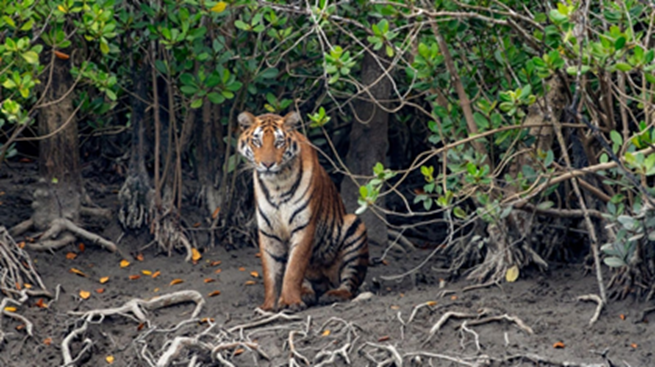
- Support rich biodiversity including the Royal Bengal Tiger, estuarine crocodile and migratory birds.
- Economic Importance
- Sustain fisheries and coastal livelihoods.
- Promote ecotourism.
- Improve water quality by trapping sediments and pollutants.
| Threats to Mangroves | Conservation Measures in India |
| Conversion into aquaculture (fish/shrimp ponds).Illegal encroachments and land reclamation.Coastal infrastructure and urbanisation.Pollution.Sea-level rise and climate change.Cyclones and salinity changes. | National Mangrove and Coral Reef Committee under the Ministry of Environment, Forest and Climate Change (MoEFCC).MISHTI (Mangrove Initiative for Shoreline Habitats & Tangible Incomes) launched in Budget 2023–24 for mangrove plantation and restoration.Protection through the Coastal Regulation Zone (CRZ) Notification.Restoration under CAMPA and State Forest Department initiatives.Integration with Ramsar Convention, Blue Carbon and climate adaptation efforts. |
| Important CTC from this article for UPSC: Sunder bans Saltwater Crocodile Nature Environment and Wildlife Society (NEWS) |
Q. With reference to mangrove ecosystems in India, consider the following statements:
1. Mangroves are salt-tolerant plants that grow in intertidal coastal regions.
2. The Sundarbans is the largest mangrove forest in the world.
3. MISHTI is an initiative launched to promote mangrove plantation and restoration.
Which of the statements given above is/are correct?
A. 1 and 2 only
B. 2 and 3 only
C. 1 and 3 only
D. 1, 2 and 3
Answer: D. 1, 2 and 3
Statement 1 is Correct: Mangroves are halophytic (salt-tolerant) plants adapted to grow in intertidal zones, estuaries, river deltas and other coastal areas influenced by tides.
Statement 2 is Correct: The Sundarbans, spread across India and Bangladesh, is the largest contiguous mangrove ecosystem in the world and is a UNESCO World Heritage Site.
Statement 3 is Correct: MISHTI (Mangrove Initiative for Shoreline Habitats & Tangible Incomes) was announced in the Union Budget 2023–24 to expand mangrove plantations and restore degraded mangrove ecosystems along India's coastline.