
Context
Recently, Alberta’s separatist movement has gained momentum amid debates over federal policies, oil and gas development, environmental regulations, and the province’s relationship with the Canadian federal government.
About Alberta
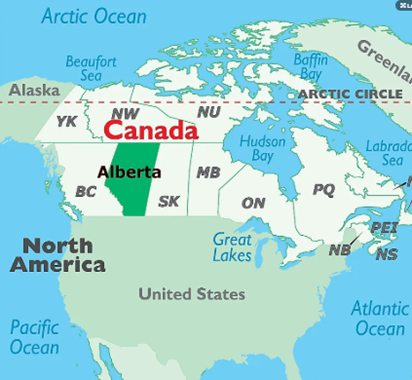
- Location: A landlocked western province of Canada, bordered by British Columbia to the west and Saskatchewan to the east.
- Capital: Edmonton.
- Major economic resource: Home to ‘oil sands’ and holds the world’s fourth-largest proven oil reserves, trailing behind Venezuela, Saudi Arabia, and Iran.
- Economic Contribution: Accounts for more than 80% of Canada’s crude oil production and contributes a disproportionate share to the national economy.
Causes of Separatist Sentiments
- Federal vs. Provincial Policies: Resistance against federal environmental/climate policies aimed at curbing oil extraction.
- Economic Grievance: A perception among local constituents that the province contributes significantly more to the federal government than it receives back.
- Pandemic Restrictions & External Influences: Discontent over COVID-19 pandemic restrictions and regulations, coupled with political rhetoric from neighboring border regions advocating provincial autonomy over local resources and tax collection.
Constitutional Position on Secession in Canada
I. Reference re Secession of Quebec, 1998
- The Supreme Court of Canada held that a province cannot unilaterally secede under the Canadian Constitution.
- A clear majority voting in favour of secession on a clear question would create an obligation to negotiate, rather than an automatic right to independence.
- Constitutional principles involved include federalism, democracy, constitutionalism, the rule of law and respect for minority rights.
II. Clarity Act, 2000
- Provides a framework for determining whether a referendum question and the expression of support for secession are sufficiently clear.
- The House of Commons considers the clarity of the question and whether a clear majority has expressed a desire to secede.
- Secession requires a constitutional amendment and negotiations involving the federal and provincial governments.
Q. In which region is Alberta’s oil sands deposit mainly located?

(a) Athabasca
(b) Labrador
(c) Nova Scotia
(d) Yukon

Answer: (a) Athabasca

Alberta’s oil sands are concentrated in three regions: Athabasca, Cold Lake and Peace River. Athabasca, in the northeast around Fort McMurray, is the largest and most developed, and it is the only one with deposits shallow enough for open-pit mining.

Labrador and Nova Scotia are in eastern Canada, and Yukon is in the far northwest. None of them has major oil sands.