
Context
Recently, the Election Commission of India (ECI), through Chief Election Commissioner (CEC) Gyanesh Kumar and Election Commissioners Sukhbir Singh Sandhu and Vivek Joshi, filed a joint affidavit of nearly 250 pages in the Supreme Court.
Key Highlights of the Affidavit
- Security of Tenure: The CEC can be removed only on the same grounds and in the same manner as a Supreme Court judge, so any attempt to restrain the CEC’s functioning is contrary to law.
- Rule of Majority: In case of a difference of opinion, decisions follow the majority rule under Section 18 of the 2023 Act.
- Decision-making Process: Decisions are routed first to one EC, then to the other, and finally to the CEC. They are signed by all three and then notified and implemented by the ECI Secretariat.
- Electronic Approvals: When members cannot be present in person, approval may be obtained through electronic means and recorded later in the official file.
Removal Procedures & Security of Tenure
| Position | Safeguard / Ground for Removal | Removal Process |
| Chief Election Commissioner (CEC) | High level of security of tenure. Guaranteed under Article 324(5). Can be removed only on the grounds of proved misbehaviour or incapacity. | Same manner and grounds as a Judge of the Supreme Court (Requires an order of the President passed after an address by each House of Parliament supported by a special majority). |
| Election Commissioners (ECs) | No direct constitutional security of tenure. | Can be removed from office only on the recommendation of the CEC (Article 324(5) proviso). |
Decision-Making and the “Rule of Majority”
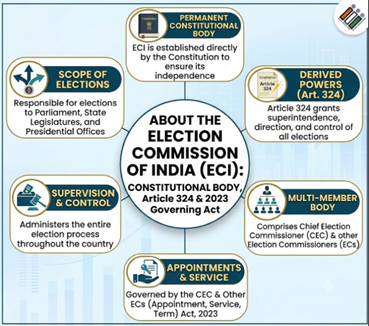
- Statutory Provision: Under Section 18 of the Chief Election Commissioner and Other Election Commissioners (Appointment, Conditions of Service and Term of Office) Act, 2023, the Election Commission follows a multi-member, collective decision-making framework.
- Rule of Majority: If a difference of opinion arises among the Chief Election Commissioner (CEC) and the other Election Commissioners on any matter, the issue is decided according to the opinion of the majority.
- The CEC does not possess veto or overriding powers over the other Election Commissioners.
Q. With reference to the decision-making process within the Election Commission of India, consider the following statements:

1. The Chief Election Commissioner exercises a casting vote in case of a tie among members.
2. Section 18 of the Chief Election Commissioner and Other Election Commissioners Act, 2023 mandates that all decisions in case of a difference of opinion shall be taken by a majority vote.

Which of the statements given above is/are correct?

(a) 1 only
(b) 2 only
(c) Both 1 and 2
(d) Neither 1 nor 2

Answer: (b) 2 only

Statement 1 is incorrect. The CEC has no casting vote. The ECI is a multi-member body in which the CEC and the Election Commissioners have equal powers, and a decision is taken by majority. With three members a tie does not normally arise, and the law does not give the CEC a tie-breaking vote.
Statement 2 is correct. As reported in the affidavit, if the members differ in opinion, the matter is decided by the rule of majority under Section 18 of the 2023 Act.
The statutory provision on transaction of business has the same effect as in the earlier 1991 Act, which was in Section 10. Its principle is that the Commission tries to decide unanimously and otherwise goes by majority. I’m relying on the affidavit report for the “Section 18” numbering, so it’s worth checking against the Act’s text before using it in a published note.