
Context
- A recent drone attack on foreign-flagged cargo vessels has spotlighted the Sea of Azov, underscoring its status as a highly contested and volatile maritime zone caught in the geopolitical crossfire between Russia and Ukraine.
Geographical Extent and Mapping
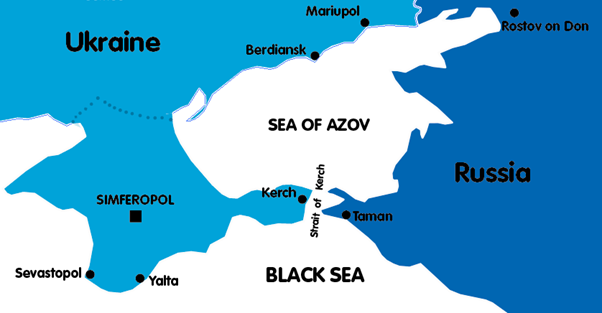
- Bordering Territories: The inland sea is bordered by Ukraine to the north and northwest, Russia to the east and southeast, and the Crimean Peninsula to the west.
- Strategic Chokepoint: The Kerch Strait serves as the exclusive maritime gateway, connecting the Sea of Azov southward to the Black Sea. Following the 2014 annexation of Crimea, Russia assumed authority over both sides of this critical passage.
- Bathymetry: Covering roughly 37,600 square kilometers, it holds the geographical distinction of being the shallowest sea in the world, with a maximum depth of only 14 meters.
Hydrology and Oceanography
- Drainage System: The basin is primarily fed by the Don and Kuban rivers. The heavy deposition of sand and silt from these rivers actively shapes the coastline, forming numerous bays, limans, and narrow spits (e.g., the Fedotova Spit).
- Salinity and Ecology: The massive freshwater influx ensures low salinity levels. Sitting in a transition zone between steppe and forest-steppe ecosystems, the nutrient-rich waters support abundant plant life, such as green algae, and highly productive fisheries.
- Climatology: The region experiences a temperate continental climate with regular winter fogs. Extreme frosts lead to stationary ice formation along the northern shores between December and March, necessitating the deployment of icebreakers for navigation.
Economic Corridors and Infrastructure
- Major Port Cities: The coastline hosts critical freight and passenger hubs, including Taganrog, Yeysk, Mariupol, and Berdyansk.
- Inland Connectivity: The regional network is augmented by the Volga-Don Canal, a vital artificial waterway that links the Caspian Sea basin to Central Asia, highlighting the broader economic reliance on this maritime corridor.
With respect to the Sea of Azov consider the following statements:
I. The Kerch Strait acts as its exclusive maritime connection to the Black Sea.
 II. The Don and Kuban rivers are the primary drainage systems emptying into it.
 III. High freshwater influx from surrounding rivers results in exceptionally high salinity levels.
How many of the above statements are correct?
A. Only one
B. Only two
C. All three
D. None
Answer: B
Explanation:
Statement I is correct: The Kerch Strait is the sole maritime gateway that physically connects the Sea of Azov southward to the Black Sea, making it a critical geopolitical chokepoint.
Statement II is correct: The hydrological profile of the sea is primarily sustained by the Don and Kuban rivers, which discharge massive amounts of freshwater, silt, and sand into the basin.
Statement III is incorrect: Due to the massive freshwater influx from primary rivers, the Sea of Azov is characterized by exceptionally low salinity levels, not high salinity.