
Context:
- A 7.8-magnitude earthquake recently struck the southern Philippines (south of General Santos), killing at least 35 people and triggering widespread tsunami warnings.
- The offshore quake was followed by a series of powerful aftershocks, the largest measuring magnitude 6.5. The event underscores the region’s intense vulnerability to seismic and tectonic activities.
Fundamentals of Earthquakes
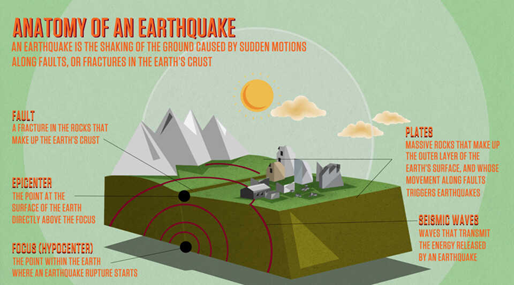
- Definition: An earthquake is the shaking of the earth’s surface caused by seismic waves generated from a sudden release of energy in the earth’s crust (shallow-focus) or upper mantle (intermediate and deep-focus).
- Measurement: A seismograph (or seismometer) detects and records these seismic waves.
- Focus and Epicentre:
- Focus (Hypocentre): The exact point of energy release within the earth.
- Epicentre: The point on the surface directly above the focus, which is the first to experience the earthquake waves.
- Isoseismic Line: A line connecting all points on the surface where the earthquake intensity is identical.
- Foreshocks, Aftershocks, and Swarms:
- Foreshock: A mild earthquake preceding the main violent shock.
- Aftershocks: Lesser-size earthquakes that usually follow a major or moderate shallow-focus earthquake.
- Swarms: Large numbers of small earthquakes occurring in a region for months without a major main shock; often associated with volcanic activity and magma movement.
Causes of Earthquakes
- Fault Zones: The sudden release of stress along a fault rupture (crack) in the earth’s crust, due to intense temperature and pressure changes, is the immediate cause of shallowest earthquakes.
- Plate Tectonics: Slipping of land along convergent, divergent, and transform boundaries.
- Convergent Boundaries (Reverse Faults): Associated with the most powerful “megathrust” earthquakes (magnitude 8 or more) occurring at subduction zones.
- Transform Boundaries (Strike-Slip Faults): Can produce major earthquakes up to magnitude 8 (e.g., the San Andreas Fault).
- Divergent Boundaries (Normal Faults): Generally, produce earthquakes of less than magnitude 7.
- Volcanic Activity: Movement of magma and tectonic faults in volcanic regions release elastic strain energy, causing quakes that can warn of imminent eruptions.
- Human-Induced Earthquakes: Minor earthquakes and tremors caused by human activities such as mining, petroleum extraction, and nuclear tests.
- Reservoir-Induced Seismicity: The immense pressure and water percolation from large artificial lakes alter stress along faults, potentially triggering quakes (e.g., the 1967 Koynanagar earthquake).
Classification Based on Depth of Focus
Earthquakes are classified into three zones within the 0 – 700 km depth range:
- Shallow-Focus (Crustal) Earthquakes (0 – 70 km): Constitute the great majority of earthquakes and release 70-85% of total earthquake energy. Though often of lower magnitude, they can cause relatively greater surface damage because the energy is concentrated over a smaller area.
- Intermediate-Focus Earthquakes (70 – 300 km): Release about 12-15% of total earthquake energy.
- Deep-Focus (Intraplate) Earthquakes (300 – 700 km): Occur within deeper subduction zones. They often have larger magnitudes (6 to 8) but cause less surface destruction as their energy dissipates over a wider area. They commonly occur in patterns called Benioff zones.
Global Distribution of Earthquakes
- Circum-Pacific Belt (Pacific Ring of Fire): The most critical earthquake belt, coinciding with tectonic plate margins around the Pacific Ocean (affecting Japan, New Zealand, the western coasts of the Americas, etc.). It accounts for roughly 68% of all earthquakes.
- Alpine Belt (Mid-World Mountain Belt): Extending from the Mediterranean Sea across the Alpine-Caucasus ranges to the Himalayas, accounting for about 15% of total earthquake energy.
- Oceanic Ridges and Rift Valleys: Striking connected belts of seismic activity occur along oceanic ridges and the rift valleys of East Africa.
With respect to earthquakes, consider the following statements:
I. Shallow-focus earthquakes generally cause less surface damage compared to deep-focus earthquakes due to their overall lower magnitudes.
II. Megathrust earthquakes of magnitude 8 or more typically occur at convergent boundaries along subduction zones.
III. The Circum-Pacific Belt accounts for the majority of all global earthquakes.
How many of the above statements are correct?
 A. Only one
B. Only two
C. All three
D. None
Answer: B
Explanation:
Statement I is incorrect: Though comparatively of lower magnitude, shallow-focus earthquakes can cause relatively greater damage at the surface because the whole energy is directed towards a small area compared to their deep-focus counterparts, where the energy dissipates over a wider area.
Statement II is correct: Reverse faults at convergent boundaries are associated with the most powerful megathrust earthquakes, including almost all of those of magnitude 8 or more, which occur at subduction zones where one tectonic plate is forced underneath another.
Statement III is correct: The Circum-Pacific Belt, popularly dubbed the "Pacific Ring of Fire," is the most important earthquake belt and accounts for about 68 per cent of all earthquakes globally.