
After Reading This Article You Can Solve This UPSC Mains Model Question:
Fire safety is an integral component of disaster risk reduction in rapidly urbanising India. Discuss the causes of recurring urban fire accidents and evaluate the preparedness of India’s fire safety ecosystem. 15 Marks (GS3, Disaster Management)
Introduction
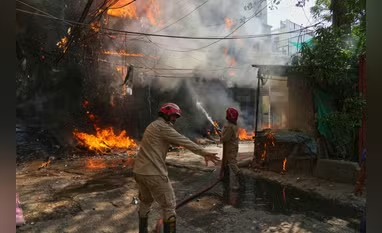
The recent Lucknow fire tragedy, which claimed 15 lives (mostly students), highlights the critical intersection between India’s demographic dividend and its regulatory deficits. It reflects a booming, unregulated education economy thriving amidst unplanned urbanization, emphasizing that India’s transition to a developed nation (Viksit Bharat) is fundamentally incomplete without ensuring a safe nation (Surakshit Bharat).
Core Reason of the Fire Safety & Urban Governance Crisis
A. Socio-Economic Drivers
- Booming Coaching Ecosystem: A young population eager to acquire skills for a rapidly changing job market (driven by AI disruptions) has fueled a high-profit, low-capital ecosystem of coaching centres.
- Institutional Lag: Formal educational institutions are failing to keep pace with modern skill requirements, forcing students toward these parallel, informal training hubs.
B. Structural & Regulatory Failures
- Unauthorized Commercialization: Educational hubs frequently operate out of buildings not zoned or authorized for commercial use.
- Enforcement Deficit: Despite repeated demolition notices by civic authorities, illegal structures continue to operate, highlighting corruption and administrative inertia.
- Commodification of Safety: Business owners consistently bypass basic fire safety norms and mandatory building codes to maximize profit margins.
C. Systemic Bottlenecks in India’s Fire Governance
- Lack of Investigative Culture: Post-disaster investigations are superficial, rarely moving beyond superficial blame to identify systemic engineering or electrical flaws.
- Infrastructure & Human Resource Deficit: India suffers from a severe shortage of modern firefighting equipment and trained fire-forensics experts capable of conducting rigorous root-cause analyses.
- Absence of Standard Systems: Unlike developed nations, Indian commercial buildings largely lack automated, mandatory fire detection and suppression systems (e.g., smart sprinklers, integrated smoke alarms).
Government scheme and legislation
- Article 243W & the 12th Schedule of the Constitution: Empowers Urban Local Bodies (ULBs) and municipalities with the constitutional functional domain to organize, regulate, and execute fire services locally.
- Disaster Management Act, 2005 (NDMA Guidelines): Shifts the national fire response paradigm from reactive firefighting to proactive mitigation by mandating periodic, regular vulnerability assessments and structural fire safety audits.
- AMRUT 2.0 (Atal Mission for Rejuvenation and Urban Transformation): Links central fiscal devolution to urban programmatic reforms, incentivizing municipalities to digitize, monitor, and streamline building plan approvals alongside safety compliance.
Global Examples of Fire Safety and Urban Governance Models
- United Kingdom (Hackitt Review Implementation): Introduced strict, continuous “safety case” regimes for high-rise buildings following the Grenfell Tower tragedy to eliminate regulatory loopholes.
- Singapore (Fire Safety Act & SCDF Regulation): Enforces mandatory, automated fire-shutter and sprinkler links directly tied to the Civil Defence Force for real-time monitoring of commercial properties.
- United States (NFPA Code Enforcement): Utilizes the National Fire Protection Association’s highly standardized, legally binding codes coupled with third-party forensic investigations to prevent electrical failures.
- Japan (Disaster-Resilient Urban Zoning): Integrates strict fire-retardant material mandates with localized community firefighting infrastructure within dense, historic commercial districts.
Way Forward
- Launch National Risk Audits: Initiate scientifically designed, sample-based national building surveys to create a data-driven vulnerability database for urban centers.
- Enforce Smart Technology: Update building bye-laws to mandate Arc-Fault Protection Devices (AFPDs) and sensor-based, automated fire suppression systems in all commercial hubs.
- Fix Institutional Accountability: Establish strict legal and administrative penalties for civic officials who fail to execute issued demolition or safety violation notices.
- Institutionalize Fire Forensics: Establish a dedicated cadre of trained fire-forensics experts to move post-disaster investigations from superficial blame to technical root-cause analysis.
- Empower Urban Local Bodies: Enhance the fiscal and technical capacities of municipalities under Article 243W to modernization local firefighting infrastructure and emergency response times.
- Formalize Parallel Education Hubs: Implement a strict, mandatory registration and licensing framework specifically targeting informal coaching centers to regulate their spatial and structural safety.
Conclusion
Transforming India into a Viksit Bharat demands prioritizing a Surakshit Bharat through data-driven sample safety audits, mandatory smart sensor-based automated suppression systems, and strict municipal accountability to secure its demographic dividend.