
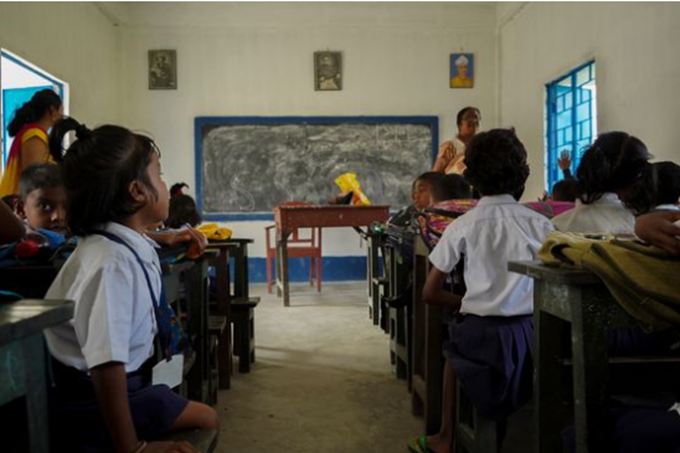
After reading this article you can answer this UPSC PYQ 2017
To what extent would the right to education under Article 21A mean that every child of the age of 6–14 years has a right to receive education in a neighborhood school? Discuss. 15 marks (GS2 Mains Governance)
Context
Several Indian states—including Uttar Pradesh, Madhya Pradesh, Rajasthan, Odisha, Maharashtra, Punjab, and Bihar—have initiated school rationalisation by merging or closing government schools with very low enrolment. However, concerns have emerged regarding children’s access to education, increased dropouts, gender inequality, and the constitutional Right to Education (RTE).
Introduction
Education is not merely a welfare measure but a fundamental right guaranteed under Article 21A of the Constitution. The Right of Children to Free and Compulsory Education (RTE) Act, 2009 seeks to ensure universal access to elementary education. While school rationalisation aims to improve efficiency by consolidating underutilized schools, indiscriminate closure of government schools—especially in rural, tribal and remote areas—may undermine equity, inclusiveness and constitutional commitments.
What is School Rationalisation?
School rationalisation refers to the merging, relocation or closure of schools with extremely low enrolment and redeployment of teachers and infrastructure to schools with better student strength.
Objectives
- Efficient utilisation of teachers
- Better pupil-teacher ratio
- Optimum use of infrastructure
Why Are Government Schools Being Shut Down?
1. Declining Student Enrolment
Government schools are witnessing continuous decline in enrolment because of:
- Preference for private schools
- Better English-medium education
- Perceived higher quality
- Migration towards urban centres
- Government Findings
- UDISE+ data shows a gradual decline in enrolment in many government elementary schools while private school enrolment has increased over the last decade in several states.
2. Extremely Low Student Strength
Thousands of schools have:
- Less than 20 students
- Single-digit enrolment
3. Teacher Shortage and Unequal Distribution
Many schools have:
- Only one teacher
- Vacant teaching posts
- Subject teacher shortages
4. Fiscal Constraints
Governments face increasing expenditure on:
- Salaries
- Infrastructure
- Maintenance
- Administrative costs
5. Infrastructure Consolidation
Governments argue that larger schools provide:
- Science laboratories
- Libraries
- Digital classrooms
- Sports facilities
- Better extracurricular activities
instead of maintaining multiple poorly equipped schools.
Implications of Government School Closures
1. Reduced Educational Access
Closure increases the distance to the nearest school.Consequences include:
- Higher transportation costs
- Safety concerns
- Irregular attendance
- Increased absenteeism
Remote and tribal children are disproportionately affected.
2. Increase in Dropout Rates
Longer travel discourages attendance, particularly among:
- Girls
- Tribal children
- Children with disabilities
- Economically weaker sections
This undermines the objective of universal elementary education.
3. Gender Inequality
Girls face:
- Safety concerns
- Social restrictions
- Lack of transport
- Early marriage risks
Parents may discontinue girls’ education if schools are distant.
4. Impact on Marginalised Communities
Most affected groups include:
- Scheduled Tribes
- Scheduled Castes
- Minorities
- Forest dwellers
- Aspirational districts
Educational inequality may widen.
5. Violation of RTE Spirit
Although schools may technically be merged, practical accessibility may decline, weakening:
- Neighbourhood school concept
- Equity
- Inclusion
- Universal education
6. Teacher Displacement
Rationalisation may involve:
- Frequent transfers
- Administrative burden
- Reduced community engagement
- Teacher dissatisfaction
Government Reports and Findings on implication
1. UDISE+ (Unified District Information System for Education)
Highlights:
- Significant number of schools have fewer than 30 students.
- Teacher vacancies continue in many states.
- Infrastructure has improved but quality disparities remain.
2. ASER (Annual Status of Education Report)
Findings include:
- Persistent learning deficits in reading and arithmetic.
- Foundational learning gaps remain despite improved enrolment.
- School quality influences parental preference more than proximity.
3. National Education Policy (NEP) 2020
NEP recommends:
- School Complex/Cluster Model
- Sharing teachers
- Resource pooling
- Better academic support
- Improved governance
Importantly, NEP does not advocate indiscriminate closure, but strengthening access through school complexes while ensuring equitable availability.
4. NITI Aayog – School Education Quality Index (SEQI)
Highlights:
- Learning outcomes vary significantly across states.
- Governance reforms and teacher quality are central to improvement.
- Educational quality is as important as enrolment.
Way Forward
1. Adopt NEP 2020 School Complex Model
Instead of closing schools, create:
- School clusters
- Shared teachers
- Shared laboratories
- Shared digital facilities
- Common administrative support
2. Distance-Based Rationalisation
Closure should never occur where students must travel beyond RTE neighbourhood norms or where geography creates access barriers.
3. Child Impact Assessment
Before any closure, governments should assess:
- Travel distance
- Dropout risk
- Gender impact
- Disability access
- Tribal implications
4. Strengthen Foundational Learning
Implement the NIPUN Bharat Mission to improve foundational literacy and numeracy, making government schools more attractive through better learning outcomes.
5. Improve School Quality
Focus on:
- Teacher training (NISHTHA)
- Smart classrooms
- Libraries
- Laboratories
- Sports infrastructure
- ICT-enabled education
- Regular teacher recruitment
6. Digital and Hybrid Education
Expand:
- PM eVIDYA
- DIKSHA Platform
- SWAYAM
- Digital classrooms
while ensuring adequate digital infrastructure and connectivity.
Conclusion
- Restructuring of government schools must uphold the constitutional guarantee under Article 21A, protect the neighbourhood school principle, and ensure that no child—especially girls, tribal children, children with disabilities, or those from economically weaker sections—is deprived of access to quality education.
- A balanced approach, combining NEP 2020’s School Complex model, data-driven planning, community participation, safe transportation, and sustained investment in learning outcomes, can transform rationalisation into an instrument of educational inclusion rather than exclusion.