
Context
- A major international consortium has signed contracts to launch the I-2SEA submarine cable system, a high-capacity subsea project designed to significantly boost digital connectivity and support AI workloads across the India-Southeast Asia corridor.
Key Highlights for UPSC Prelims
- The Consortium Members: The project is being built by a collaboration comprising Microsoft, Singtel, Tata Communications, and the AI connectivity platform Lightstorm.
- Geographical Links: The cable system directly connects India, Malaysia, and Singapore.
- Key City Nodes Connected:
- India: Connects the data centre hubs of Hyderabad and Chennai.
- Singapore: Acts as the regional cloud interconnect and AI hub.
- Malaysia: Taps into the emerging data centre corridor in Kuala Lumpur.
- Dual Landings in India: The cable features two specific landing points on India’s east coast:
- Machilipatnam (Andhra Pradesh): Provides the shortest subsea access routes onward to Hyderabad.
- South Chennai (Tamil Nadu): A new diverse landing location.
- Technical Specifications:
- Length: Approximately 3,600 km spanning from Singapore to Machilipatnam.
- Target Timeline: Slated to be ready-for-service by Q4 2029.
- Partners: NEC Corporation has been chosen as the system supplier, while ASEAN Cableship (ACPL) will serve as the marine installation partner.
Strategic and Economic Significance
- Catering to AI Infrastructure: The facility is specifically engineered to handle complex AI training, inference workloads, GPU infrastructure needs, and hyperscaler demands across South and Southeast Asia.
- Critical City Corridor: The Singapore-Malaysia-Hyderabad corridor is identified as a strategically critical city pair for regional digital infrastructure.
About Submarine Communication Cables
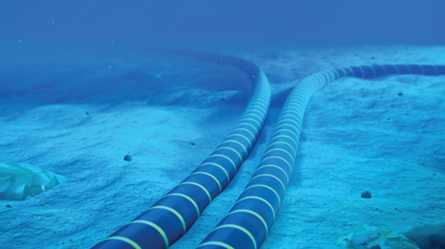
- They are fibre-optic cables laid on the seabed.
- Carry over 95% of international internet traffic.
- Transmit data using light signals through optical fibres.
- Protected with multiple layers of insulation and armour near coastal areas.
- Maintained using specialised cable-laying and repair ships.
- Submarine cables are internationally regulated within the framework of the United Nations Convention on the Law of the Sea (UNCLOS).
- Cable installation and maintenance can disturb marine animals that rely on sound and electromagnetic signals for navigation and communication.
With reference to the India–Singapore-2 (I-S2) submarine cable project, consider the following statements:
1. It is a submarine fibre-optic communication cable connecting India, Malaysia, and Singapore.
2. The project aims to improve connectivity for AI workloads, cloud computing, and data centres.
3. The Indian landing stations are located at Mumbai and Chennai.
Which of the statements given above is/are correct?
(a) 1 only
(b) 1 and 2 only
(c) 2 and 3 only
(d) 1, 2 and 3
Answer: B
Explanation:
•  Statement 1 is correct: As detailed in the provided text from image_d045bf.png, the I-2SEA (or India-Singapore-2) cable system directly connects India, Malaysia, and Singapore.
•  Statement 2 is correct: The text explicitly notes that the facility is designed to cater to the rapidly growing demand from hyperscalers, GPU infrastructure providers, and enterprises running AI training, inference workloads, cloud interconnect, and data centres across the region.
•  Statement 3 is incorrect: The dual landing sites on India's east coast are located at Machilipatnam (Andhra Pradesh) and South Chennai (Tamil Nadu), not Mumbai. Machilipatnam provides the shortest subsea route to connect the data centre cluster in Hyderabad.