
Context
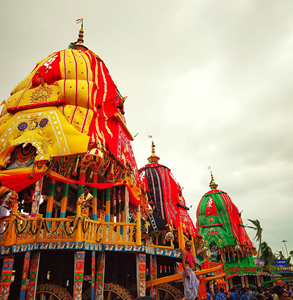
- Recently, President Droupadi Murmu, ahead of the Rath Yatra beginning on 16 July 2026 in Puri, shared her lifelong devotion to Lord Jagannath, describing the festival as the most spectacular celebration in Puri. The event has once again brought the Jagannath tradition and Odisha’s cultural heritage into national focus.
Key Facts
1. The Deities & Cultural Core
- The Triad: The festival revolves around three deities: Lord Jagannath (a form of Lord Vishnu/Krishna), his elder brother Lord Balabhadra, and his younger sister Goddess Subhadra, along with the weapon Sudarshana Chakra.
- Material & Renewal: Unlike the stone or metal idols typical of most Hindu shrines, these idols are crafted out of sacred neem wood (Daru Brahma). They are ceremonially replaced every 12 to 19 years in a ritual known as Nabakalebara.
- Anasara Period: Following the annual ritual bathing festival (Snana Yatra), the deities are believed to fall ill and are kept away from public view for 15 days, during which they are represented by traditional Odia cloth paintings called Anasara Pattis.
2. The Chariots (Raths)
The three grand wooden chariots are constructed fresh every year starting on Akshaya Tritiya without using metal nails, employing ancient joinery techniques instead.
| Deity | Chariot Name | Canopy Colours | Number of Wheels |
| Lord Jagannath | Nandighosa (or Garudadhwaja) | Red and Yellow | 16 wheels |
| Lord Balabhadra | Taladhwaja | Red and Bluish-Green/Green | 14 wheels |
| Goddess Subhadra | Darpadalana (or Devadalana) | Red and Black | 12 wheels |
3. Key Rituals
- Chhera Pahanra: The Gajapati King of Puri sweeps the floor of the chariots with a golden broom before the procession starts. This ritual signifies absolute equality before the divine, demonstrating that even the highest temporal authority is a humble servant.
- Gundicha Yatra & Return: The deities travel along the Bada Danda (Grand Avenue) to the Gundicha Temple (their aunt’s home), staying for nine days before making their return journey, known as the Bahuda Yatra.
Shree Jagannath Temple
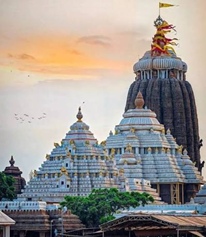
- Historical Origin: Built in the 12th Century CE by King Anantavarman Chodaganga Deva of the Eastern Ganga Dynasty, and completed by Anangabhima Deva III.
- Style: A classic example of the Kalinga style of architecture (a distinct sub-style of the Northern Nagara style).
- Temple Layout: It is a Pancharatha plan temple built on an elevated platform. It features four main interconnected axial structures:
- Vimana / Deula: The sanctum sanctorum housing the deities.
- Jagamohana: The assembly hall for devotees.
- Natamandira: The dancing/festival hall.
- Bhogamandapa: The hall for food offerings.
- Key Identifiers:
- Known historically to sailors as the “White Pagoda” (while the Konark Sun Temple was called the “Black Pagoda”).
- It is one of the standard Char Dham pilgrimage sites (alongside Badrinath, Dwarka, and Rameswaram).
The top of the temple is adorned with the Nilachakra (an eight-spoked alloy wheel) and the fortifying outer boundary wall is named Meghanada Pacheri.
Consider the following statements regarding the Puri Rath Yatra and the Jagannath Temple architecture:
1. Unlike traditional Hindu shrines, the idols of the main triad are carved from sacred wood and undergo a ceremonial renewal process known as Nabakalebara.
2. The Chhera Pahanra ritual, where the Gajapati King sweeps the chariots, symbolizes the concept of absolute spiritual equality.
3. The temple complex represents the Nagara sub-style of architecture and was constructed by the rulers of the Eastern Ganga Dynasty.
Which of the statements database given above are correct?
A) 1 and 2 only
B) 2 and 3 only
C) 1 and 3 only
D) 1, 2 and 3
Correct Answer: D) 1, 2 and 3
Explanation:
• Statement 1 is correct: The idols are made of sacred neem wood (Daru Brahma) and are periodically replaced in the Nabakalebara ritual, unlike stone or metal idols.
• Statement 2 is correct: The ritual of the King of Puri sweeping the chariots with a golden broom highlights that everyone, regardless of social or temporal rank, is equal before the divine.
• Statement 3 is correct: The Shree Jagannath Temple is a classic specimen of the Kalinga architecture (a distinct sub-style of the Nagara style) and was commissioned by King Anantavarman Chodaganga Deva of the Eastern Ganga Dynasty in the 12th century.