
Context
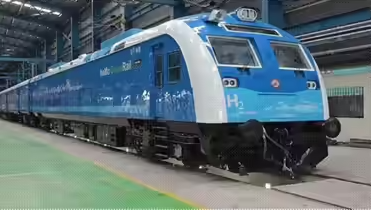
- Recently, Indian Railways inaugurated India’s first indigenous hydrogen fuel cell-powered train, marking a major step towards clean and sustainable transportation.
- Scheduled to commence operations on 17 July 2026 on the Jind–Sonipat section of the Northern Railway, the train generates electricity onboard using hydrogen and is supported by dedicated storage and refuelling infrastructure
Key Features of the Hydrogen Powered Train
- 10-car hydrogen fuel cell-based trainset.
- Powered by a 1200 kW hydrogen fuel cell propulsion system.
- Approved to operate at a maximum speed of 75 kmph with a design speed of 110 kmph.
- Capacity of Around 2,600 Passengers.
- Developed from the design stage through prototype manufacturing.
- It will connect Jind Junction, Gohana Junction and Sonipat while serving intermediate stations.
- Proposed halts include Jind City, Pandu Pindara Junction, Lalit Khera Halt, Bhambhewa, Isapur Kheri Halt, Butane Halt, Khandrai Halt, Rabrah Halt, Lath Halt, Mohana, Barwasni Halt and Sonipat New.
Technology Behind the Train
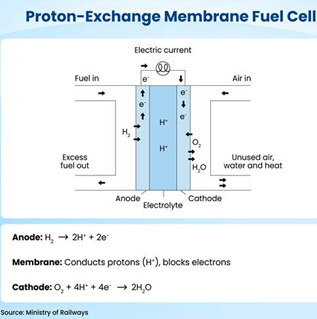
- Working Principle: Hydrogen fuel cell technology generates electricity through a chemical reaction between hydrogen and oxygen.
- Technology Used: The train is powered by a Proton Exchange Membrane Fuel Cell (PEMFC).
- PEMFC Mechanism: It produces electricity by reacting hydrogen and oxygen across a proton-conducting Perfluorosulfonic Acid (PFSA) polymer membrane.
- By-products: The process emits only water vapour and heat, ensuring near-zero emissions.
- High Energy Density: Hydrogen has an energy content of 120 MJ/kg, significantly higher than diesel’s 43 MJ/kg.
- Advantages: It is a low-maintenance technology with a relatively small carbon footprint.
- Significance: Hydrogen fuel cells are considered the cleanest propulsion technology currently available for rail transport.
- Supporting Infrastructure: Indian Railways has developed dedicated hydrogen storage, refuelling and operational infrastructure to support the technology.
Hydrogen Infrastructure
- The country’s largest railway hydrogen storage and refuelling facility has been established at Jind, Haryana.
- The indigenous facility can store nearly 3,000 kg of hydrogen at a time to support hydrogen-powered train operations.
- The required licence for storage and dispensing of compressed hydrogen gas has been granted by the Petroleum and Explosives Safety Organisation (PESO).
- The hydrogen ecosystem has been designed in accordance with international standards, including NFPA-2 and the ISO 19880 Series.
- The entire system has undergone an independent third-party safety assessment by TÜV SÜD, Germany.
- The train comprises two Hydrogen Driving Power Cars (DPCs) and eight Trailer Coaches (TCs).
- Each DPC houses:
- Fuel cells.
- Lithium iron phosphate (LFP) batteries.
- Hydrogen storage cylinders.
- The supporting infrastructure includes:
- A hydrogen compression system for refuelling operations.
- Technical support and critical spare parts.
- A standby compressor to ensure uninterrupted refuelling.
- The integrated infrastructure ensures safe and efficient hydrogen-powered rail operations.
Safety Measures
- Hydrogen leak detectors have been installed at the production, storage and dispensing facilities.
- Flame detectors have also been installed for continuous monitoring.
- Safety sensors will undergo regular inspection and cleaning.
- Non-stop ventilation keeps air moving through the train at all times.
- If anything unusual is detected, like heat, flame or smoke, the system can automatically cut off the hydrogen supply on its own.
- The Loco Pilot’s cabin has been designed with a special mode that allows the train to be moved to safety in an emergency.
- A screen shows the real health of the whole system to the Loco Pilot at all times.
- Inspection and maintenance schedules have been prescribed to ensure safe operations.
With reference to India’s first hydrogen fuel cell-powered train, consider the following statements:
1. The train generates electricity onboard through a Proton Exchange Membrane Fuel Cell (PEMFC) using hydrogen and oxygen.
2. Hydrogen fuel cells emit only water vapour and heat as by-products at the point of use.
3. The hydrogen storage and refuelling facility established at Jind can store nearly 30,000 kg of hydrogen at a time.
Which of the statements given above is/are correct?
(a) 1 and 2 only
(b) 2 and 3 only
(c) 1 and 3 only
(d) 1, 2 and 3
Answer: (a) 1 and 2 only
Explanation:
• Statement 1 is Correct: The train is powered by a Proton Exchange Membrane Fuel Cell (PEMFC), which generates electricity through a chemical reaction between hydrogen and oxygen.
• Statement 2 is Correct: Hydrogen fuel cells produce only water vapour and heat as by-products, resulting in near-zero emissions at the point of use.
• Statement 3 is Incorrect: The hydrogen storage and refuelling facility at Jind, Haryana, can store nearly 3,000 kg, not 30,000 kg, of hydrogen.