
Context
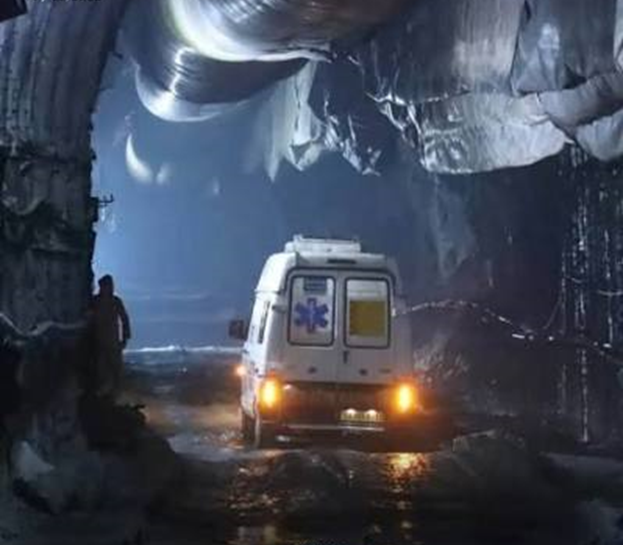
- A suspected methane gas leak inside the under-construction Teesta Stage-VI Hydroelectric Project tunnel in Namchi district, Sikkim, led to the death of 12 workers, while rescue operations continued for trapped workers. The incident highlights the hazards associated with underground tunnelling and gas accumulation.
Why is Methane Dangerous in Tunnels?
- Methane accumulates in poorly ventilated underground spaces.
- Concentration of 5–15% in air forms an explosive mixture.
- A spark, heat source or blasting activity can trigger an explosion.
- Methane can also displace oxygen, causing asphyxiation (oxygen deficiency).
- Explosions often generate toxic gases such as carbon monoxide and dense smoke.
Tunnel Safety Measures
- Continuous methane and oxygen monitoring sensors.
- High-capacity ventilation systems.
- Flame-proof electrical equipment.
- Emergency evacuation routes.
- Personal gas detectors for workers.
- Regular geotechnical and geological surveys before excavation.
Teesta Stage-VI Hydroelectric Project
- River: Teesta River
- Location: Samardung, Namchi District (South Sikkim), Sikkim.
- Executing Agency: NHPC Ltd.
- Type: Run-of-the-river Hydroelectric Project
- Developed to enhance renewable energy generation in the Himalayan region.
- River Basin: Designed as a Run-of-River (RoR) scheme on the Teesta River.
- Source: The Teesta River originates from the Cho Lamo glacier in the high Himalayas.
- Course: It flows southward through Sikkim and West Bengal before emptying into the Brahmaputra River (Jamuna) in Bangladesh.
| Methane (CH₄) Methane (CH₄) is a colourless, odourless, highly flammable hydrocarbon gas.It is the main component of natural gas.It is the second-largest contributor to global warming after carbon dioxide.Over a 20-year period, methane has nearly 80 times higher warming potential than CO₂.Major Sources Natural wetlands Coal mines and underground rock formations Oil and natural gas extraction Landfills and sewage Livestock (enteric fermentation) Rice cultivation. |
| Important CTC from this article for UPSC: NHPC Methane Gas Teesta River |
Q. Consider the following statements regarding the Teesta River:
1.	It is a major tributary of the Brahmaputra River.
2.	The river originates from the Cho Lamo glacier.
3.	Teesta flows entirely within the borders of India.
Which of the statements given above are correct?
•	A) 1 and 2 only
•	B) 2 and 3 only
•	C) 1 and 3 only
•	D) 1, 2, and 3
Answer: A) 1 and 2 only
Statement 1 is CORRECT: The Teesta River is a major right-bank tributary of the Brahmaputra River (known as the Jamuna in Bangladesh). Historically, Teesta used to flow southward to join the Ganga, but after a massive flood in 1787, it altered its course eastward to merge with the Brahmaputra system.
Statement 2 is CORRECT: The river originates from the Tso Lhamo (Cho Lamo) Lake / Glacier complex at an elevation of over 5,300 meters in North Sikkim. This is one of the highest lakes in the world.
Statement 3 is INCORRECT: The Teesta River is an international/transboundary river. It flows through Sikkim and West Bengal in India before crossing the international border into Bangladesh, where it finally joins the Brahmaputra. Because it spans multiple nations, it is a subject of long-standing bilateral water-sharing discussions between India and Bangladesh.