
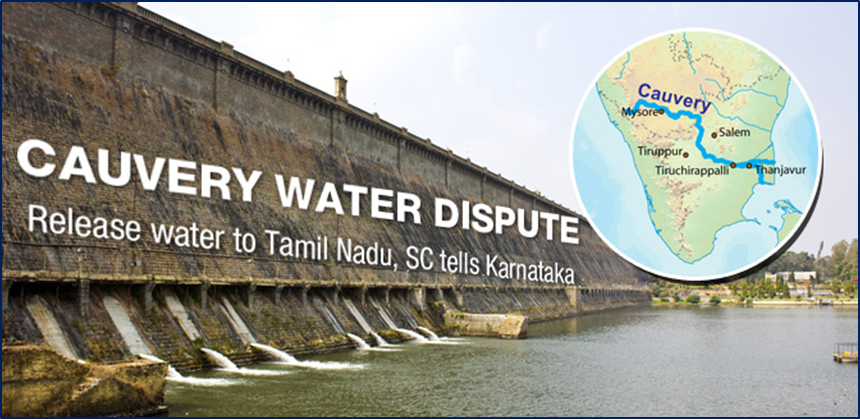
Context
- The Cauvery Water Regulation Committee (CWRC) directed Karnataka to release 3,500 cusecs of water per day to Tamil Nadu for 15 days after assessing reservoir storage, rainfall, inflows, and water availability in the Cauvery basin. The decision was approved by the Cauvery Water Management Authority (CWMA).
About Cauvery Water Dispute
- The Cauvery is an inter-State river, and its waters are shared mainly between Karnataka, Tamil Nadu, Kerala, and Puducherry.
- Water availability varies due to monsoon-dependent rainfall, leading to disputes over irrigation, drinking water, and reservoir management.
- The dispute is governed by the Cauvery Water Disputes Tribunal (CWDT) Award (2007), later modified by the Supreme Court (2018).
Cauvery Water Management Authority (CWMA)
- About
- A statutory authority constituted by the Central Government in 2018.
- Established under the Inter-State River Water Disputes Act, 1956 to implement the final award of the Cauvery Water Disputes Tribunal, as modified by the Supreme Court.
- Functions
- Implements the water-sharing formula among basin States.
- Supervises reservoir operations.
- Issues directions regarding water releases.
- Ensures compliance with the Tribunal Award and Supreme Court judgment.
Cauvery Water Regulation Committee (CWRC)
- About
- A technical committee functioning under the CWMA.
- Headed by the Member (Water Resources), CWMA.
- Composition
- Central Water Commission (CWC)
- India Meteorological Department (IMD)
- Ministry of Jal Shakti
- Basin States’ Chief Engineers
- Ministry of Agriculture & Farmers’ Welfare
- Key Functions
- Monitors daily reservoir storage, inflows, and outflows.
- Assesses rainfall and weather forecasts.
- Recommends periodic water releases.
- Submits reports to CWMA for final approval.
Reservoirs Monitored by CWRC
| State | Reservoirs |
| Karnataka | Hemavathi, Harangi, Krishnarajasagara (KRS), Kabini |
| Tamil Nadu | Mettur, Bhavanisagar, Amaravathi |
| Kerala | Banasurasagar |
Factors Considered Before Ordering Water Release
The CWRC evaluates:
- Southwest and Northeast monsoon rainfall.
- Rainfall forecast for the coming weeks.
- Live storage in reservoirs.
- Reservoir inflows and outflows.
- Water availability across the basin.
- Irrigation and drinking water requirements.
- Realisation of flows at Biligundlu (inter-State measuring point).
- Compliance with the Tribunal Award and Supreme Court judgment.
Constitutional & Legal Architecture
- Article 262: Empowers the Parliament to adjudicate disputes relating to the waters of inter-State rivers or river valleys. It allows Parliament to bar the jurisdiction of all courts, including the Supreme Court, over such disputes.
- Inter-State River Water Disputes Act, 1956: Enacted under Article 262, it provides for the creation of ad-hoc tribunals when negotiations fail. Amendments over time have sought to institutionalize permanent implementation bodies like the CWMA.
- Seventh Schedule Allocations:
- State List (Entry 17): Water, including water supplies, irrigation, canals, drainage, embankments, and water power (subject to Union control).
- Union List (Entry 56): Regulation and development of inter-State rivers and river valleys to the extent declared by Parliament to be expedient in the public interest.
Cauvery River – At a Glance
- Origin: Talakaveri, Brahmagiri Hills, Karnataka (Western Ghats).
- Length: About 800 km.
- States Covered: Karnataka, Tamil Nadu; forms boundary with Kerala in parts; drains into Puducherry (Karaikal).
- Mouth: Bay of Bengal.
- Major Tributaries:
- Left Bank: Harangi, Hemavathi, Shimsha, Arkavathi.
- Right Bank: Kabini, Bhavani, Noyyal, Amaravathi.
| Important CTC from this article for UPSC: Cauvery Water Management Authority (CWMA) Cauvery River |
Q. With reference to the Cauvery Water Management Authority (CWMA) and the Cauvery Water Regulation Committee (CWRC), consider the following statements:
1. The CWMA is a statutory authority constituted to implement the Cauvery Water Disputes Tribunal Award as modified by the Supreme Court.
2. The CWRC functions as the technical arm of the CWMA and monitors reservoir storage, inflows, and outflows in the Cauvery basin.
3. The CWRC has the final authority to allocate and enforce water-sharing among the basin States.
Which of the statements given above is/are correct?
(a) 1 and 2 only
(b) 2 and 3 only
(c) 1 and 3 only
(d) 1, 2 and 3
Answer: (a) 1 and 2 only
• Statement 1 – Correct: The CWMA is a statutory authority established in 2018 to implement the Cauvery Water Disputes Tribunal Award, as modified by the Supreme Court.
• Statement 2 – Correct: The CWRC is the technical committee under the CWMA that monitors rainfall, reservoir storage, inflows, and outflows and recommends water releases.
• Statement 3 – Incorrect: The CWRC does not have the final decision-making power. It only makes technical recommendations; the CWMA is the authority that issues and enforces directions regarding water sharing.