
Important for UPSC Prelims: IR
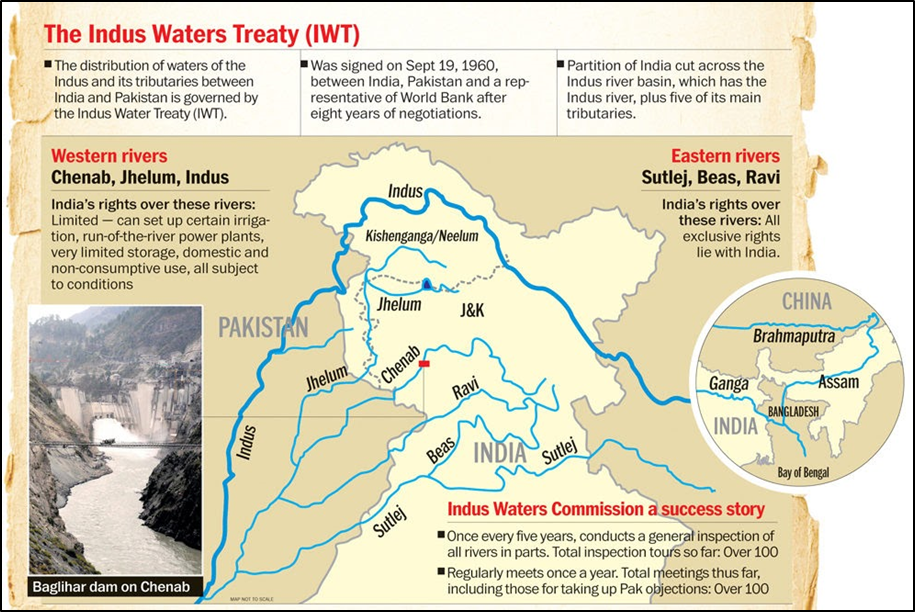
About Indus Waters Treaty (IWT)
- The Indus Waters Treaty (IWT) is a bilateral water-sharing agreement between India and Pakistan, signed on 19 September 1960 at Karachi. It was brokered by the World Bank to regulate the use of the waters of the Indus River System.
- The Treaty allocates the waters of the six rivers of the Indus Basin between the two countries while establishing institutional mechanisms for cooperation and dispute resolution.
Background
- Before Partition (1947), the Indus Basin Irrigation System functioned as a single integrated network.
- Partition divided the basin into:
- India as the upper riparian.
- Pakistan as the lower riparian.
- Important canal headworks such as Madhopur (Ravi) and Ferozepur (Sutlej) remained in India, while most canals irrigated agricultural land in Pakistan.
- Water disputes emerged soon after Independence.
- In 1951, the World Bank initiated negotiations between the two countries.
- After nearly nine years of negotiations, the Indus Waters Treaty was signed on 19 September 1960 by:
- Prime Minister Jawaharlal Nehru
- President Field Marshal Ayub Khan
- with the World Bank as a signatory.
Rivers Covered under the Treaty
- The Indus Waters Treaty covers the six rivers of the Indus River System.
- The Eastern Rivers—Ravi, Beas and Sutlej—are allocated to India for unrestricted use.
- The Western Rivers—Indus, Jhelum and Chenab—are allocated to Pakistan, while India is allowed limited uses under the Treaty.
India’s Permitted Uses on Western Rivers
- India can use the Western Rivers for domestic purposes, navigation, fisheries, recreation, limited irrigation, and run-of-the-river hydroelectric projects.
- It may also create storage within prescribed limits but cannot divert the rivers or significantly alter their natural flow.
Permanent Indus Commission (PIC)
- The Treaty established the Permanent Indus Commission (PIC) under Article VIII, comprising one Commissioner from each country.
- The Commission meets annually to exchange information, inspect projects, resolve technical issues and promote cooperation.
Data Sharing
- India and Pakistan are required to regularly exchange river flow data, hydrological information, flood data and details of new projects to ensure transparency and smooth implementation of the Treaty.
No Unilateral Exit
- The Treaty does not contain an exit clause. It can only be amended or terminated through mutual consent of both India and Pakistan.
Major Projects under the Treaty
- The Baglihar Hydroelectric Project on the Chenab River was examined by a Neutral Expert in 2007.
- The Kishanganga Hydroelectric Project, located on a tributary of the Jhelum, was decided by a Court of Arbitration in 2013.
- The Ratle Hydroelectric Project, also on the Chenab River, remains a major point of dispute between India and Pakistan.
Conclusion
The Indus Waters Treaty remains a cornerstone of India–Pakistan water cooperation despite recurring disputes. Its long-term success depends on effective implementation, mutual trust and adapting to emerging water challenges.
| This concept has been discussed in the following article Ujh Multipurpose Project (UMP) |