
Context
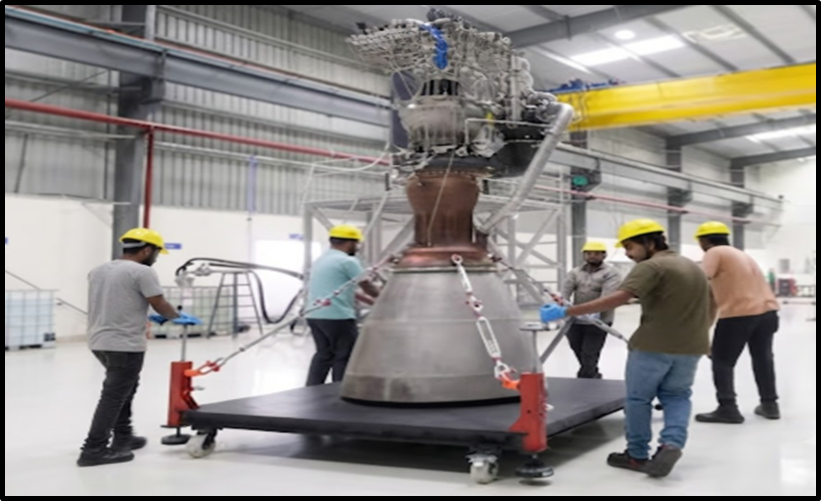
Bengaluru-based Astrobase Space Technologies unveiled EVEREST, India’s first privately built 800 kilonewton Full-Flow Staged Combustion (FFSC) LOX-Methane rocket engine.
Astrobase is the fourth commercial company globally to successfully develop a high-thrust FFSC engine, joining a select group of nations and firms capable of this propulsion technology.
About the EVEREST Engine
- Engine Class: 800 kN (kilonewton)-class engine, equivalent to lifting approximately 80 tonnes of thrust in vacuum conditions.
- Cycle: India’s first fully integrated Full-Flow Staged Combustion (FFSC) engine — among the most advanced rocket engine architectures, enabling chamber pressures exceeding 300 bar.
- Propellant: Runs on Liquid Oxygen and Liquid Methane (methalox), which burns cleaner than kerosene and suits reusable launch vehicles.
- Global Rarity: Only SpaceX’s Raptor has flown an FFSC engine to date; globally, just seven FFSC engines have ever run on a test stand.
Significance for India’s Private Space Sector
- Indigenous Control: Critical propulsion design authority, systems engineering, manufacturing knowledge, software and mission configuration remain under Indian control.
- Complete Industrial Chain: Astrobase is building the full chain from engine manufacturing and high-flow testing to stage integration, vehicle qualification and launch operations.
- Complements ISRO: Distinct from ISRO’s ongoing semi-cryogenic engine programme, which uses a different propulsion cycle and fuel combination for the LVM3 launch vehicle.
Roadmap and Test Milestones
- Prior Milestones: Sub-scale hot-fire test in September 2025; high-speed turbopump trials in January 2026.
- Test Facility: A 21.5-acre propulsion test facility in Anantapur, Andhra Pradesh, capable of handling thrust levels up to 200 tonnes.
- Next Step: A full-scale engine hot-fire test, followed by a planned cluster of seven EVEREST engines under a reusable medium-lift rocket targeting a maiden orbital launch by 2029.
Conclusion
The unveiling of EVEREST marks a milestone for India’s private space industry, placing Astrobase Space Technologies among the rare global developers of Full-Flow Staged Combustion propulsion and strengthening India’s indigenous launch and reusable-rocket capabilities.
Q. With reference to the EVEREST rocket engine, consider the following statements:
I. EVEREST is India's first privately built Full-Flow Staged Combustion (FFSC) rocket engine.
II. The engine uses a combination of Liquid Oxygen and Liquid Hydrogen as propellant.
III. SpaceX's Raptor is the only Full-Flow Staged Combustion engine to have flown in space to date.
Which of the statements given above is/are correct?
a. I and II only
b. II and III only
c. I and III only
d. I, II and III
Answer: c. I and III only
Explanation
Statement I is Correct: EVEREST is India's first fully integrated, privately built FFSC rocket engine, developed by Astrobase Space Technologies.
Statement II is Incorrect: EVEREST runs on Liquid Oxygen and Liquid Methane (methalox), not Liquid Hydrogen.
Statement III is Correct: SpaceX's Raptor remains the only FFSC engine to have flown in space to date; EVEREST is yet to complete its full-scale hot-fire qualification.