
After Reading This Article You Can Solve This UPSC Mains Model Question:
The Mecca Defence Agreement reflects the emergence of a more multipolar and regionally driven security architecture in West Asia. Examine its implications for India and suggest an appropriate strategic response. 15 marks (GS 2, International Relations)
Context
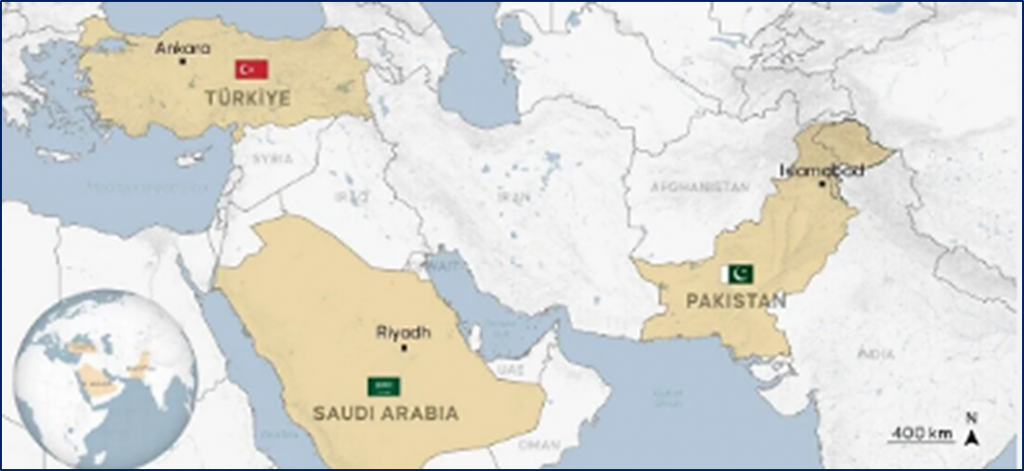
On 7 August 2026, Pakistan, Saudi Arabia and Türkiye signed a collective defence pact in Mecca, pledging mutual security and deterrence. It reflects West Asia’s shifting security order, as regional powers seek greater strategic autonomy amid conflicts and uncertainty over U.S. security commitments.
What is Driving the Agreement?
- Changing West Asian Security Architecture
- Traditional West Asian security has largely depended on the U.S. security umbrella.
- Regional conflicts and questions over the future U.S. role have encouraged countries to seek alternative security partnerships.
- The Iran-Israel conflict and attacks involving U.S. bases have increased Gulf states’ perception of vulnerability.
- Saudi Arabia’s Security Concerns
- Vulnerability to Iranian missiles and drones.
- Desire to reduce excessive dependence on external security guarantees.
- Saudi Arabia’s economic power gives it the financial capacity to support regional defence initiatives.
- Türkiye’s Strategic Ambition
- Türkiye seeks a larger role in West Asian geopolitics.
- Its growing defence-industrial capacity, particularly in drones and military technology, strengthens its strategic relevance.
- Pakistan’s Search for Strategic Space
- Pakistan seeks to expand its role beyond South Asia.
- It can potentially position itself as a security partner and mediator in West Asia.
- Defence ties with Saudi Arabia also have longstanding historical foundations.
Strategic Significance
1. Emergence of Regional Security Partnerships
- Signals a shift from dependence on the U.S. security umbrella towards regional balancing and minilateral cooperation.
- Reflects growing strategic autonomy among West Asian powers amid regional instability.
2. Collective Defence
- The principle of “attack on one = attack on all” aims to create collective deterrence against external threats.
- However, its credibility depends on actual military commitments and willingness to respond collectively.
3. Defence Interoperability
- Can promote joint exercises, intelligence sharing, defence technology and military coordination.
- Cooperation in drones, counter-drone systems and surveillance could strengthen regional capabilities.
4. Türkiye–Saudi Rapprochement
- Shows former strategic competitors moving towards cooperation based on common security interests.
- Indicates that shared regional threats can encourage pragmatic geopolitical realignment.
5. Pakistan’s Expanding West Asian Role
- Provides Pakistan an opportunity to project itself as a regional security partner beyond South Asia.
- Could enhance its diplomatic influence and strategic relevance in the Muslim world and Gulf region.
Why the Agreement May Struggle to Become a Credible Deterrent
1. Lack of Strategic Convergence
- The three countries face different threats: Saudi Arabia—Iran/Gulf security; Türkiye—regional conflicts; Pakistan—India-centric security.
- Hence, a common defence pledge may not necessarily translate into collective military action.
2. Different Strategic Priorities
- Their strategic theatres differ: Saudi Arabia—Persian Gulf; Türkiye—West Asia/Mediterranean; Pakistan—South Asia.
- Different geographical interests may limit sustained strategic and operational coordination.
3. Existing Conflicts Test Credibility
- The pact comes amid ongoing regional conflicts, raising doubts about whether partners would actually fight together during a crisis.
- Lack of clarity on command, force deployment, rules of engagement and decision-making weakens its credibility.
4. The Iran Factor
- If perceived as an anti-Iran coalition, the pact could intensify regional strategic competition.
- It may provoke Iranian counter-balancing and greater instability in the Persian Gulf.
5. Alliance ≠ Deterrence
- A formal alliance alone cannot guarantee deterrence; it requires capability, credibility and clear communication.
- The agreement shows political commitment, but its actual military credibility remains untested.
Opportunities for India (INDIA’S PERSPECTIVE)
1. Strategic Autonomy
- A more multipolar West Asia gives India greater diplomatic space and reduces dependence on any single external power.
- It strengthens India’s multi-alignment and strategic autonomy.
2. Stronger India–Saudi Arabia Relations
- India can deepen cooperation with Saudi Arabia in energy, investment, defence, infrastructure and counter-terrorism.
- The partnership can support India’s broader West Asia strategy.
3. India–Türkiye Engagement
- India should maintain pragmatic diplomatic and economic engagement with Türkiye despite differences.
- This can prevent Pakistan from gaining disproportionate strategic influence in Ankara.
4. Protection of Diaspora and Energy Interests
- Gulf stability is crucial for India’s energy supplies, trade, remittances and large diaspora.
- Regional conflict can therefore directly affect India’s economic and human security.
5. Connectivity
- A stable West Asia is essential for India’s connectivity ambitions, particularly the India–Middle East–Europe Economic Corridor (IMEC).
- Regional instability could disrupt trade routes and connectivity investments.
Concerns for India (INDIA’S PERSPECTIVE)
1. Pakistan’s Strategic Expansion
- The pact could enhance Pakistan’s image as a regional and Islamic-world security actor.
- This may increase India’s strategic and diplomatic challenges.
2. Possibility of Anti-India Spillover
- Pakistan could potentially gain military, technological or diplomatic advantages from deeper regional defence cooperation.
- These benefits may indirectly affect India’s security environment.
3. Regional Polarisation
- An explicitly anti-Iran or anti-U.S. bloc could complicate India’s relations with Saudi Arabia, Iran, Israel, Türkiye and the U.S.
- India would face greater difficulty in maintaining its balanced multi-alignment.
4. Impact on Energy Security
- Escalation in the Gulf could disrupt oil supplies, shipping and the Strait of Hormuz, affecting India.
- Higher energy prices could increase India’s import bill and inflationary pressures.
5. Maritime Security
- Instability in the Persian Gulf and Arabian Sea can threaten India’s Sea Lines of Communication (SLOCs).
- This makes maritime surveillance, naval preparedness and protection of commercial shipping increasingly important.
India’s Strategic Approach
1. Deepen Bilateral Partnerships
- Strengthen independent partnerships with Saudi Arabia, UAE, Iran, Israel and Türkiye based on India’s national interests.
- Avoid exclusive blocs and preserve India’s strategic flexibility and diplomatic space.
2. Maintain Strategic Autonomy
- India should not become part of competing West Asian security blocs or take sides in regional rivalries.
- Follow a multi-alignment approach, engaging all major regional powers.
3. Strengthen Maritime Security
- Enhance maritime domain awareness, naval cooperation and surveillance across the Arabian Sea and Indian Ocean.
- Secure India’s SLOCs and commercial shipping against conflict-related disruptions.
4. Energy Diversification
- Reduce vulnerability by diversifying crude suppliers, expanding Strategic Petroleum Reserves and promoting renewables.
- This can shield India from supply disruptions and volatile global energy prices.
5. Diplomatic Balancing
- Use India’s relationships with competing regional actors to promote dialogue, de-escalation and conflict resolution.
- India’s role should be that of a balancing and constructive partner, rather than a bloc participant.
6. Protect the Diaspora
- Strengthen early-warning, evacuation and crisis-response mechanisms for Indians living in conflict-prone regions.
- Ensure continuity of remittances, consular assistance and citizen protection during regional crises.
Conclusion
The Mecca Agreement reflects the shift towards a more multipolar West Asian security order.
For India, strategic autonomy, multi-alignment and regional balancing remain crucial.
India should protect its energy, diaspora, connectivity and maritime interests while avoiding bloc politics.