
After Reading This Article You Can Solve This UPSC Mains PYQ (2024)
Flooding in urban areas is an emerging climate-induced disaster. Discuss the causes of this disaster. Mention the features of two such major floods in the last two decades in India. Describe the policies and frameworks in India that aim at tackling such floods. (GS 3, Disaster Management)
Context
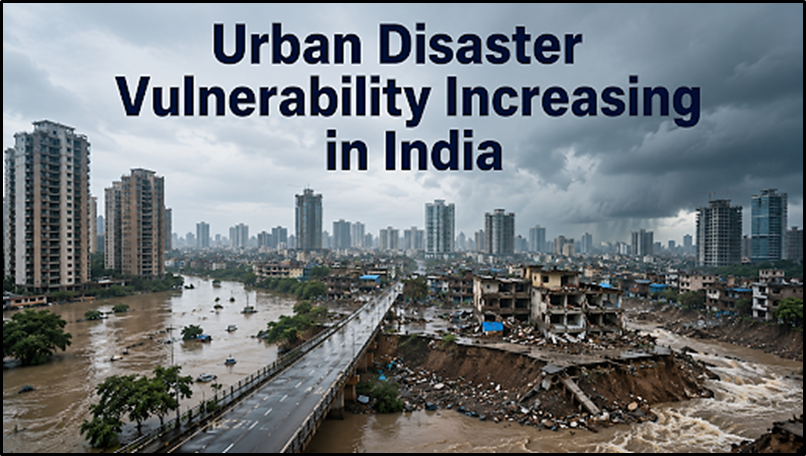
Recent extreme weather events in Gurugram severe heatwaves followed by paralyzing floods highlight a profound governance deficit. These dual crises expose how meteorological hazards swiftly transform into anthropogenic urban disasters when compounded by unregulated concretisation, compromised drainage networks, and a lack of climate-responsive spatial planning.
Introduction
Rapid urbanization and climate change have transformed Indian cities into epicenters of compounding crises. As defined by the UNDRR, a hazard becomes a disaster only when it intersects with systemic societal vulnerabilities. With India’s urban population projected to reach 951 million by 2050, shifting urban governance from reactive relief to proactive climate resilience is imperative to protect vulnerable demographics and sustain economic growth.
What is Urban Disaster Risk?
- It is the outcome of a natural hazard (like a heatwave, cloudburst, or cyclone) striking a location where people, buildings, and public services are highly exposed and lack the capacity to withstand it.
- In cities, risks are exacerbated by hydrological choke points (narrowed natural drains, encroached wetlands) and the Urban Heat Island (UHI) effect (dense construction trapping heat).
Legislative Basis
- The Disaster Management (Amendment) Act, 2025 inserted Section 41A, mandating the creation of Urban Disaster Management Authorities (UDMAs) in state capitals and major municipal corporations.
- The 2026-31 Finance Commission included heatwaves and lightning as notified natural calamities, allowing states to unlock specific disaster response and mitigation funds.
Significance of Building Urban Resilience
1. Future-Proofing Urban Infrastructure
- Over half of the infrastructure Indian cities will need by 2050 is yet to be built.
- Integrating climate risk assessments now prevents the locking-in of structural vulnerabilities and averts future catastrophic losses.
2. Financial Prudence and Loss Prevention
- Proactive adaptation is highly lucrative; timely interventions could prevent $5 billion in annual flood losses by 2030 and save over 130,000 lives from extreme heat by 2050.
- It protects against the invisible economic toll, such as lost wages for informal workers and the disruption of MSMEs.
3. Empowering Decentralised Governance
- The establishment of UDMAs marks a paradigm shift from ad-hoc, district-level responses to institutionalized, city-specific disaster management.
- It empowers local municipal commissioners to lead tailored, localized mitigation strategies.
4. Mitigating the Urban Heat Island (UHI) Effect
- Proper planning ensures neighbourhoods do not absorb and retain dangerous levels of heat, which currently makes city centres 3-4°C hotter than surrounding areas.
- It directly shields outdoor workers and residents of poorly ventilated slums from fatal heat exposure.
5. Data-Driven Policy Formulation
- The legislative mandate for a national database containing real-time risk assessments ensures that urban master planning is backed by scientific, localized data.
- This facilitates the creation of actionable flood and heat hazard maps to guide urban expansion.
Challenges Associated with Urban Climate Resilience
1. Implementation Lethargy and Ambiguity
- The 2025 amendment lacks strict deadlines for UDMA formation. By early 2026, Karnataka was the only state to have notified an authority for Bengaluru.
- This leaves major metropolitan centers structurally blind and unprepared for impending crises.
2. Severe Capacity and Planning Deficit
- A NITI Aayog report highlighted that 65% of India’s urban settlements lack a master plan.
- State planning departments suffer from massive vacancies, having fewer than 4,000 town planners against an estimated requirement of 12,000.
3. Institutional Fragmentation
- Urban governance remains siloed, with responsibilities haphazardly split between municipal corporations, district administrations, and state departments.
- This overlapping jurisdiction leads to a lack of accountability and poor coordination during emergencies.
4. Poor Enforcement of Master Plans
- Climate action plans and zoning regulations exist largely as advisory documents.
- They routinely fail to halt lucrative real estate and road projects that encroach upon critical floodplains, lakes, and open spaces.
5. Reactive Financing Models
- Despite recent amendments, financial mechanisms heavily favor post-disaster relief rather than mitigation.
- There is a lack of structural frameworks linking municipal infrastructure grants directly to climate-resilient land-use compliance.
Global Best Practices
1. China – Sponge City Initiative
- Focuses on managing urban flood risks by using permeable surfaces, green roofs, and constructed wetlands to absorb and reuse 70% of rainwater.
- Shifts urban infrastructure from “grey” (concrete) to “blue-green” (natural), heavily reducing the burden on artificial drainage.
2. Netherlands – Room for the River Programme
- Instead of building higher dams, the framework restores natural floodplains to give rivers more space to manage high water levels.
- Integrates spatial planning with water management to ensure long-term ecological and infrastructural safety.
Way Forward
1. Statutory Integration of Risk Mapping
- Micro-level flood and heat hazard maps must be legally embedded into city master plans.
- These maps should dictate strict “no-build” zones, building plinth levels, and mandatory ventilation standards.
2. Deadline-Driven Institutionalization of UDMAs
- The Union Government must enforce strict timelines for States to operationalize UDMAs.
- These authorities must be equipped with dedicated budgets and the power to coordinate diverse municipal and emergency services.
3. Aggressive Capacity Building
- Urgently bridge the human resource deficit by recruiting qualified urban planners, hydrologists, and climate scientists into local governance.
- Technical experts are needed to ensure development decisions account for hazard exposure and resilience measures.
4. Conditional Financial Devolution
- Link infrastructure grants and municipal funding directly to a city’s compliance with land-use rules, drainage maintenance, and green-cover preservation.
- Financing must structurally extend beyond post-disaster relief.
5. Invest in Blue-Green Infrastructure (BGI)
- Mandate nature-based engineering solutions, such as permeable pavements, wetland restoration, and expansive urban tree canopies.
- This naturally mitigates both the Urban Heat Island effect and localized flooding.
6. Actionable Early Warning Systems (EWS)
- Move beyond passive weather alerts by instituting standardized, pre-agreed action protocols.
- Warnings should automatically trigger mandatory outdoor work halts, hospital readiness, and school closures based on specific weather thresholds.
Conclusion
While extreme weather events are inevitable byproducts of climate change, urban disasters are the result of human planning failures. As India stands on the cusp of an unprecedented urban transition, integrating statutory climate resilience into daily governance is non-negotiable to ensure our cities remain safe, sustainable engines of economic growth.
| Important Current to Concept (CTC) from this Article for UPSC 1. India Meteorological Department (IMD) 2. Urban Heat Island (UHI) effect |