
After Reading This Article You Can Solve This UPSC Mains Model Question:
“The Supreme Court’s mandate on the OBC creamy layer income test attempts to rectify ‘hostile discrimination,’ yet poses severe administrative challenges. Analyze the complexities and suggest measures to balance constitutional equality with administrative feasibility.” 15 Marks (GS-2, Social Justice)
Context
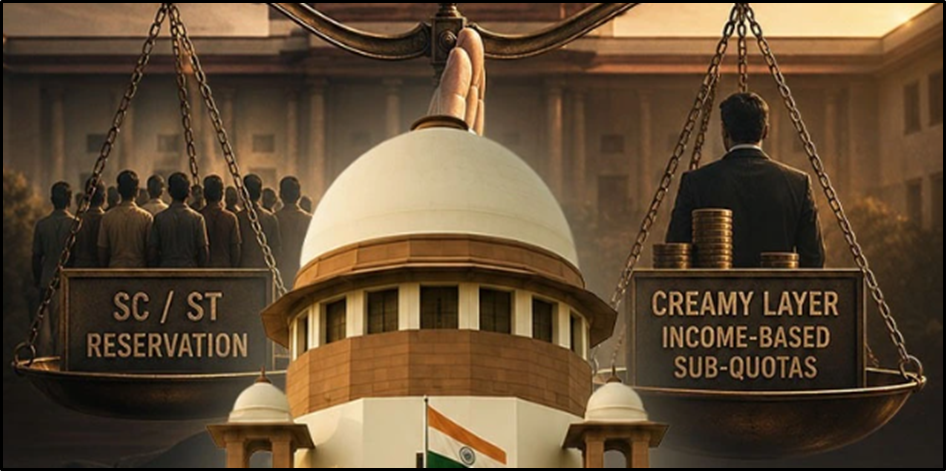
The Supreme Court is reviewing the Centre’s plea regarding the March 11 judgment on the OBC creamy layer exclusion criteria. The Centre argues that retrospective implementation of the income/wealth test from 2012 is extremely difficult and will cause a severe cascading effect across all civil service allocations, including the Unreserved category.
Introduction
The creamy layer concept emerged from the 1992 Indra Sawhney judgment to exclude privileged OBCs from reservation benefits. Recent judicial scrutiny highlights arbitrary interpretations by the Department of Personnel and Training (DoPT), emphasizing the urgent need for equitable policy application between government and private/PSU employees to uphold the right to equal opportunity.
About Creamy Layer of OBC
The Creamy Layer refers to the wealthier and better-educated segment within the OBC category. These individuals are considered socially advanced and are subsequently excluded from reservation benefits in public jobs, education, and government welfare schemes meant for socially and educationally backward classes.
Eligibility Criteria for Creamy Layer (As of 2026)
- Income Limit: Annual family income exceeds ₹8 lakh.
- Categories Included: Individuals holding constitutional posts, Group A/Class I and Group B/Class II government officers, PSU employees, professionals, businesspersons, and property owners.
- Service-Based Criteria: Children of Group A officers or those promoted to Group A before the age of 40. Similarly, if both parents are Group B direct recruits, their children are excluded.
- Armed Forces Personnel: Officers holding ranks above Lieutenant Colonel are classified under the creamy layer.
Non-Creamy Layer of OBC
The Non-Creamy Layer refers to the economically and socially backward segment of OBCs. This specific group genuinely qualifies for affirmative action and reservation benefits in education, employment, and targeted government schemes.
Eligibility Criteria for Non-Creamy Layer:
- Income Limit: Annual family income is strictly less than ₹8 lakh.
- Employment Status: Parents are not employed in senior government posts or high-earning private positions.
- Certification Requirement: Must officially obtain a Non-Creamy Layer Certificate to avail of reservation quotas.
Difference Between Creamy Layer and Non-Creamy Layer of OBC
The classification ensures an equitable distribution of reservation benefits. While SC/ST categories do not have a creamy layer restriction, OBCs are distinctly divided.
| Aspect | Creamy Layer of OBC | Non-Creamy Layer of OBC |
| Eligibility for Reservation | Not eligible | Eligible |
| Annual Income Limit | Above ₹8 lakh | Below ₹8 lakh |
| Social Status | Economically and socially advanced | Economically and socially backward |
| Government Job Criteria | Parents in Group A/Group B jobs | Parents in lower categories or unemployed |
| Purpose of Classification | To exclude affluent OBCs from benefits | To provide benefits to the truly backward |
| Proof Required | No certificate needed | Must obtain a Non-Creamy Layer Certificate |
Significance of the Supreme Court Ruling on the Income Test
1. Rectifies Hostile Discrimination
- Eliminates arbitrary treatment by ensuring OBC candidates with parents in PSUs or the private sector are not evaluated differently from those in government services.
2. Clarifies the ‘Residual Filter’ Concept
- Validates the 1993 Office Memorandum (OM), establishing that the income/wealth test must strictly act as a residual filter, explicitly leaving out salaries and agricultural income.
3. Protects Deserving Aspirants
- Prevents the unjust denial of reservation benefits to eligible candidates based solely on gross parental income, securing the rights of at least 50 candidates wrongfully excluded since 2015.
4. Upholds Constitutional Equality
- Ensures that similarly placed individuals are evaluated using uniform metrics, preventing equals from being treated unequally under the law.
5. Resolves Policy Ambiguities
- Invalidates the conflicting interpretations arising from the 2004 DoPT letter, restoring the original intent of the exclusion criteria and standardizing non-government employment evaluations.
Challenges in Implementing the Supreme Court Directives
1. Retrospective Administrative Burden
- Revising settled Civil Services Examinations (CSE) allocations back to 2012 poses severe logistical nightmares and disrupts established bureaucratic frameworks.
2. The “Cascading Effect” on Seniority
- Adjusting existing service strengths by creating supernumerary posts will alter seniority lists and negatively impact promotional avenues for all candidates, including the Unreserved category.
3. Risk of Elite Capture
- The Centre argues that ignoring salary income entirely might allow highly affluent OBC candidates (e.g., parents earning up to ₹1 crore) to exploit non-creamy layer status.
4. Disruption of Ongoing Recruitment
- Over 950 recommended candidates for CSE 2025 face immediate uncertainty, as their Foundation Course allocations were based on the older income test interpretation.
5. Surge in Judicial Litigation
- The March 11 judgment has triggered 22 new court orders and 12 fresh cases from previously unrepresented candidates, complicating final allocations and increasing the judicial burden.
6. Absence of Post Equivalence Data
- The foundational delay in establishing equivalence between Central/State PSUs and regular government services leaves the DoPT without a concrete metric to evaluate non-government dependents.
Way Forward
1. Establish Post Equivalence Urgently
- The government must immediately finalize the equivalence of posts between PSUs, the private sector, and government services to remove the core ambiguity in the income test.
2. Explore Prospective Application
- To protect the settled seniority of past civil service batches, the Judiciary and Executive should consider applying the ruling prospectively to safeguard existing administrative structures.
3. Revise Income Criteria Comprehensively
- Formulate a nuanced wealth test that balances the exclusion of basic salaries while introducing caps to prevent elite capture by extremely high earners.
4. Enhance Inter-Ministerial Coordination
- Establish synergy between the DoPT and the Ministry of Social Justice and Empowerment to formulate a unified, discrimination-free policy on reservations as per the Allocation of Business Rules.
5. Formulate a Clear Judicial Roadmap
- The newly constituted Supreme Court Bench must provide a precise, step-by-step implementation guide to aid the DoPT in navigating the current administrative gridlock.
6. Conduct Stakeholder Consultations
- Engage legal and administrative experts to systematically address the grievances of newly filing candidates without collapsing the unreserved category structure.
7. Fast-Track Redressal for Excluded Candidates
- Develop a dedicated, time-bound committee to review the claims of the 50 petitioners and the 12 new applicants to ensure rapid, targeted relief without disrupting the broader service grid.
Conclusion
Balancing constitutional equality with administrative stability remains paramount. A pragmatic policy resolution is essential to ensure that affirmative action reaches the truly marginalized OBC segments without destabilizing the foundational hierarchy of India’s civil services.
| Important Current to Concept (CTC) from this Article for UPSC What is the ‘Creamy Layer’ |