
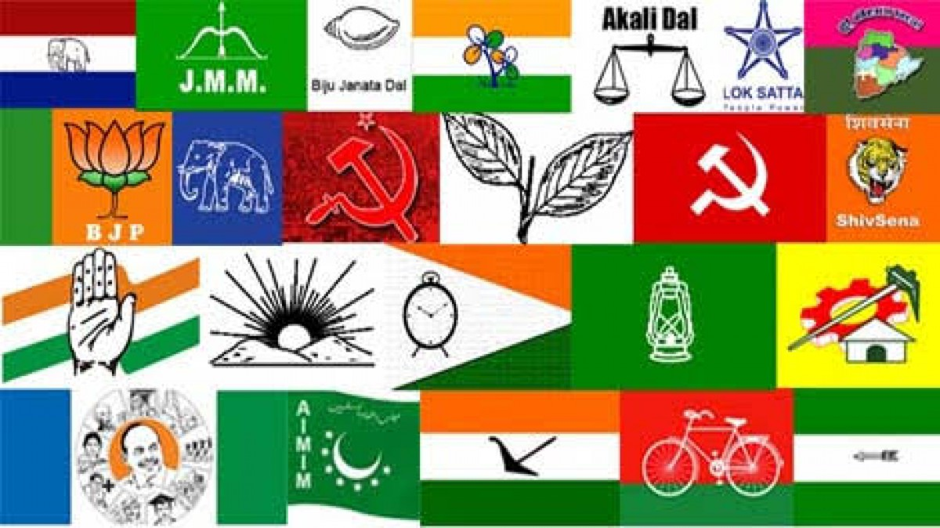
What is Political Party
A political party is an organized group of individuals that aggregates public interests, contests elections, forms governments, and shapes public policy within a representative democracy.
Constitutional and Legal Framework
Although not explicitly defined in the Constitution, Indian political parties are governed by a network of laws and provisions:
- Article 19(1)(c): Guarantees the right to form associations.
- Article 324: Grants the Election Commission of India (ECI) control over elections.
- Representation of the People Act, 1951 (Section 29A): Mandates party registration.
- Election Symbols Order, 1968: Regulates party recognition and symbol allocation.
- 10th Schedule (52nd Amendment): Governs anti-defection measures.
Registration and Classification
Parties must register with the ECI under Section 29A of the RPA, 1951, within 30 days of formation, pledging allegiance to the Constitution. The ECI classifies them based on electoral performance:
- National Parties: Must secure specific vote shares (e.g., 6% across four states) or seat thresholds (e.g., 2% of Lok Sabha seats). India currently has six recognized National Parties.
- State Parties: Must meet distinct state-level vote or seat requirements.
- Registered Unrecognised Political Parties (RUPPs): The vast majority of parties (over 2,700). They can contest elections but do not receive permanently reserved symbols.
Core Functions
Political parties sustain representative democracy by:
- Selecting candidates and contesting elections.
- Aggregating public interests and shaping policy manifestos.
- Forming governments or operating as the opposition to ensure accountability.
- Acting as the primary bridge between citizens and the state.
Evolution of the Party System
India’s political landscape has shifted significantly since independence:
- 1950s–1960s: Single-party dominance (the “Congress System”).
- 1967 Onwards: Emergence of strong regional and opposition parties.
- Late 1980s–2014: The era of coalition governments (e.g., NDA, UPA).
- 2014–2019: Return to single-party majorities.
- 2024 Onwards: Renewed reliance on coalition politics.
Committees on Electoral and Political-Party Reforms
Successive expert bodies have proposed systemic frameworks to strengthen India’s electoral integrity. Key committee interventions include:
- Tarkunde Committee (1975): Proposed state funding for elections.
- Dinesh Goswami Committee (1990): Recommended limited, in-kind state funding (e.g., fuel, electoral rolls).
- Vohra Committee (1993): Investigated the nexus between politicians, criminals, and bureaucrats.
- Indrajit Gupta Committee (1998): Advocated partial, in-kind state funding exclusively for recognized parties.
- 170th Law Commission (1999): Supported state funding, contingent on establishing robust regulatory frameworks for parties.
- National Commission to Review the Working of the Constitution (NCRWC) (2001–02): Opposed state funding unless strict party regulations were implemented first.
- 2nd ARC (2007): Backed partial state funding to curb illegitimate electoral spending.
- 255th Law Commission (2015): Proposed mandatory intra-party elections, statutory caps on party campaign expenditures, and expanded ECI deregistration powers.
Conclusion
Political parties are the foundational engines of India’s parliamentary democracy, translating diverse citizen aspirations into actionable governance. However, continuous electoral reforms remain absolutely essential to ensure their operational transparency and financial accountability.
| This concept has been elaborately discussed in the following article — The Architecture of Political Finance: Balancing Democratic Participation with Accountability |