
Context
- Recently, Scientists have discovered a new species of legless amphibian, Gegeneophis chandgadi, from Chandgad in Kolhapur district, Maharashtra. The discovery takes the number of known Gegeneophis species in India to 12, of which 11 are endemic to the Western Ghats.
About Gegeneophis chandgadi
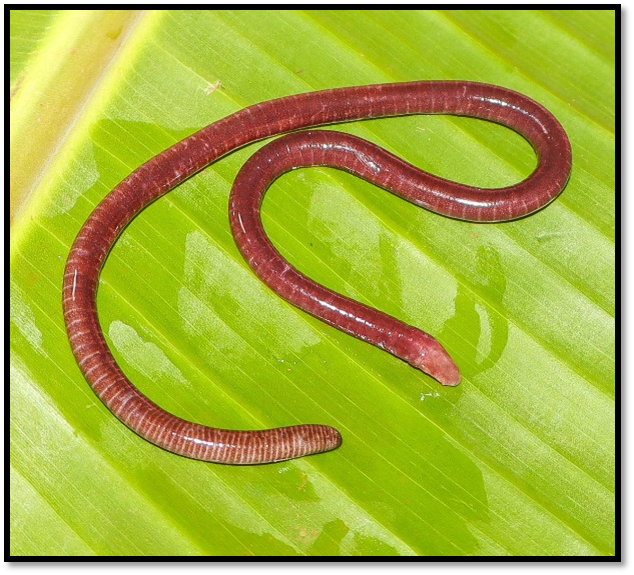
- New Species: Gegeneophis chandgadi is a newly described caecilian, a limbless, burrowing amphibian belonging to the order Gymnophiona.
- Location: It was discovered near Buzawade village in Chandgad, Kolhapur district, Maharashtra, in the Northern Western Ghats.
- Physical Features: It has a slender, flesh-coloured, worm-like body with ring-like folds called annuli.
- Habitat: Like other caecilians, it is adapted to a subterranean lifestyle, spending most of its life in moist soil.
- Naming Classification: The species name chandgadi pays tribute to the local culture, being named after the Chandgadi language, a distinct dialect of Marathi spoken by the people of the region where the species was discovered.
What are Caecilians?
- Caecilians are legless, elongated amphibians adapted mainly to a burrowing lifestyle.
- Their worm-like appearance can lead to confusion with earthworms or snakes, but they are amphibians.
- They generally live underground or in moist soil, making them difficult to detect.
- Their reduced eyes and specialised sensory structures reflect their subterranean adaptation.
- Caecilians constitute one of the three living orders of amphibians.
Ecological Importance of Caecilians
- Soil Health: Burrowing helps maintain soil aeration and nutrient cycling.
- Food Web: Act as both predators and prey in soil ecosystems.
- Bioindicators: Their dependence on moist habitats can indicate ecosystem health.
- Biodiversity: Their high endemism reflects the unique biodiversity of the Western Ghats.
Gegeneophis chandgadi
- Group: Caecilian
- Order: Gymnophiona
- Genus: Gegeneophis
- Distribution: Northern Western Ghats, Maharashtra
- Habitat: Moist soil and subterranean environments
- Endemism: Part of the highly endemic caecilian diversity of the Western Ghats.
| Important CTC from this article for UPSC: Zoological Survey of India |
Q. With reference to caecilians, consider the following statements:
1. They are legless amphibians belonging to the order Gymnophiona.
2. They are primarily adapted to a subterranean or burrowing lifestyle.
3. All caecilian species found in India are endemic to the Western Ghats.
Which of the statements given above is/are correct?
(a) 1 and 2 only
(b) 2 and 3 only
(c) 1 and 3 only
(d) 1, 2 and 3
Answer: A. 1 and 2 only
Statement 1 is Correct: Caecilians are legless amphibians belonging to the order Gymnophiona.
Statement 2 is Correct: They are generally burrowing and subterranean, living in moist soil and leaf litter.
Statement 3 is Incorrect: While most Indian Gegeneophis species are endemic to the Western Ghats, it is incorrect to state that all caecilians in India are endemic to the Western Ghats.