
Context
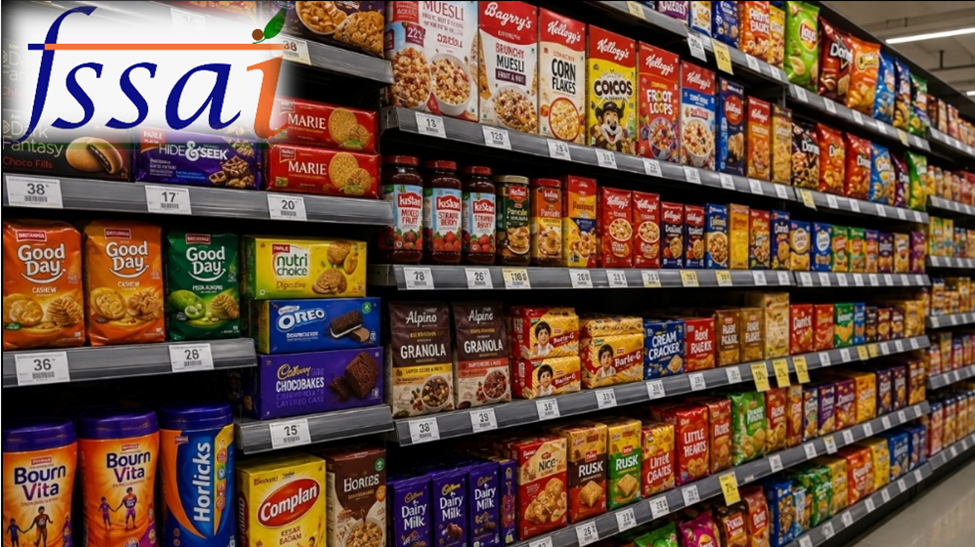
- Recently, the Supreme Court has sought clarity from the Food Safety and Standards Authority of India (FSSAI) on its proposed front-of-pack warning labels for packaged foods high in added sugar, salt and fat. FSSAI has proposed red hexagonal warning labels, with nutrient thresholds linked to the Dietary Guidelines for Indians, 2024.
Supreme Court’s Key Concerns
- Ambiguous Nutrient Thresholds: Questioned the clarity and scientific methodology FSSAI uses to determine when packaged food is classified as “high” in salt, sugar, or saturated fats.
- Child and Public Health Risks: Emphasized that weak or delayed food safety standards pose direct long-term health risks, particularly to growing children.
- Regulatory Laxity: Urged FSSAI to treat front-of-pack warning label enforcement as a critical matter of “national interest” rather than delaying action.
What are Front-of-Pack Warning Labels?
- Front-of-Pack Labelling (FoPL) provides simplified nutritional information on the front side of packaged food, allowing consumers to identify important health-related information quickly.
- Warning labels are intended to highlight products containing high levels of nutrients of concern, such as sugar, salt/sodium and fats.
- FSSAI’s proposed system uses a red hexagonal warning to alert consumers when a packaged food crosses the prescribed threshold for specified nutrients.
Basis for Determining “High” Levels
- FSSAI has indicated that the proposed thresholds would be based on the Dietary Guidelines for Indians, 2024.
- These guidelines were developed by the ICMR–National Institute of Nutrition (ICMR-NIN).
- The Supreme Court has sought greater clarity on how the regulator will determine the threshold beyond which a food product will be classified as “high” in sugar, salt or fat.
About FSSAI
- FSSAI is India’s statutory food-safety regulator.
- It was established under the Food Safety and Standards Act, 2006.
- It works under the Ministry of Health and Family Welfare.
- Its broad mandate includes:
- Setting food standards.
- Regulating the manufacture, storage, distribution, sale and import of food.
- Ensuring the availability of safe and wholesome food.
- Providing scientific and regulatory frameworks for food safety.
| Important Current to Concept (CTC) from this Article for UPSC FSSAI |
Q. With reference to front-of-pack warning labels in India, consider the following statements:
1. FSSAI has proposed prominent warning labels on packaged foods containing high levels of specified nutrients such as added sugar, added fat and salt.
2. The proposed thresholds are linked to the Dietary Guidelines for Indians, 2024.
3. FSSAI is a statutory authority established under the Food Safety and Standards Act, 2006.
4. Front-of-pack labelling is intended only to provide information about the manufacturing and expiry dates of packaged food.
Which of the statements given above are correct?
(a) 1, 2 and 3 only
(b) 1 and 4 only
(c) 2, 3 and 4 only
(d) 1, 2, 3 and 4
Answer: (a) 1, 2 and 3 only
Explanation
• Statement 1 – Correct: FSSAI has proposed prominent warning labels for packaged foods high in specified nutrients such as added fat, added sugar and salt.
• Statement 2 – Correct: The proposed thresholds are to be based on the Dietary Guidelines for Indians, 2024, issued by ICMR-NIN.
• Statement 3 – Correct: FSSAI is a statutory authority established under the Food Safety and Standards Act, 2006.
• Statement 4 – Incorrect: Front-of-pack labelling primarily provides simplified nutritional information, not merely manufacturing or expiry details.