
Context
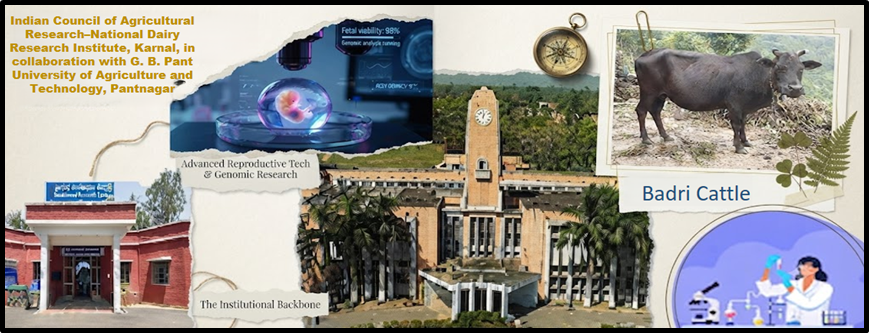
- Recently, a healthy Badri female calf was successfully born through Ovum Pick-Up and In Vitro Fertilization (OPU-IVF) technology, marking an important step towards the conservation and genetic improvement of Uttarakhand’s indigenous Badri cattle breed.
- The reproductive technology, jointly developed by ICAR–National Dairy Research Institute (NDRI), Karnal, and G. B. Pant University of Agriculture and Technology, Pantnagar, marks an important step towards the conservation and genetic improvement of the Badri breed.
Key Highlights of the Achievement
- Breed Significance: Badri cattle are the indigenous state animal of Uttarakhand.
- Collaborating Institutions: ICAR–National Dairy Research Institute (ICAR-NDRI), Karnal, and G. B. Pant University of Agriculture and Technology, Pantnagar, with funding from the Uttarakhand Biotechnology Council, Haldi.
What is OPU-IVF?
- Ovum Pick-Up (OPU): A technique in which oocytes (egg cells) are collected from genetically valuable female animals, generally through ultrasound-guided procedures.
- In Vitro Fertilization (IVF): The collected oocytes are matured and fertilised with semen under controlled laboratory conditions.
- Embryo Transfer: The resulting embryos are transferred into synchronised recipient cows for gestation.
- Advantage: Enables the production of multiple embryos from elite females, potentially accelerating the multiplication of superior germplasm compared with conventional reproductive methods.
About Badri Cattle
- Indigenous Breed: Badri cattle are an important indigenous cattle genetic resource of Uttarakhand.
- State Animal: Badri cattle are recognised as the state animal of Uttarakhand.
- Conservation: Advanced reproductive technologies such as OPU-IVF and embryo transfer can support their long-term conservation and genetic improvement.
- Characteristics: Badri cattle are relatively small in size, with varied coat colors ranging from black, brown, red, and white to gray. Badri is reared mainly for bullock power, milk and manure.
Significance for Himalayan Livestock Development
- The initiative demonstrates how indigenous genetic resources can be integrated with advanced reproductive biotechnology.
- It supports the conservation of indigenous breeds, faster multiplication and wider dissemination of elite germplasm, and genetic improvement of valuable cattle.
- It also promotes sustainable livestock development and strengthens cattle breeding in the Himalayan region.
| Important CTC from this article for UPSC Ovum Pick-Up and In-Vitro Fertilization (OPU-IVF) technology National Dairy Research Indtitute ICAR |
Q. Consider the following statements regarding the recent advancement in Badri cattle conservation:
I. Badri cattle are recognized as the state animal of Uttarakhand.
II. The OPU-IVF embryo transfer for the landmark calf was successfully carried out using a Holstein Friesian recipient cow.
III. The collaborative research was initiated in 2023 under the leadership of G. B. Pant University and ICAR-NDRI.
Which of the statements given above are correct?
(a) I and II only
(b) I and III only
(c) II and III only
(d) All of the above
Answer: (b)
Explanation:
• Statement I is Correct: Badri cattle are an important indigenous genetic resource recognized as the state animal of Uttarakhand.
• Statement II is Incorrect: The embryo was transferred into a Sahiwal recipient cow, not a Holstein Friesian cow.
• Statement III is Correct: The research programme was initiated in 2023 through scientific collaboration between G. B. Pant University and ICAR-NDRI.