
Context
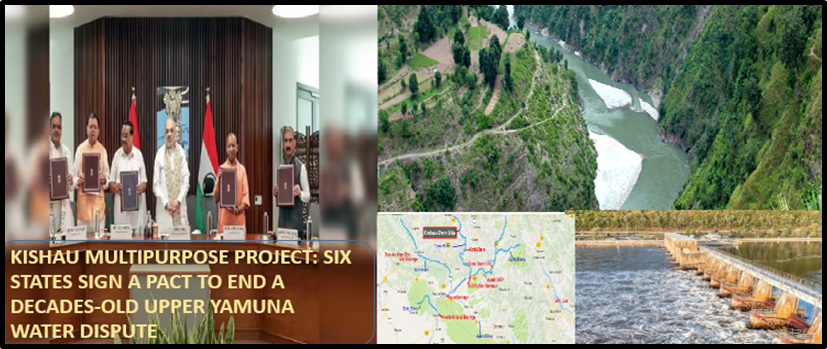
Recently, six states – Himachal Pradesh, Haryana, Uttarakhand, Uttar Pradesh, Delhi, and Rajasthan—have signed a milestone agreement to implement the ₹15,624-crore Kishau Multipurpose Project, marking the resolution of a long-standing inter-state water sharing dispute.
Key Points of the Agreement:
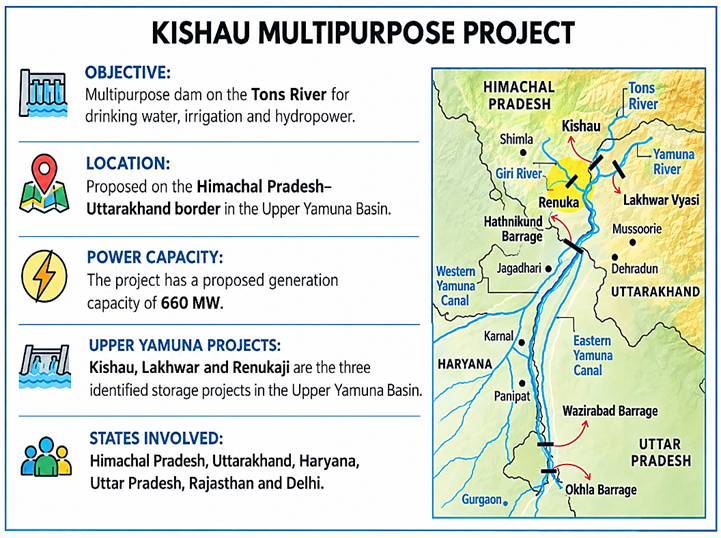
- Participating States: Himachal Pradesh, Uttarakhand, Haryana, Uttar Pradesh, Delhi, and Rajasthan.
- Location: A 232.6-metre-high dam built on the Tons River (a major tributary of the Yamuna) on the border between Himachal Pradesh and Uttarakhand.
- Total Cost & Funding: The Central Government will pay around 90% of the cost, and the remaining 10% will be shared among the six states.
Main Benefits of the Project:
- Electricity: Generates 422 MW of hydropower (approx. 1,476 million units of clean electricity per year).
- Irrigation: Provides water to irrigate roughly 97,000 hectares of farmland.
- Drinking Water: Delhi will be a major beneficiary, receiving around 110 million cubic metres of drinking water annually to address shortages.
| Important CTC from this article for UPSC – Hydropower Development in the Himalayan Region Kishau Multipurpose Project |
Q. Consider the following statements regarding the Kishau Multipurpose Project:
I. It is proposed on the Tons river along the Himachal Pradesh--Uttarakhand border.
II. It has a proposed installed capacity of 422 MW and an estimated cost of ₹15,624 crore.
III. Under the 1994 agreement, the Centre will bear about 50 per cent of the project cost.
Which of the statements given above is/are correct?
(a) I only
(b) I and II only
(c) II and III only
(d) I, II and III
Answer: (b)
Explanation:
• Statement I -- Correct: The dam is to be built on the Tons, a Yamuna tributary, straddling the Himachal Pradesh--Uttarakhand border.
• Statement II -- Correct: The 422 MW project carries an estimated cost of ₹15,624 crore.
• Statement III -- Incorrect: The Centre will bear approximately 90 per cent of the financial burden, with the participating States contributing the remaining 10 per cent.