
About
- Ultraviolet radiation is a form of electromagnetic radiation with wavelengths shorter than visible violet light but longer than X-rays.
- Wavelength: approximately 100–400 nm
- Source: Primarily the Sun
- Energy: Higher than visible light because of its shorter wavelength.
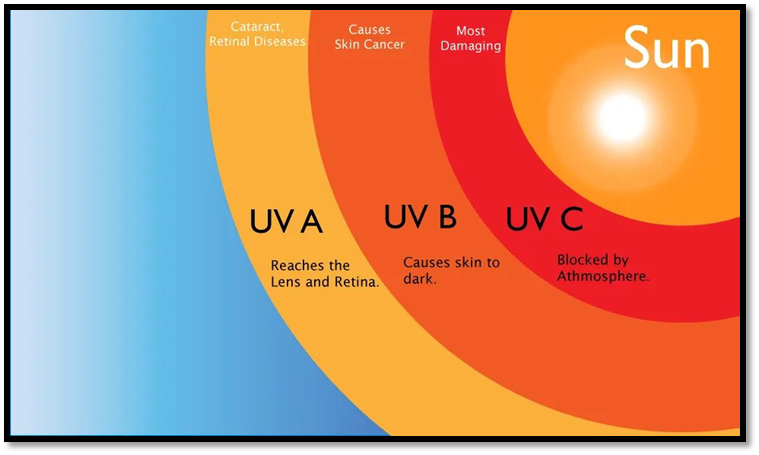
- UV radiation is divided into UVA, UVB and UVC based on wavelength.
Three Types of UV Radiation
| Type | Wavelength | Atmospheric Behavior | Biological & Environmental Impact |
| UVA | 315–400 nm (Longest) | Not absorbed by the ozone layer; reaches Earth entirely. | Penetrates deep into skin; causes premature aging, tanning, and indirect DNA damage. |
| UVB | 280–315 nm (Medium) | Mostly absorbed by the ozone layer, but some reaches the surface. | Causes sunburns, skin cancer, cataracts; vital for human Vitamin D synthesis. |
| UVC | 100–280 nm (Shortest) | Completely absorbed by oxygen and ozone in the stratosphere. | Most lethal and energetic; does not reach the Earth’s surface naturally. |
Conclusion:
- Understanding UVA, UVB and UVC is essential to link UV exposure, ozone-layer protection and associated health and environmental impacts.
| This concept has been elaborately discussed in the following article – Montreal Protocol and the Road to Ozone Recovery |