
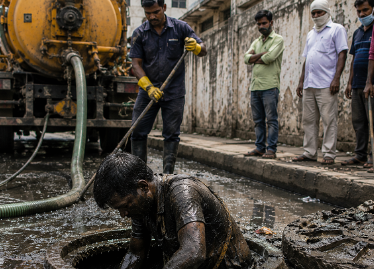
Manual Scavenging (What is it?)
- Manual scavenging refers to the manual removal, carrying, disposal or handling of human excreta from insanitary latrines and specified insanitary conditions.
- It is a caste-based, degrading and hazardous occupation historically imposed on marginalised communities.
- The practice is prohibited under the Prohibition of Employment as Manual Scavengers and their Rehabilitation Act, 2013.
- The Act replaced the earlier Employment of Manual Scavengers and Construction of Dry Latrines (Prohibition) Act, 1993.
- The Ministry of Social Justice and Empowerment is the nodal ministry responsible for its implementation.
- The Act aims to prohibit manual scavenging, prevent hazardous sanitation work and rehabilitate identified manual scavengers.
Key Features of the 2013 Act
- Prohibition of Manual Scavenging: Prohibits employment of persons as manual scavengers and construction or maintenance of insanitary latrines.
- Prohibition of Hazardous Cleaning: Prohibits hazardous cleaning of sewers and septic tanks without prescribed protective equipment and safety precautions.
- Identification and Rehabilitation: Provides for identification and rehabilitation of manual scavengers through financial assistance, skill development and alternative livelihood opportunities.
- Offences and Penalties: Prescribes imprisonment and fines for violations of the Act.
- Responsibility of Local Authorities: Mandates local authorities to ensure insanitary latrines are converted or demolished and sanitation facilities are properly maintained.
Constitutional Provisions
- Article 14: Guarantees equality before the law and equal protection of laws.
- Article 17: Abolishes untouchability and prohibits its practice in any form.
- Article 21: Protects the right to life and personal dignity.
- Article 23: Prohibits forced labour and other forms of exploitation.
- Article 46: Directs the State to promote the educational and economic interests of weaker sections, particularly Scheduled Castes and Scheduled Tribes.
Conclusion
Eliminating manual scavenging requires more than legal prohibition; it demands mechanisation, rehabilitation, social security and the dismantling of caste-based occupational discrimination. Ensuring the dignity and safety of sanitation workers is essential to achieving the constitutional vision of equality and social justice.
| This Concept has been discussed in the following article: DANGER IN THE SEWER: ELIMINATING SEWER CLEANING DEATHS IN INDIA |