
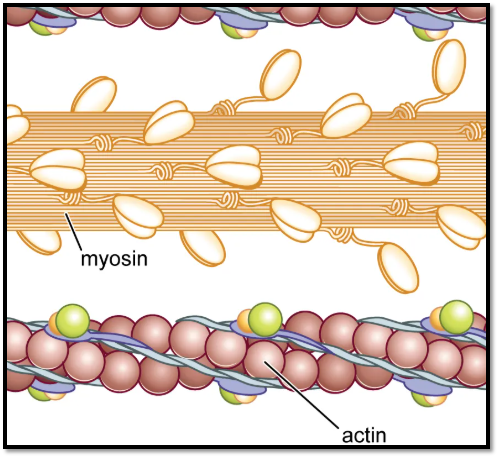
About Myosin
- Myosin is a family of motor proteins that convert chemical energy derived from ATP (Adenosine Triphosphate) into mechanical energy to produce movement.
- It plays a crucial role in muscle contraction, cellular movement and intracellular transport.
- Myosin works in association with actin filaments, which are components of the cell’s cytoskeleton.
- It is found in almost all eukaryotic cells and is particularly important in skeletal, cardiac and smooth muscles.
- Myosin moves along actin filaments through repeated cycles of ATP binding, hydrolysis and release.
Structure of Myosin
Myosin molecules generally consist of three major regions:
- Head Region: Contains ATP-binding and actin-binding sites and is responsible for generating mechanical force.
- Neck Region: Acts as a lever arm and is associated with light chains that regulate movement.
- Tail Region: Helps in binding to cellular structures, cargo transport and assembly of myosin molecules.
Types of Myosin
- Myosin I: Primarily involved in intracellular transport, membrane movement and organisation of the cell surface.
- Myosin II: Responsible for muscle contraction and generating contractile forces in non-muscle cells.
- Myosin V: Plays an important role in transporting cellular cargo, including vesicles and organelles.
- Myosin VI: Involved in intracellular transport and generally moves towards the pointed end of actin filaments, unlike most other myosins.
Major Functions of Myosin
- Muscle Contraction: Enables skeletal, cardiac and smooth muscles to generate force and movement.
- Intracellular Transport: Facilitates the movement of vesicles, organelles and other cellular materials.
- Cell Division: Helps in cytokinesis, the process through which a parent cell divides into two daughter cells.
- Cell Movement: Supports cellular migration and changes in cell shape.
- Cellular Organisation: Helps maintain cell structure and regulate the organisation of the cytoskeleton.
Conclusion
Myosin is an essential motor protein that converts ATP-derived chemical energy into mechanical work. Its interaction with actin is fundamental to muscle contraction, intracellular transport, cell division and several other cellular activities.
| This concept has been mentioned in the following article: Maternal Genes Determine Left- and Right-Handed Shell Coiling in Snails |