
After Reading This Article You Can Solve This UPSC Mains Model Question:
Despite legislative safeguards and judicial interventions, sewer cleaning deaths continue in India. Examine the structural challenges responsible for this persistent problem and suggest measures to ensure the safety and dignity of sanitation workers. 15 Marks (GS 2, Social Justice)
Context
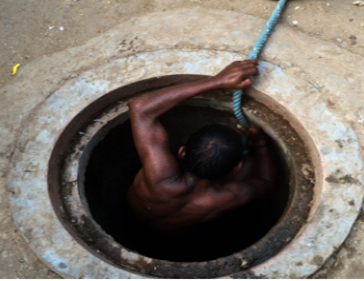
The recent death of four sanitation workers while cleaning a hotel’s food-waste chamber in Ujjain, Madhya Pradesh, highlights the persistent prevalence of unsafe sanitation practices in India. Between 1993 and 2025, approximately 1,350 workers died in sewer and septic tank cleaning-related incidents.
Introduction
Manual scavenging involves the manual removal of human excreta, often under hazardous conditions. Rooted in caste-based discrimination, it reflects deep social inequality and human indignity. Despite its prohibition under the 2013 Act, weak enforcement and inadequate mechanisation allow its persistence, violating constitutional values of equality and dignity.
Background: Understanding the Issue
A. Manual Scavenging vs Hazardous Sewer Cleaning
- Manual Scavenging: Manual handling and disposal of human excreta from insanitary latrines and other specified places.
- Hazardous Sewer Cleaning: Entry into sewers and septic tanks without prescribed safety precautions and protective equipment.
B. Constitutional and Legal Framework
- Article 17: Abolishes untouchability and prohibits its practice in any form.
- Article 21: Guarantees the right to life with dignity, including protection from hazardous working conditions.
- Prohibition of Employment as Manual Scavengers and their Rehabilitation Act, 2013: Prohibits manual scavenging and regulates hazardous sewer and septic tank cleaning.
- National Action for Mechanised Sanitation Ecosystem (NAMASTE): Promotes mechanised sanitation, safety equipment, training and rehabilitation of sanitation workers.
Major Challenges: Why Do Sewer Cleaning Deaths Continue?
A. Institutional and Governance Failures
- Poor enforcement: Municipal bodies and private contractors frequently violate restrictions on manual sewer cleaning.
- Administrative complacency: The government’s claim that manual scavenging has been eliminated has weakened the urgency of identifying and addressing unsafe sanitation practices.
- Accountability deficit: Contractors evade liability by employing undocumented daily-wage workers.
B. Socio-economic and Caste-based Vulnerability
- Caste-based occupational segregation: Historically marginalised caste communities remain disproportionately represented in sanitation work.
- Informal employment: Undocumented workers lack formal contracts, insurance, social security and legal protection.
- Economic compulsion: Poverty and limited livelihood alternatives force workers to undertake hazardous jobs.
C. Technological and Operational Deficiencies
- Inadequate mechanisation: Despite the availability of mechanised cleaning technologies, manual entry continues in several sanitation operations.
- Safety violations: Workers are exposed to toxic gases and oxygen-deficient environments without adequate protective measures.
- Infrastructure gaps: Poor sewerage design, inadequate maintenance and lack of modern sanitation infrastructure increase dependence on manual intervention.
D. Weak Rehabilitation and Social Security
- Implementation gap: NAMASTE has witnessed a gap between its objectives and actual outcomes.
- Inadequate rehabilitation: Limited alternative livelihood opportunities perpetuate occupational dependence.
- Poor compensation enforcement: Judicially mandated compensation is not consistently delivered to victims’ families.
Judicial Interventions: Strengthening Accountability
| Case / Intervention | Key Directions |
| Safai Karamchari Andolan v. Union of India (2014) | Directed identification, rehabilitation and compensation for sewer deaths. |
| Dr. Balram Singh v. Union of India (2023) | Strengthened safeguards against sewer entry, including restrictions on outsourced contracts requiring manual entry; enhanced compensation to ₹30 lakh per death. |
| Supreme Court intervention (2025–26) | Directed an end to manual sewer cleaning in four metropolitan cities; subsequently issued notices to 15 Chief Secretaries over non-compliance with earlier directions. |
Why Existing Measures Have Failed?
- Outcome vs input approach: Excessive focus on distributing safety kits and providing administrative assistance rather than eliminating situations requiring human entry.
- Fragmented responsibility: Multiple stakeholders, including municipal authorities, contractors and private establishments, dilute accountability.
- Data deficiencies: Under-reporting and inconsistent identification of deaths weaken policy responses.
- Reactive governance: Compensation and post-accident investigations receive greater attention than preventive safety mechanisms.
Way Forward: From Hazard Management to Hazard Elimination
A. Eliminate Human Entry
- Make mechanised cleaning the default and prohibit hazardous manual entry.
- Deploy robotic cleaners, suction machines, jetting machines and advanced sewer-inspection technologies.
- Redesign sewerage infrastructure to minimise the need for human intervention.
B. Strengthen Institutional Accountability
- Establish independent safety audits of municipal bodies and private establishments.
- Fix direct accountability of municipal officials and contractors for violations.
- Introduce mandatory digital records of sewer-cleaning operations and worker deployment.
C. Formalisation and Social Security
- Ensure formal employment contracts, minimum wages, insurance and social security benefits.
- Extend compensation and rehabilitation to all affected workers and their families.
- Eliminate caste-based occupational dependence through alternative livelihood opportunities and skill development.
D. Improve Implementation and Monitoring
- Strengthen NAMASTE through measurable outcome-based targets.
- Create a centralised database of sanitation workers, hazardous operations, accidents and compensation.
- Ensure strict implementation of the 2013 Act and judicial directives.
E. Dignity and Social Justice
- Promote behavioural change to eliminate caste-based discrimination associated with sanitation work.
- Involve sanitation workers in policy formulation, technology selection and workplace safety decisions.
Conclusion
The problem of sewer cleaning deaths is not merely a technological or occupational safety challenge; it reflects deeper failures of governance, social justice and human dignity. India must move from managing hazardous sanitation work to eliminating the circumstances that necessitate human entry into sewers. Mechanisation, formal employment and strict accountability must become the foundation of a dignified sanitation ecosystem.
| Important Current to Concept From This Article for UPSC Manual Scavenging |