
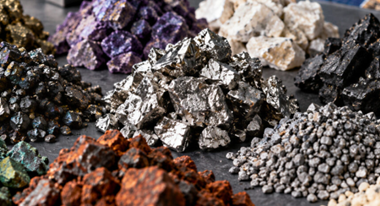
About Lithium, Nickel and Cobalt
- Lithium, nickel and cobalt are important critical minerals used in battery manufacturing, electric vehicles, renewable energy storage and advanced industrial applications.
- Lithium: A soft, lightweight, silvery-white alkali metal, widely used in rechargeable batteries.
- Nickel: A hard, silvery-white transition metal known for its corrosion resistance and ability to improve the strength of alloys.
- Cobalt: A hard, lustrous, bluish-grey transition metal used in rechargeable batteries and high-performance alloys.
Basic Characteristics, Production, Geographical Distribution and Applications
| Feature | Lithium | Nickel | Cobalt |
| Basic characteristics | Soft, lightweight alkali metal; highly reactive | Hard, silvery-white transition metal; corrosion-resistant | Hard, bluish-grey transition metal; magnetic in nature |
| Major ores / sources | Spodumene, lepidolite and lithium-rich brines | Pentlandite, garnierite and laterite ores | Cobaltite, erythrite; often obtained as a by-product of copper and nickel mining |
| Major applications | Lithium-ion batteries, EVs, grid storage, ceramics, glass and lubricants | Stainless steel, alloys, EV batteries, electroplating and catalysts | Lithium-ion batteries, superalloys for aircraft engines, magnets and cutting tools |
| Key battery role | Main component of lithium-ion battery chemistry | Improves energy density and performance in some battery chemistries | Enhances energy density and thermal stability in certain battery cathodes |
Production and Geographical Distribution
1. Lithium
- Major production countries: Australia, China, Chile, Zimbabwe and Argentina.
- Lithium Triangle: The region comprising Argentina, Bolivia and Chile has extensive lithium-rich salt flats and brine deposits.
- Australia: A major producer of lithium from hard-rock deposits, particularly spodumene.
- China: Important in both lithium mining and refining.
- India: Lithium resources have been identified in the Salal-Haimana area of Reasi district, Jammu and Kashmir, and the Marlagalla area of Mandya district, Karnataka.
2. Nickel
- Major production countries: Indonesia, the Philippines, Russia, Canada, China and Australia.
- Indonesia: The world’s largest nickel mine producer, with extensive laterite deposits.
- Philippines: A major producer of nickel from laterite deposits.
- Canada and Russia: Important sources of nickel from sulphide deposits.
- India: Nickel-bearing resources occur mainly in Odisha, Jharkhand and Nagaland, with Odisha accounting for a major share.
3. Cobalt
- Major production countries: Democratic Republic of the Congo (DRC), Indonesia, Russia, Australia and the Philippines.
- DRC: The world’s largest mined cobalt producer, accounting for approximately 73% of global production in 2025.
- Central African Copper Belt: The DRC and Zambia contain major cobalt deposits associated with copper ores.
- Indonesia and Australia: Important sources of cobalt associated with nickel laterite deposits.
- India: Small deposits are known in Odisha and Jharkhand, often associated with copper ores.
Important Indian Mineral Resources
| Mineral | Important locations | Key information |
| Lithium | Reasi, Jammu & Kashmir; Mandya, Karnataka | GSI identified an inferred resource of 5.9 million tonnes of lithium ore in the Salal-Haimana area of Reasi. |
| Nickel | Odisha, Jharkhand and Nagaland | Major occurrences in Odisha, particularly Jajpur, Mayurbhanj and Keonjhar districts. |
| Cobalt | Odisha and Jharkhand | Occurs in small deposits, generally associated with copper ores. |
Significance of These Minerals
- Electric Mobility: Essential for manufacturing batteries used in electric vehicles.
- Renewable Energy: Support energy storage systems for solar and wind power.
- Industrial Applications: Nickel and cobalt are used in aerospace, defence, stainless steel and specialised alloys.
- Energy Security: Domestic exploration, processing and recycling can reduce dependence on imports.
- Critical Mineral Supply Chains: Concentration of production in a few countries creates supply-chain vulnerabilities.
Conclusion
Lithium, nickel and cobalt are strategically important minerals for the global clean-energy transition. Their uneven geographical distribution and concentration of production in a few countries make their exploration, processing, recycling and secure supply important for India’s energy and industrial security.
| This concept has been mentioned in the following article: Capex Support Scheme to Promote Critical Mineral Processing |