
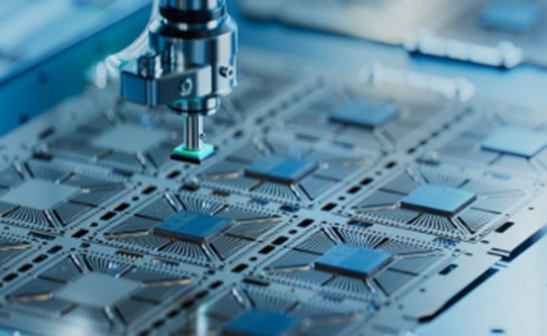
About Semiconductors
- Semiconductors are materials whose electrical conductivity lies between conductors and insulators and can be precisely controlled.
- Silicon is the most widely used semiconductor material, while germanium and compound semiconductors such as gallium nitride (GaN) are also used in specific applications.
- Their ability to control the flow of electric current makes them fundamental to modern electronic devices.
- Semiconductors form the basic building blocks of integrated circuits (ICs), transistors, diodes, sensors and microprocessors.
How Do Semiconductors Work?
- Controlled Conductivity: Their conductivity can be modified by factors such as temperature, light, electric fields and addition of impurities.
- Doping: Small quantities of impurities are added to semiconductor materials to create n-type and p-type semiconductors.
- Transistors: Combining different semiconductor regions enables the creation of transistors that can switch or amplify electrical signals.
- Integrated Circuits: Millions or billions of transistors can be fabricated on a single chip to perform complex computational tasks.
Types of Semiconductors
- Intrinsic Semiconductors: Relatively pure semiconductor materials such as pure silicon.
- Extrinsic Semiconductors: Semiconductors whose electrical properties are modified through doping:
- n-type: Uses donor impurities and has electrons as the majority charge carriers
- p-type: Uses acceptor impurities and has holes as the majority charge carriers
- Compound Semiconductors: Made from two or more elements, such as GaN and gallium arsenide (GaAs), and used in applications including high-frequency communication and power electronics.
Applications
- Consumer Electronics: Smartphones, computers, televisions and other electronic devices.
- Automobiles: Electronic control systems, electric vehicles and advanced driver-assistance systems.
- Communication: Mobile networks, optical communication and satellite systems.
- Artificial Intelligence: High-performance processors and AI accelerators.
- Renewable Energy: Solar cells and power-management systems.
Conclusion
Semiconductors form the foundation of modern electronics, enabling technologies ranging from smartphones and automobiles to AI, telecommunications, defence systems and renewable energy.
| This concept has been elaborately discussed in – Semiconductor Future of India |