
Context
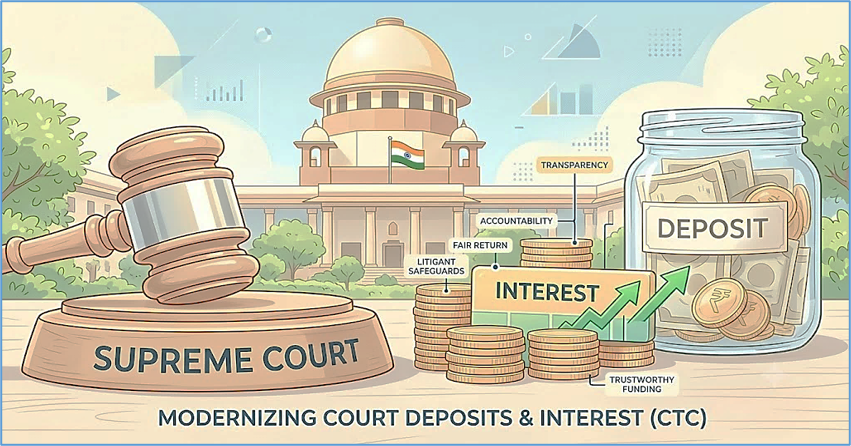
- Recently, the Supreme Court called for a uniform statutory framework to regulate litigants’ court deposits, ensuring their proper investment and protection of time value and interest.
What are Court Deposits?
- Court deposits are amounts deposited by litigants with a court/tribunal, often as a condition for obtaining a stay, pursuing an appeal or complying with a judicial order.
- The money remains subject to the outcome or directions of the court.
- Since cases can remain pending for years, how the deposited money is invested and whether it earns interest becomes important.
Why Did the Supreme Court Raise the Issue?
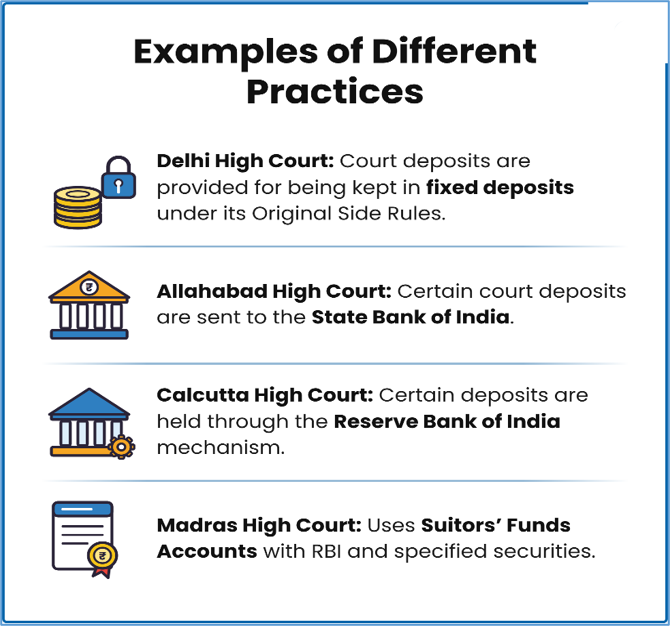
- Different courts follow different methods for handling deposited money.
- Some courts invest deposits in Fixed Deposits (FDs), while others follow different banking or government-security mechanisms.
- Such differences can result in unequal treatment of similarly placed litigants.
- Lack of uniformity can also create disputes regarding investment, accounting and interest.
Supreme Court’s Proposed Approach
The Court suggested:
- A uniform mechanism for handling court deposits.
- Deposited money could be pooled through a common platform.
- The pooled funds could be invested in an appropriate financial instrument to protect their value and generate returns.
- It referred to the U.S. Court Registry Investment System (CRIS) as an international model worth examining.
- It requested the Law Commission of India to examine the need for legislation and consult relevant institutions, including the RBI, Ministry of Finance and Ministry of Law & Justice.
Existing Supreme Court Position
- In K.L. Suneja v. Dr. Manjeet Kaur Monga (2023), the Supreme Court had directed courts and judicial forums to frame guidelines so that money deposited with their registry/office is mandatorily placed in a bank or financial institution, thereby preventing loss to litigants.
| Important Current to Concept (CTC) from this article for UPSC What is the Supreme Court (Number of Judges) Amendment Bill, 2026? |
Q. With reference to court deposits in India, consider the following statements:
1. Court deposits may be made by litigants pursuant to judicial directions during ongoing proceedings.
2. The Supreme Court has highlighted the need for greater uniformity in the handling and investment of such deposits.
3. The Supreme Court has suggested examining the U.S. Court Registry Investment System as a possible model.
4. The Law Commission of India has been directed to establish the proposed common investment platform immediately.
Which of the statements given above are correct?
(a) 1 and 2 only
(b) 1, 2 and 3 only
(c) 2, 3 and 4 only
(d) 1, 2, 3 and 4
Answer: (b) 1, 2 and 3 only
Explanation:
• Statement 1 – Correct: Litigants may be required to deposit money pursuant to court orders.
• Statement 2 – Correct: The Supreme Court has highlighted differences in existing practices and the need for standardisation.
• Statement 3 – Correct: The Court referred to the U.S. Court Registry Investment System (CRIS) for consideration.
• Statement 4 – Incorrect: The Court requested the Law Commission to examine the issue; it did not direct it to immediately establish the platform.